Grade 6 · Social StudiesHIS.6.3Premium
Who Won at Kadesh? Two Accounts of Ramses II's Battle
Grade 6 history: compare Ramses II's and the Hittites' accounts of the Battle of Kadesh to study Egypt's rulers, beliefs, temples and rule over Kush.
Preview
OwlSheets.com
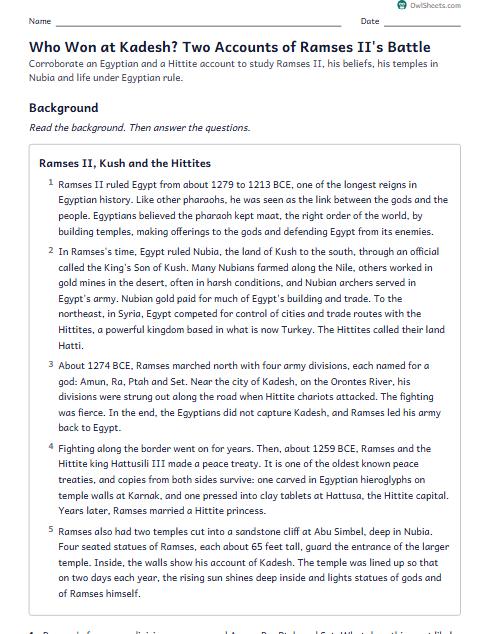
Who Won at Kadesh? Two Accounts of Ramses II's Battle
Corroborate an Egyptian and a Hittite account to study Ramses II, his beliefs, his temples in Nubia and life under Egyptian rule.
Background
Read the background. Then answer the questions.
Ramses II, Kush and the Hittites
1Ramses II ruled Egypt from about 1279 to 1213 BCE, one of the longest reigns in Egyptian history. Like other pharaohs, he was seen as the link between the gods and the people. Egyptians believed the pharaoh kept maat, the right order of the world, by building temples, making offerings to the gods and defending Egypt from its enemies.
2In Ramses's time, Egypt ruled Nubia, the land of Kush to the south, through an official called the King's Son of Kush. Many Nubians farmed along the Nile, others worked in gold mines in the desert, often in harsh conditions, and Nubian archers served in Egypt's army. Nubian gold paid for much of Egypt's building and trade. To the northeast, in Syria, Egypt competed for control of cities and trade routes with the Hittites, a powerful kingdom based in what is now Turkey. The Hittites called their land Hatti.
3About 1274 BCE, Ramses marched north with four army divisions, each named for a god: Amun, Ra, Ptah and Set. Near the city of Kadesh, on the Orontes River, his divisions were strung out along the road when Hittite chariots attacked. The fighting was fierce. In the end, the Egyptians did not capture Kadesh, and Ramses led his army back to Egypt.
4Fighting along the border went on for years. Then, about 1259 BCE, Ramses and the Hittite king Hattusili III made a peace treaty. It is one of the oldest known peace treaties, and copies from both sides survive: one carved in Egyptian hieroglyphs on temple walls at Karnak, and one pressed into clay tablets at Hattusa, the Hittite capital. Years later, Ramses married a Hittite princess.
5Ramses also had two temples cut into a sandstone cliff at Abu Simbel, deep in Nubia. Four seated statues of Ramses, each about 65 feet tall, guard the entrance of the larger temple. Inside, the walls show his account of Kadesh. The temple was lined up so that on two days each year, the rising sun shines deep inside and lights statues of gods and of Ramses himself.
- A. Egyptians worshipped a single god who ruled over war.
- B. Egyptians believed their gods stood behind the army in war.
- C. Egyptians kept religion out of matters of war and rule.
- D. Egyptians named the divisions after four Hittite kings.
The peace treaty was made about years after the Battle of Kadesh.
The preview shows the first questions. Unlock the worksheet to see all of it.
Related worksheets
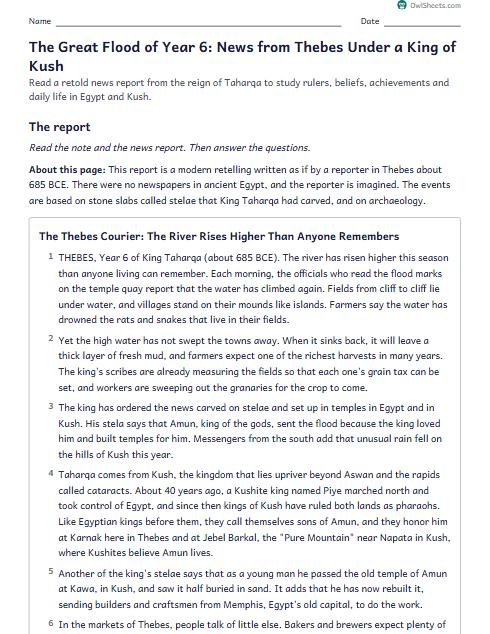
The Great Flood of Year 6: News from Thebes Under a King of Kush
Grade 6 · HIS.6.3
14 questionsPremium
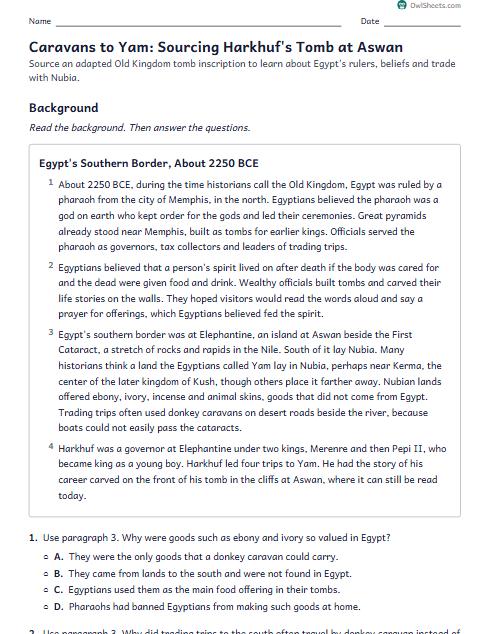
Caravans to Yam: Sourcing Harkhuf's Tomb at Aswan
Grade 6 · HIS.6.3
14 questionsPremium
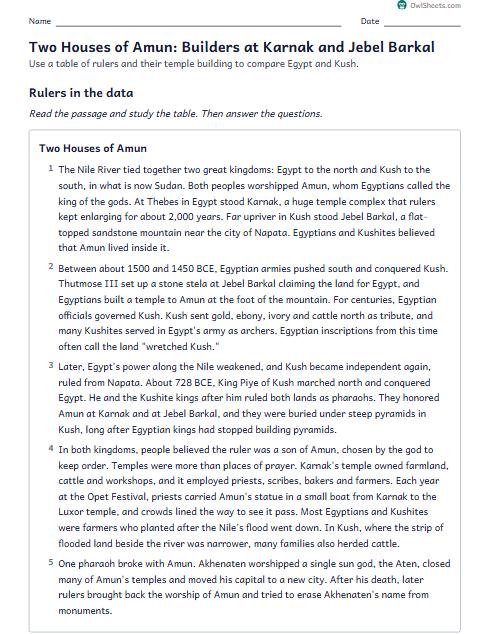
Two Houses of Amun: Builders at Karnak and Jebel Barkal
Grade 6 · HIS.6.3
13 questionsPremium
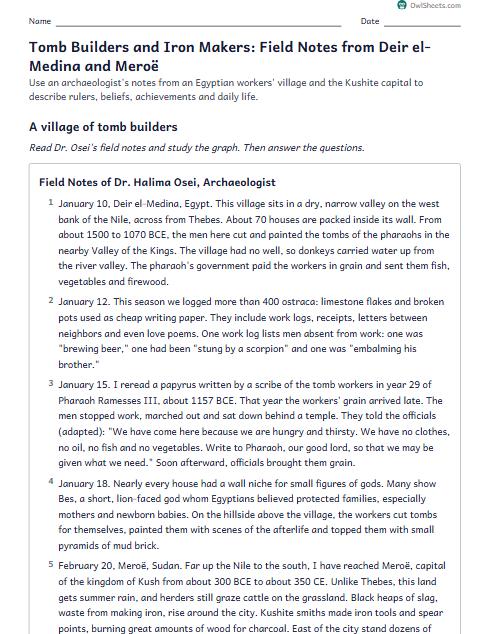
Tomb Builders and Iron Makers: Field Notes from Deir el-Medina and Meroë
Grade 6 · HIS.6.3
14 questionsPremium
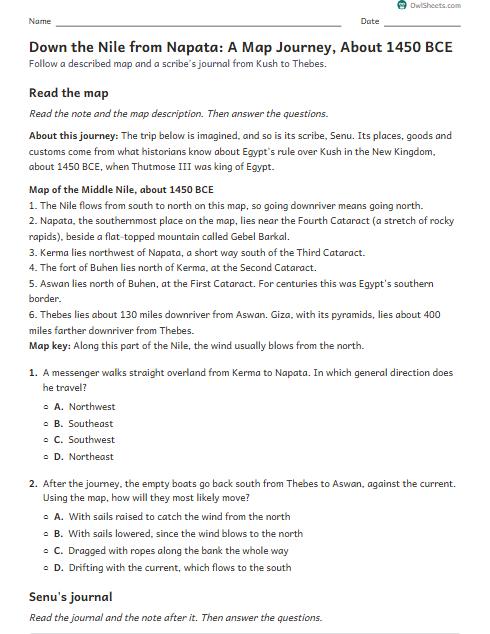
Down the Nile from Napata: A Map Journey, About 1450 BCE
Grade 6 · HIS.6.3
11 questionsPremium
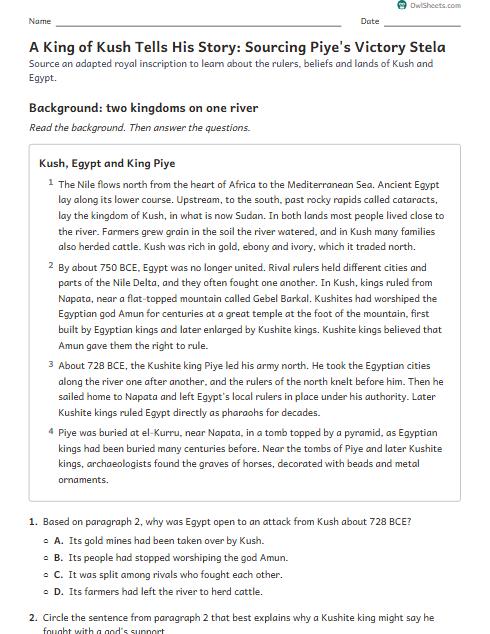
A King of Kush Tells His Story: Sourcing Piye's Victory Stela
Grade 6 · HIS.6.3
10 questionsFree