Grade 6 · Social StudiesGEO.6.3Premium
Bare Hills and Grain Ships: Two Accounts of Attica's Land
Grade 6 geography: compare Attica with the Black Sea grain lands using climate, population and land-use data, then weigh two accounts of Attica's soil loss.
Preview
OwlSheets.com
Bare Hills and Grain Ships: Two Accounts of Attica's Land
Compare Attica with a Black Sea grain region and test two accounts of how Attica's hills lost their soil.
Two grain regions
Read the background and the table. Then answer the questions.
Athens and the Grain Ships
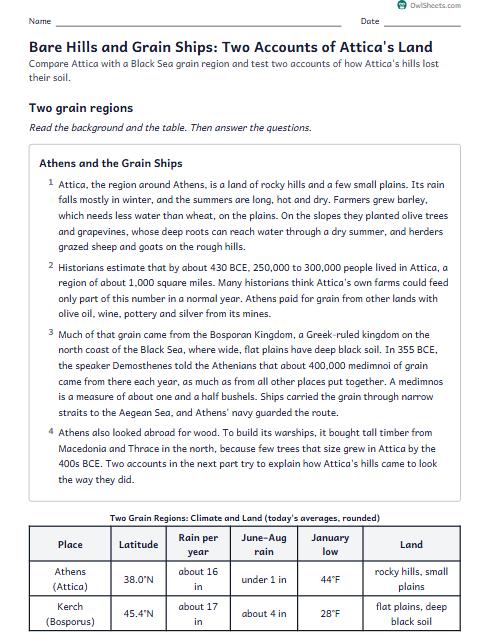
1Attica, the region around Athens, is a land of rocky hills and a few small plains. Its rain falls mostly in winter, and the summers are long, hot and dry. Farmers grew barley, which needs less water than wheat, on the plains. On the slopes they planted olive trees and grapevines, whose deep roots can reach water through a dry summer, and herders grazed sheep and goats on the rough hills.
2Historians estimate that by about 430 BCE, 250,000 to 300,000 people lived in Attica, a region of about 1,000 square miles. Many historians think Attica's own farms could feed only part of this number in a normal year. Athens paid for grain from other lands with olive oil, wine, pottery and silver from its mines.
3Much of that grain came from the Bosporan Kingdom, a Greek-ruled kingdom on the north coast of the Black Sea, where wide, flat plains have deep black soil. In 355 BCE, the speaker Demosthenes told the Athenians that about 400,000 medimnoi of grain came from there each year, as much as from all other places put together. A medimnos is a measure of about one and a half bushels. Ships carried the grain through narrow straits to the Aegean Sea, and Athens' navy guarded the route.
4Athens also looked abroad for wood. To build its warships, it bought tall timber from Macedonia and Thrace in the north, because few trees that size grew in Attica by the 400s BCE. Two accounts in the next part try to explain how Attica's hills came to look the way they did.
| Place | Latitude | Rain per year | June–Aug rain | January low | Land |
|---|---|---|---|---|---|
| Athens (Attica) | 38.0°N | about 16 in | under 1 in | 44°F | rocky hills, small plains |
| Kerch (Bosporus) | 45.4°N | about 17 in | about 4 in | 28°F | flat plains, deep black soil |
- A. Kerch gets more summer rain than Athens but has colder winters.
- B. Athens lies farther north, so its summers are cooler and wetter.
- C. Athens gets far more rain in a year than Kerch does.
- D. Kerch lies farther south than Athens and has milder winters.
The preview shows the first questions. Unlock the worksheet to see all of it.
Related worksheets
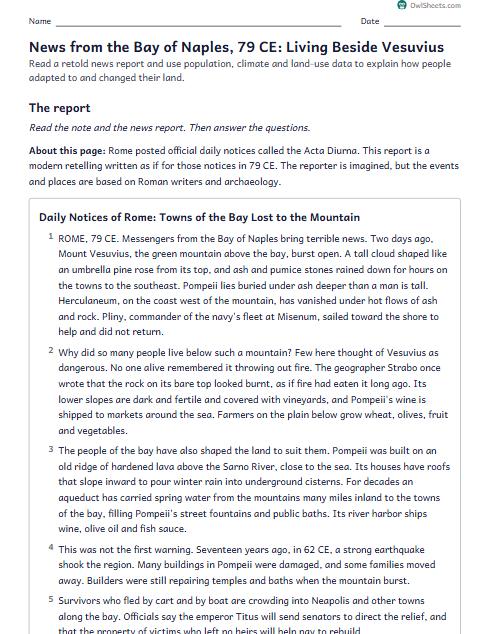
News from the Bay of Naples, 79 CE: Living Beside Vesuvius
Grade 6 · GEO.6.3
14 questionsPremium
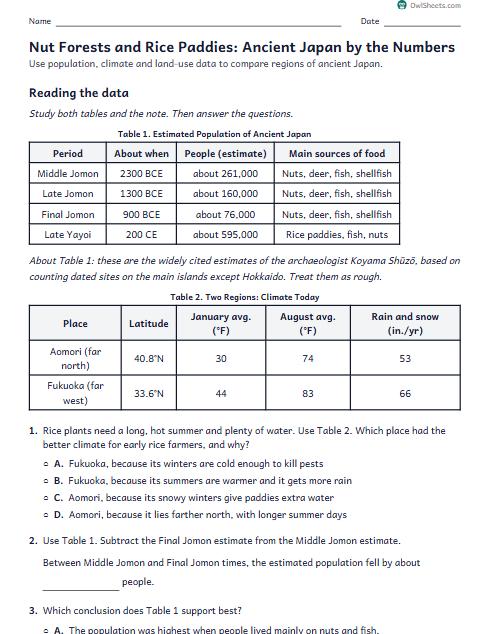
Nut Forests and Rice Paddies: Ancient Japan by the Numbers
Grade 6 · GEO.6.3
14 questionsPremium
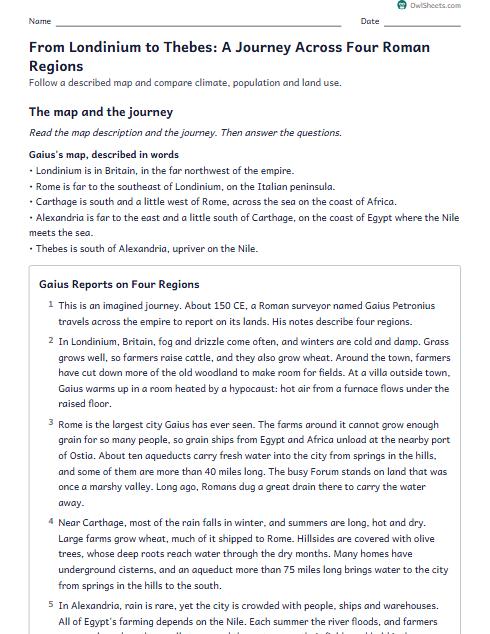
From Londinium to Thebes: A Journey Across Four Roman Regions
Grade 6 · GEO.6.3
13 questionsPremium
Stone Houses and House Mounds: Field Notes from Two Windy Coasts
Grade 6 · GEO.6.3
13 questionsPremium
Hall of Dry Lands: Water in the Sahara, Iran and the Steppe
Grade 6 · GEO.6.3
11 questionsPremium
Cut the Cedars? A Council Meeting in Byblos
Grade 6 · GEO.6.3
10 questionsPremium