Grade 5 · Social StudiesECO.5.1Premium
Repair Orders at Tidepatch Island
Use an island repair-shop story and work orders to compare how geography shaped livelihoods in three colonial regions.
Preview
OwlSheets.com
Repair Orders at Tidepatch Island
Connect colonial work to land, climate, and waterways.
An Island Shop's Customers
Read the historical fiction. Use its details to answer the questions.
Work Beyond the Island
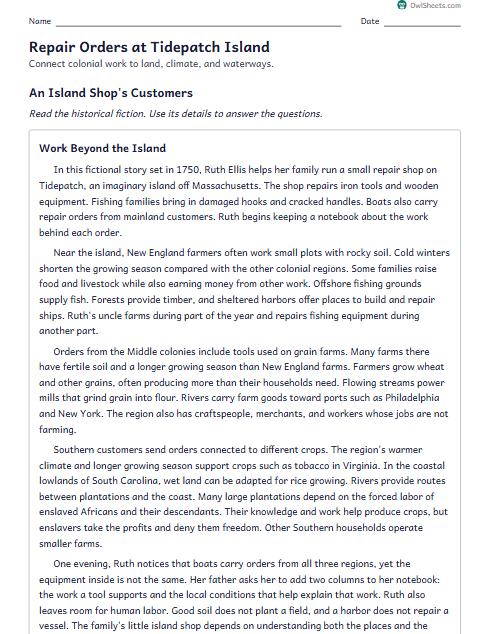
In this fictional story set in 1750, Ruth Ellis helps her family run a small repair shop on Tidepatch, an imaginary island off Massachusetts. The shop repairs iron tools and wooden equipment. Fishing families bring in damaged hooks and cracked handles. Boats also carry repair orders from mainland customers. Ruth begins keeping a notebook about the work behind each order.
Near the island, New England farmers often work small plots with rocky soil. Cold winters shorten the growing season compared with the other colonial regions. Some families raise food and livestock while also earning money from other work. Offshore fishing grounds supply fish. Forests provide timber, and sheltered harbors offer places to build and repair ships. Ruth's uncle farms during part of the year and repairs fishing equipment during another part.
Orders from the Middle colonies include tools used on grain farms. Many farms there have fertile soil and a longer growing season than New England farms. Farmers grow wheat and other grains, often producing more than their households need. Flowing streams power mills that grind grain into flour. Rivers carry farm goods toward ports such as Philadelphia and New York. The region also has craftspeople, merchants, and workers whose jobs are not farming.
Southern customers send orders connected to different crops. The region's warmer climate and longer growing season support crops such as tobacco in Virginia. In the coastal lowlands of South Carolina, wet land can be adapted for rice growing. Rivers provide routes between plantations and the coast. Many large plantations depend on the forced labor of enslaved Africans and their descendants. Their knowledge and work help produce crops, but enslavers take the profits and deny them freedom. Other Southern households operate smaller farms.
One evening, Ruth notices that boats carry orders from all three regions, yet the equipment inside is not the same. Her father asks her to add two columns to her notebook: the work a tool supports and the local conditions that help explain that work. Ruth also leaves room for human labor. Good soil does not plant a field, and a harbor does not repair a vessel. The family's little island shop depends on understanding both the places and the people behind its orders.
- A. They would connect repair needs to work and local conditions.
- B. They would show which region charged the lowest repair prices.
- C. They would connect each customer's age to a particular tool.
- D. They would show which customers lived nearest to one another.
- A. Fishing work replaced the need to raise food.
- B. A household could combine farming with coastal work.
- C. Rocky farmland provided materials for making hooks.
- D. Long growing seasons left time for equipment repairs.
The preview shows the first questions. Unlock the worksheet to see all of it.
Related worksheets
Colonial Kitchen Night
Grade 5 · ECO.5.1
14 questionsPremium
Design Lab: Comparing Colonial Worksites
Grade 5 · ECO.5.1
13 questionsFree
Three Colonial Regions at the Harvest Market
Grade 5 · ECO.5.1
14 questionsPremium
Two Park Jobs, One Bike Goal
Grade 5 · ECO.5.3
13 questionsPremium
Tuesday Mornings at the Fernhill School Bank
Grade 5 · ECO.5.3
13 questionsFree
Ice Pop Carts on Larkin Avenue
Grade 5 · ECO.5.2
14 questionsPremium