Grade 5 · Social StudiesECO.5.3
Tuesday Mornings at the Fernhill School Bank
Use a student teller's income graph and budget rule to practice income, budgeting, saving, interest and the cost of borrowing.
Preview
OwlSheets.com
Tuesday Mornings at the Fernhill School Bank
A student teller uses her income graph to decide whether to borrow or wait.
Read about Cosima
Read about Cosima and look at her income graph. Then answer the questions.
The Teller at Window Two
1Every Tuesday morning, a table by the front office of Fernhill Elementary becomes the Fernhill School Bank. A local credit union runs the program, and fifth graders work as tellers. Students bring money to deposit into their own savings accounts, and the tellers write each deposit in the account record.
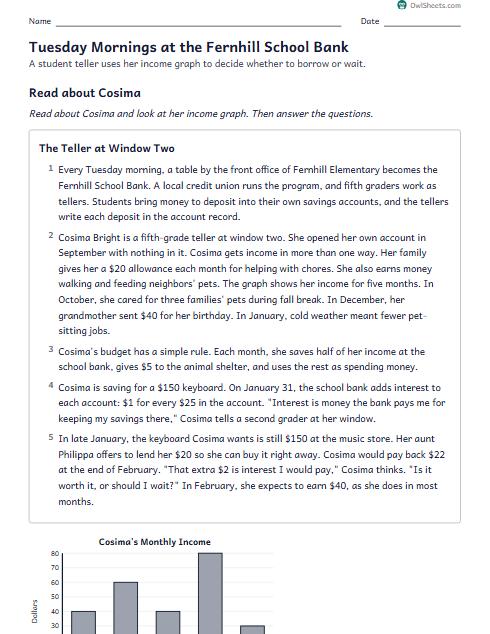
2Cosima Bright is a fifth-grade teller at window two. She opened her own account in September with nothing in it. Cosima gets income in more than one way. Her family gives her a $20 allowance each month for helping with chores. She also earns money walking and feeding neighbors' pets. The graph shows her income for five months. In October, she cared for three families' pets during fall break. In December, her grandmother sent $40 for her birthday. In January, cold weather meant fewer pet-sitting jobs.
3Cosima's budget has a simple rule. Each month, she saves half of her income at the school bank, gives $5 to the animal shelter, and uses the rest as spending money.
4Cosima is saving for a $150 keyboard. On January 31, the school bank adds interest to each account: $1 for every $25 in the account. "Interest is money the bank pays me for keeping my savings there," Cosima tells a second grader at her window.
5In late January, the keyboard Cosima wants is still $150 at the music store. Her aunt Philippa offers to lend her $20 so she can buy it right away. Cosima would pay back $22 at the end of February. "That extra $2 is interest I would pay," Cosima thinks. "Is it worth it, or should I wait?" In February, she expects to earn $40, as she does in most months.
$
- A. The school bank paid her more in some months.
- B. She saved more in some months, so she earned more.
- C. Extra pet jobs and a gift raised some months.
- D. Her allowance doubled in October and December.
- A. December
- B. October
- C. September
- D. January
$
Her $20 allowance for choresMoney she deposits at the school bankPay for walking a neighbor's dogBirthday money from her grandmotherThe $5 she gives to the animal shelterInterest the school bank adds to her account
Borrow or wait?
Use the story, the graph and your answers above.
$
- A. $150
- B. $130
- C. $152
- D. $170
- A. She has $150 saved, enough for the keyboard.
- B. She has $145 saved, $5 short of the keyboard.
- C. She has $170 saved, $20 more than she needs.
- D. She has $130 saved, because February adds nothing.
Her aunt Philippa offers to lend her $20 so she can buy it right away."That extra $2 is interest I would pay," Cosima thinks.In February, she expects to earn $40, as she does in most months.On January 31, the school bank adds interest to each account.
- A. Both choices cost $66 in all.
- B. Saving takes 6 months, and borrowing costs $6 more.
- C. Borrowing costs less, because he gets the scooter sooner.
- D. Saving costs $6 more, because he has to wait.
- A. She would have $5 more, because a drawer is free.
- B. She would have $125, because no interest is added.
- C. She would still have $130 on that day.
- D. She would owe the bank $5 in interest.
- A. Spend her gift money before she deposits any.
- B. Ask her aunt for a new $20 loan each month.
- C. Stop depositing and keep her savings at home.
- D. Move part of her spending money into savings.
Related worksheets
Two Park Jobs, One Bike Goal
Grade 5 · ECO.5.3
13 questionsPremium
A Telescope Budget at Northstar School
Grade 5 · ECO.5.3
14 questionsPremium
The Animation Club Money Plan
Grade 5 · ECO.5.3
14 questionsPremium
Ice Pop Carts on Larkin Avenue
Grade 5 · ECO.5.2
14 questionsPremium
Colonial Kitchen Night
Grade 5 · ECO.5.1
14 questionsPremium
The Meadowmere Honey Orderbook
Grade 5 · ECO.5.2
13 questionsFree