Grade 5 · Social StudiesECO.5.2
The Meadowmere Honey Orderbook
Analyze a honey business notebook and order data to explain markets, competition, and changes in supply and demand.
Preview
OwlSheets.com
The Meadowmere Honey Orderbook
Use a family business notebook to investigate markets and prices.
Inside the business notebook
Read this fictional family business notebook. Use its details to answer the questions.
Honey at the Meadowmere Craft Fair
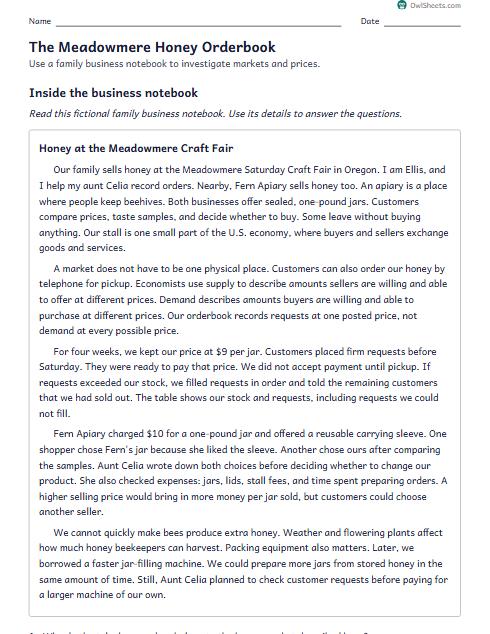
Our family sells honey at the Meadowmere Saturday Craft Fair in Oregon. I am Ellis, and I help my aunt Celia record orders. Nearby, Fern Apiary sells honey too. An apiary is a place where people keep beehives. Both businesses offer sealed, one-pound jars. Customers compare prices, taste samples, and decide whether to buy. Some leave without buying anything. Our stall is one small part of the U.S. economy, where buyers and sellers exchange goods and services.
A market does not have to be one physical place. Customers can also order our honey by telephone for pickup. Economists use supply to describe amounts sellers are willing and able to offer at different prices. Demand describes amounts buyers are willing and able to purchase at different prices. Our orderbook records requests at one posted price, not demand at every possible price.
For four weeks, we kept our price at $9 per jar. Customers placed firm requests before Saturday. They were ready to pay that price. We did not accept payment until pickup. If requests exceeded our stock, we filled requests in order and told the remaining customers that we had sold out. The table shows our stock and requests, including requests we could not fill.
Fern Apiary charged $10 for a one-pound jar and offered a reusable carrying sleeve. One shopper chose Fern's jar because she liked the sleeve. Another chose ours after comparing the samples. Aunt Celia wrote down both choices before deciding whether to change our product. She also checked expenses: jars, lids, stall fees, and time spent preparing orders. A higher selling price would bring in more money per jar sold, but customers could choose another seller.
We cannot quickly make bees produce extra honey. Weather and flowering plants affect how much honey beekeepers can harvest. Packing equipment also matters. Later, we borrowed a faster jar-filling machine. We could prepare more jars from stored honey in the same amount of time. Still, Aunt Celia planned to check customer requests before paying for a larger machine of our own.
- A. They let the family avoid competition from nearby sellers.
- B. They turn the honey from a good into a service.
- C. They let buyers and a seller arrange an exchange.
- D. They give the family control over customer spending.
- A. Customers can place orders before the market opens.
- B. A shopper pays more for the jar with a carrying sleeve.
- C. The family keeps a record of its packing expenses.
- D. The two businesses sell jars of the same weight.
A customer selects Fern's honey because of its carrying sleeve.The family records the number of jars ready for pickup.A customer selects the family's honey after tasting samples.The family lists the cost of lids in its notebook.
- A. Buying equipment makes bees produce honey at a faster rate.
- B. Extra packing capacity is useful if enough customers want the jars.
- C. Buying equipment gives customers more money to spend on honey.
- D. Extra packing capacity makes nearby sellers charge the same price.
- A. The family can afford to package fewer jars.
- B. The bees have more flowering plants available.
- C. Fern Apiary receives fewer customer requests.
- D. Customers have more money available for honey.
Compare stock and requests
Use the family's fictional records. The price stayed at $9 per one-pound jar. Each request was for one jar.
| Week | Jars ready | Jars requested | Notebook note |
|---|---|---|---|
| 1 | 30 | 30 | Usual week |
| 2 | 30 | 42 | New honey recipe shared |
| 3 | 18 | 42 | Lid delivery delayed |
| 4 | 42 | 42 | Lids arrive; faster filler |
- A. Weeks 1 and 2: requests rise while stock stays steady.
- B. Weeks 1 and 4: requests and stock rise together.
- C. Weeks 2 and 3: requests stay steady while stock falls.
- D. Weeks 3 and 4: stock rises while requests stay steady.
jars
- A. Requests rose because the family reduced its posted price.
- B. Stock fell because customers ordered fewer jars of honey.
- C. Sales rose because customers requested larger jars of honey.
- D. Stock rose, allowing more of the unchanged requests to be filled.
Test business decisions
Apply the notebook's ideas to these new situations. Explain your reasoning in the written answers.
- A. Records of the dates when the family bought its tables
- B. Records of the colors of jars used by existing sellers
- C. Records of the number of signs beside the market entrance
- D. Records of shoppers unable to buy at prices they would pay
| Buyers' willingness or ability | Sellers' ability to prepare jars |
|---|---|
- A. Fewer requests show that Fern Apiary has stopped selling honey.
- B. The higher price shows that the family has more honey available.
- C. The higher price itself can explain the smaller quantity requested.
- D. Fewer requests show that the family's packing costs have fallen.
Related worksheets
Ice Pop Carts on Larkin Avenue
Grade 5 · ECO.5.2
14 questionsPremium
A Saturday Salsa Market
Grade 5 · ECO.5.2
15 questionsPremium
The Silver Run Mitten Market
Grade 5 · ECO.5.2
14 questionsPremium
Two Park Jobs, One Bike Goal
Grade 5 · ECO.5.3
13 questionsPremium
Tuesday Mornings at the Fernhill School Bank
Grade 5 · ECO.5.3
13 questionsFree
Colonial Kitchen Night
Grade 5 · ECO.5.1
14 questionsPremium