Grade 5 · Social StudiesECO.5.1Premium
Colonial Kitchen Night
Three colonial dishes at a community cooking night help students compare how geography shaped work in each colonial region.
Preview
OwlSheets.com
Colonial Kitchen Night
Compare how geography shaped the way each colonial region made a living.
Read about the cooking stations
Read about the three stations and study the chef's table. Then answer the questions.
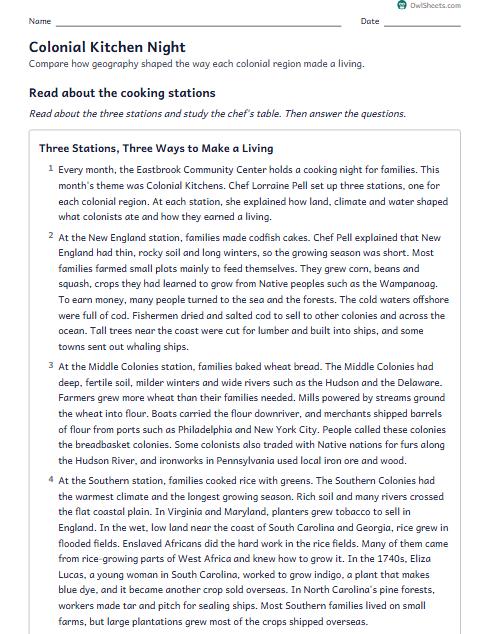
Three Stations, Three Ways to Make a Living
1Every month, the Eastbrook Community Center holds a cooking night for families. This month's theme was Colonial Kitchens. Chef Lorraine Pell set up three stations, one for each colonial region. At each station, she explained how land, climate and water shaped what colonists ate and how they earned a living.
2At the New England station, families made codfish cakes. Chef Pell explained that New England had thin, rocky soil and long winters, so the growing season was short. Most families farmed small plots mainly to feed themselves. They grew corn, beans and squash, crops they had learned to grow from Native peoples such as the Wampanoag. To earn money, many people turned to the sea and the forests. The cold waters offshore were full of cod. Fishermen dried and salted cod to sell to other colonies and across the ocean. Tall trees near the coast were cut for lumber and built into ships, and some towns sent out whaling ships.
3At the Middle Colonies station, families baked wheat bread. The Middle Colonies had deep, fertile soil, milder winters and wide rivers such as the Hudson and the Delaware. Farmers grew more wheat than their families needed. Mills powered by streams ground the wheat into flour. Boats carried the flour downriver, and merchants shipped barrels of flour from ports such as Philadelphia and New York City. People called these colonies the breadbasket colonies. Some colonists also traded with Native nations for furs along the Hudson River, and ironworks in Pennsylvania used local iron ore and wood.
4At the Southern station, families cooked rice with greens. The Southern Colonies had the warmest climate and the longest growing season. Rich soil and many rivers crossed the flat coastal plain. In Virginia and Maryland, planters grew tobacco to sell in England. In the wet, low land near the coast of South Carolina and Georgia, rice grew in flooded fields. Enslaved Africans did the hard work in the rice fields. Many of them came from rice-growing parts of West Africa and knew how to grow it. In the 1740s, Eliza Lucas, a young woman in South Carolina, worked to grow indigo, a plant that makes blue dye, and it became another crop sold overseas. In North Carolina's pine forests, workers made tar and pitch for sealing ships. Most Southern families lived on small farms, but large plantations grew most of the crops shipped overseas.
| Station | Dish | Main ingredient | How it earned money |
|---|---|---|---|
| New England | Codfish cakes | Salted cod | Sold dried cod to other places |
| Middle Colonies | Wheat bread | Flour | ? |
| Southern Colonies | Rice with greens | Rice | Sold rice overseas |
| New England | Middle Colonies | Southern Colonies |
|---|---|---|
The preview shows the first questions. Unlock the worksheet to see all of it.
Related worksheets
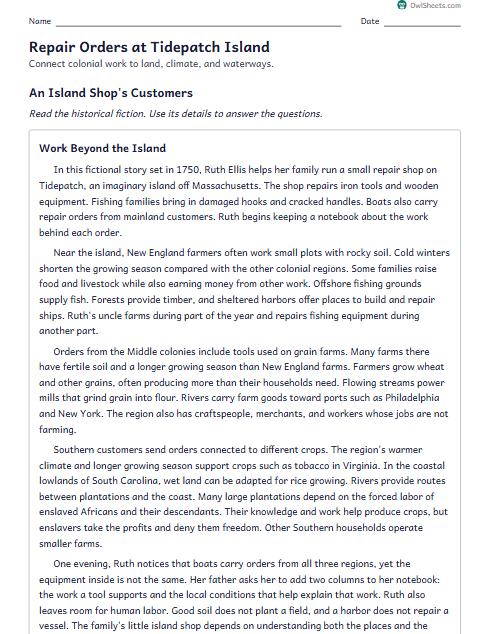
Repair Orders at Tidepatch Island
Grade 5 · ECO.5.1
13 questionsPremium
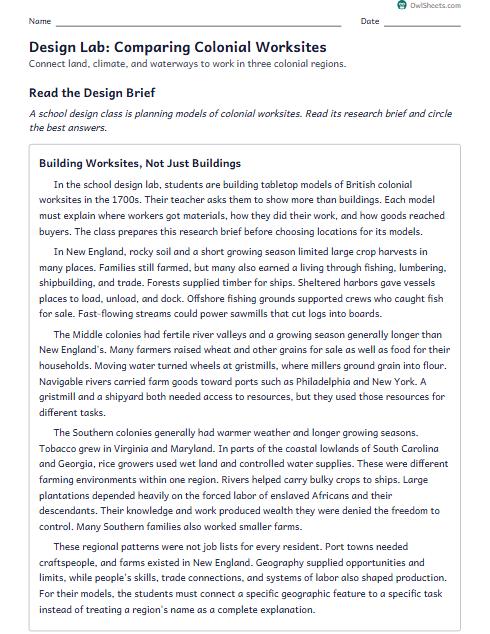
Design Lab: Comparing Colonial Worksites
Grade 5 · ECO.5.1
13 questionsFree
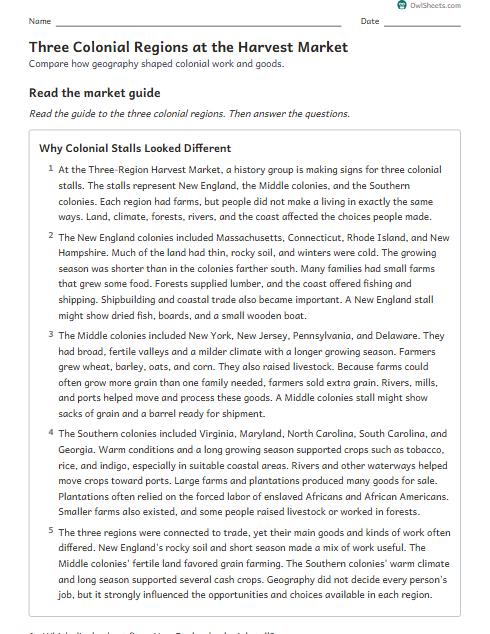
Three Colonial Regions at the Harvest Market
Grade 5 · ECO.5.1
14 questionsPremium
Two Park Jobs, One Bike Goal
Grade 5 · ECO.5.3
13 questionsPremium
Tuesday Mornings at the Fernhill School Bank
Grade 5 · ECO.5.3
13 questionsFree
Ice Pop Carts on Larkin Avenue
Grade 5 · ECO.5.2
14 questionsPremium