Grade 5 · Social StudiesCIV.5.3
Who Gives Snowhaven's Leaders Power?
Compare two snowy-town leadership plans to explore natural rights, government by consent, and the right to change harmful government.
Preview
OwlSheets.com
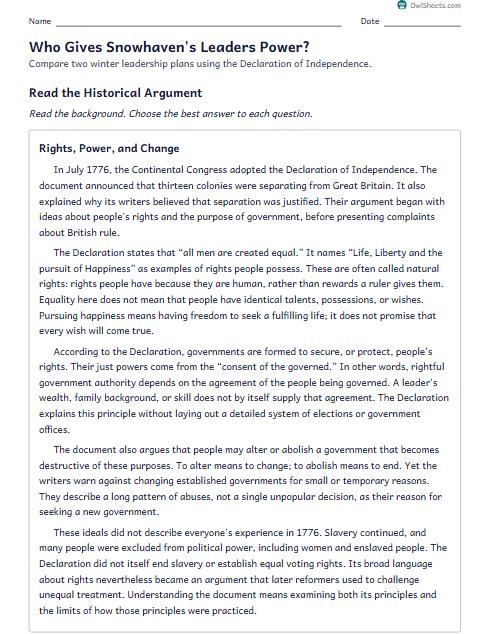
Who Gives Snowhaven's Leaders Power?
Compare two winter leadership plans using the Declaration of Independence.
Read the Historical Argument
Read the background. Choose the best answer to each question.
Rights, Power, and Change
In July 1776, the Continental Congress adopted the Declaration of Independence. The document announced that thirteen colonies were separating from Great Britain. It also explained why its writers believed that separation was justified. Their argument began with ideas about people's rights and the purpose of government, before presenting complaints about British rule.
The Declaration states that “all men are created equal.” It names “Life, Liberty and the pursuit of Happiness” as examples of rights people possess. These are often called natural rights: rights people have because they are human, rather than rewards a ruler gives them. Equality here does not mean that people have identical talents, possessions, or wishes. Pursuing happiness means having freedom to seek a fulfilling life; it does not promise that every wish will come true.
According to the Declaration, governments are formed to secure, or protect, people's rights. Their just powers come from the “consent of the governed.” In other words, rightful government authority depends on the agreement of the people being governed. A leader's wealth, family background, or skill does not by itself supply that agreement. The Declaration explains this principle without laying out a detailed system of elections or government offices.
The document also argues that people may alter or abolish a government that becomes destructive of these purposes. To alter means to change; to abolish means to end. Yet the writers warn against changing established governments for small or temporary reasons. They describe a long pattern of abuses, not a single unpopular decision, as their reason for seeking a new government.
These ideals did not describe everyone's experience in 1776. Slavery continued, and many people were excluded from political power, including women and enslaved people. The Declaration did not itself end slavery or establish equal voting rights. Its broad language about rights nevertheless became an argument that later reformers used to challenge unequal treatment. Understanding the document means examining both its principles and the limits of how those principles were practiced.
- A. Liberty belongs to people before a ruler recognizes it.
- B. Liberty belongs to people who hold government offices.
- C. Liberty is a reward that people receive for obeying leaders.
- D. Liberty comes from a leader's skill at solving problems.
- A. The government owes that person a place in the choir.
- B. The government should choose that person's next goal.
- C. Freedom to seek a goal does not guarantee success.
- D. The person loses the right to try other activities.
- A. People must choose similar goals to deserve equal basic rights.
- B. People can have different abilities while possessing equal basic rights.
- C. People gain stronger basic rights by developing greater abilities.
- D. People need equal possessions before they can possess basic rights.
- A. Officials make one unpopular decision about a meeting date.
- B. Officials take extra time to repair a damaged public building.
- C. Officials repeatedly imprison peaceful critics and ignore requests for change.
- D. Officials disagree with residents about the design of a town sign.
- A. Its claim about human equality could challenge practices that continued.
- B. The Declaration established equal voting rights before addressing slavery.
- C. The Declaration ended slavery, but later governments restored it.
- D. Its list of rights applied to government officials rather than other people.
Compare Snowhaven's Choices
Snowhaven is a fictional northern town. Read the two plans, then use the historical background to judge their ideas. These plans are comparisons, not events from 1776.
Two Plans for Winter Leadership
Snowhaven's deep winter snow can block the road to its emergency shelter. Residents are comparing two plans for choosing a winter road director. Both plans give the director the same crews and equipment. Both require clearing a safe route to the shelter before clearing roads used mainly for recreation.
Plan A: Residents elect a director for one winter. The director may close unsafe roads, but must explain closures publicly. Residents can request a review. A written procedure allows them to replace a director who repeatedly misuses the office. The director's job is to protect residents' safety and freedom.
Plan B: A skilled snowplow owner becomes director because the owner's family has lived in Snowhaven longest. The director chooses a relative as the next director. Residents may offer advice, but have no way to approve or replace the director. The director describes residents' freedom as a gift that the director may take back.
- A. Government authority comes from owning equipment.
- B. Government authority should pass through a family.
- C. Government should guarantee success in recreation.
- D. Government should help protect people's lives.
- A. How many winters has this person operated a snowplow?
- B. How did residents authorize this person to govern them?
- C. How much equipment does this person's family own?
- D. How quickly can this person reach the shelter road?
Residents elect the director for a winter.The director may close unsafe roads.The shelter route is cleared before recreation roads.Residents have a procedure for replacing a director who repeatedly misuses the office.The director receives crews and equipment.
- A. The claim is weak because an elected official has no authority to make decisions.
- B. The claim is weak because choosing a leader does not prove each action protects rights.
- C. The claim is sound because elections replace the need to protect rights.
- D. The claim is sound because elected officials decide which natural rights exist.
- A. A driver's disagreement shows that residents never authorized the director.
- B. A temporary inconvenience is enough to establish a long pattern of abuse.
- C. A government protects liberty by leaving dangerous public roads open.
- D. A safety closure is different from the repeated rights violations described in the Declaration.
- A. Recognize residents' freedom as a right the director must protect.
- B. Require the next director to have greater snowplowing skill.
- C. Allow residents to suggest a relative as the next director.
- D. Promise the director more equipment for clearing roads.
Related worksheets
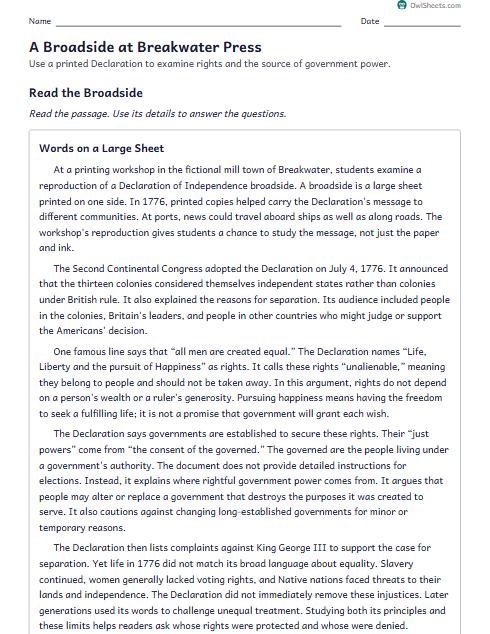
A Broadside at Breakwater Press
Grade 5 · CIV.5.3
13 questionsPremium
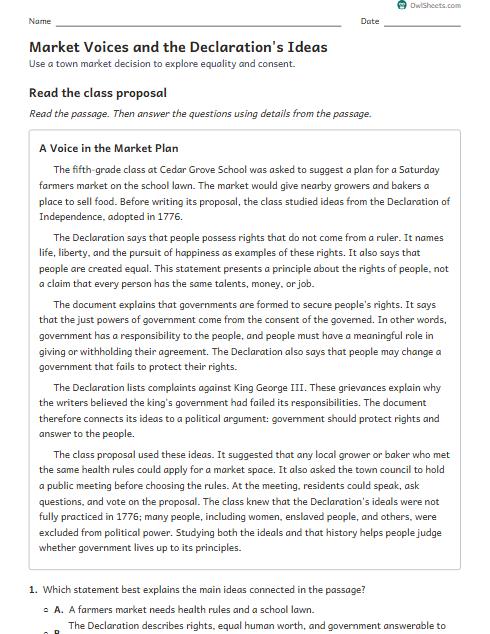
Market Voices and the Declaration's Ideas
Grade 5 · CIV.5.3
15 questionsPremium
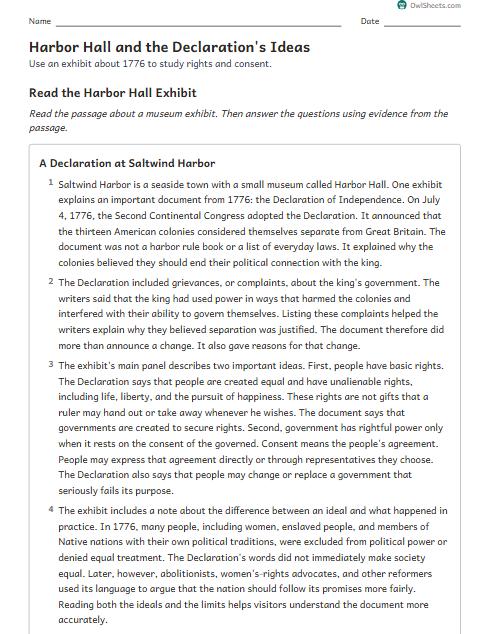
Harbor Hall and the Declaration's Ideas
Grade 5 · CIV.5.3
14 questionsPremium
A Letter from Grandma Yolanda About the Vote
Grade 5 · CIV.5.4
13 questionsFree
The Block Party Money and the Three Branches
Grade 5 · CIV.5.1
14 questionsPremium
Odette's Capitol Week Diary
Grade 5 · CIV.5.1
13 questionsPremium