Grade 5 · Social StudiesCIV.5.3Premium
A Broadside at Breakwater Press
Analyze the Declaration's ideas about equal rights, consent, and changing government through a mill-town printing-workshop passage.
Preview
OwlSheets.com
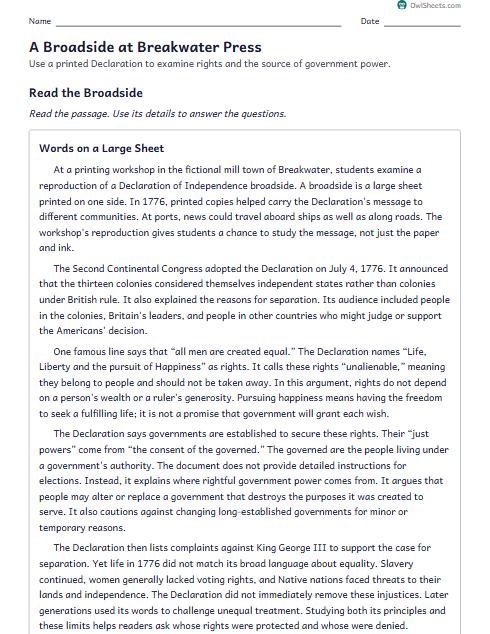
A Broadside at Breakwater Press
Use a printed Declaration to examine rights and the source of government power.
Read the Broadside
Read the passage. Use its details to answer the questions.
Words on a Large Sheet
At a printing workshop in the fictional mill town of Breakwater, students examine a reproduction of a Declaration of Independence broadside. A broadside is a large sheet printed on one side. In 1776, printed copies helped carry the Declaration's message to different communities. At ports, news could travel aboard ships as well as along roads. The workshop's reproduction gives students a chance to study the message, not just the paper and ink.
The Second Continental Congress adopted the Declaration on July 4, 1776. It announced that the thirteen colonies considered themselves independent states rather than colonies under British rule. It also explained the reasons for separation. Its audience included people in the colonies, Britain's leaders, and people in other countries who might judge or support the Americans' decision.
One famous line says that “all men are created equal.” The Declaration names “Life, Liberty and the pursuit of Happiness” as rights. It calls these rights “unalienable,” meaning they belong to people and should not be taken away. In this argument, rights do not depend on a person's wealth or a ruler's generosity. Pursuing happiness means having the freedom to seek a fulfilling life; it is not a promise that government will grant each wish.
The Declaration says governments are established to secure these rights. Their “just powers” come from “the consent of the governed.” The governed are the people living under a government's authority. The document does not provide detailed instructions for elections. Instead, it explains where rightful government power comes from. It argues that people may alter or replace a government that destroys the purposes it was created to serve. It also cautions against changing long-established governments for minor or temporary reasons.
The Declaration then lists complaints against King George III to support the case for separation. Yet life in 1776 did not match its broad language about equality. Slavery continued, women generally lacked voting rights, and Native nations faced threats to their lands and independence. The Declaration did not immediately remove these injustices. Later generations used its words to challenge unequal treatment. Studying both its principles and these limits helps readers ask whose rights were protected and whose were denied.
- A. To ask Britain's leaders to choose new officials for the colonies
- B. To explain a standard for government and argue that Britain had failed it
- C. To describe how the new states would organize their elections
- D. To give instructions for printing and delivering official news
- A. Basic rights depend on how much a person contributes in taxes.
- B. Basic rights depend on how useful a person is to the ruler.
- C. Basic rights increase when a person purchases more property.
- D. Basic rights belong to people regardless of how much money they have.
The preview shows the first questions. Unlock the worksheet to see all of it.
Related worksheets
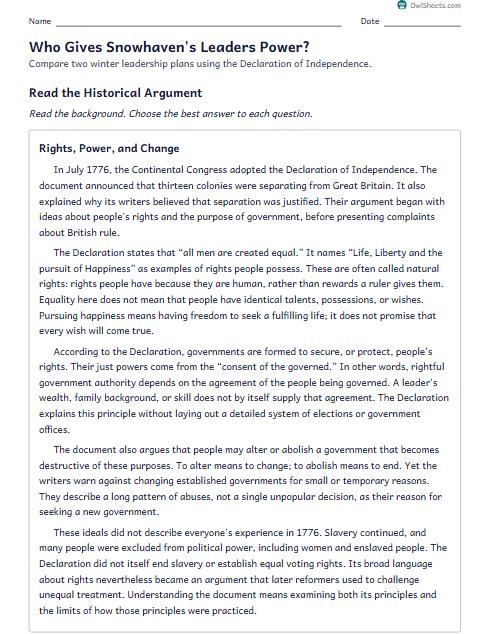
Who Gives Snowhaven's Leaders Power?
Grade 5 · CIV.5.3
13 questionsFree
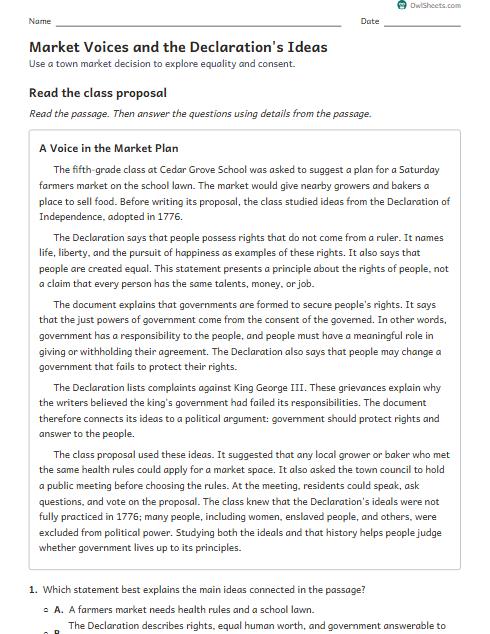
Market Voices and the Declaration's Ideas
Grade 5 · CIV.5.3
15 questionsPremium
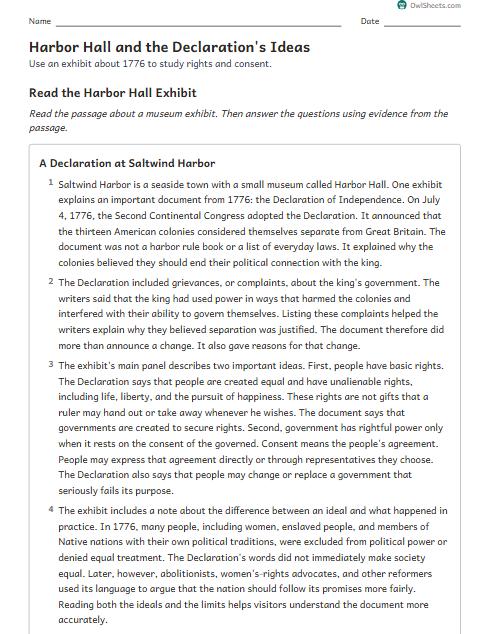
Harbor Hall and the Declaration's Ideas
Grade 5 · CIV.5.3
14 questionsPremium
A Letter from Grandma Yolanda About the Vote
Grade 5 · CIV.5.4
13 questionsFree
The Block Party Money and the Three Branches
Grade 5 · CIV.5.1
14 questionsPremium
Odette's Capitol Week Diary
Grade 5 · CIV.5.1
13 questionsPremium