Grade 4 · Social StudiesCIV.4.4
Election Day at Willowglass Pool
Use an election-day map and field notes to explain constitutional government, voting rights, and citizens' responsibilities.
Preview
OwlSheets.com
Election Day at Willowglass Pool
Use field notes and a described map to connect constitutional rights with citizen responsibilities.
Read the election-day notes
Read about this fictional polling place during a federal election. Use the field notes and map to answer the questions.
A Pool Lobby Becomes a Polling Place
Willowglass Pool usually welcomes swimmers. Today, its lobby is a polling place for a federal election. Eligible citizens arrive to vote for national leaders. Election workers check records, answer questions, and help voters follow election procedures. A student observer records what happens without looking at anyone's completed ballot.
The observer's notebook begins with the U.S. Constitution. A constitution is a government's basic plan. The U.S. Constitution gives different jobs to Congress, the president, and the federal courts. It also limits government power and protects rights. An election chooses people to hold offices; it does not give the winners permission to take over the jobs of the other branches.
The Constitution can be changed through amendments, a process requiring broad agreement beyond one town or one election. Voting protections expanded through several amendments. The Fifteenth Amendment, added in 1870, bars denying voting rights because of race. The Nineteenth, added in 1920, bars denying them because of sex. The Twenty-Fourth, added in 1964, bans poll taxes—charges required for voting—in federal elections. The Twenty-Sixth, added in 1971, protects the voting rights of otherwise eligible citizens age 18 and older against age-based denial. These amendments did not immediately end every unfair barrier. People continued working to enforce voting rights.
Citizens also have responsibilities. They should learn about candidates and issues, follow lawful voting procedures, and respect other people's choices. Voting is an important civic responsibility, but U.S. law does not require eligible citizens to vote. Other duties, such as paying taxes legally owed and serving on a jury when legally required, are required by law. Between elections, citizens can follow officials' decisions and ask whether leaders are carrying out their public duties.
People who are too young to vote can study issues, discuss ideas, and petition officials for changes. Constitutional freedoms of speech and peaceful gathering continue on election day, although lawful rules can protect access to voting. The observer watches an elected council member arrive. A worker checks her eligibility using the same records used for other voters. Later, she waits for an open voting booth.
The map has six labeled places:
• The entrance is south of the check-in table.
• The check-in table is in the center. Workers check eligibility records here.
• The question desk is west of check-in. Workers review record problems here.
• The voting booths are east of check-in. Voters mark ballots privately here.
• The ballot scanner is south of the booths. A sign says, “Cast your own ballot once. Ask a worker about scanner problems.”
• The outdoor leaflet space is west of the entrance. Local rules allow campaign leaflets there, outside the indoor voting area. The entrance must remain clear.
- A. The president's winning margin decides which powers transfer.
- B. The other branches' powers pause until the next election.
- C. The Constitution's division of powers still binds the winner.
- D. The election workers decide which branches keep their jobs.
- A. Go south to the entrance and ask campaign supporters to decide.
- B. Go to the scanner and submit a ballot before checking in.
- C. Go east to a booth and skip the record review.
- D. Go west to the question desk and request a review.
- A. Use the outdoor leaflet space and leave the entrance clear.
- B. Stand in the entrance and ask people to stop before entering.
- C. Use the check-in table and hand out leaflets with eligibility records.
- D. Stand beside the booths and discuss choices as people mark ballots.
The pool lobby is being used for a federal election.Election workers answer questions during the day.A worker checks the council member using the records used for other voters.The council member waits for an open voting booth.
- A. The age preferred by the candidate the citizen supports.
- B. The constitutional protection for eligible citizens age 18 and older.
- C. The worker's preference for a higher age at this polling place.
- D. The age limit printed on the older instruction sheet.
- A. The fee would have to be different for each voting age.
- B. The fee would make payment a condition of casting a vote.
- C. The fee would have to be approved by the winning candidate.
- D. The fee would have to be collected after the ballot is scanned.
- A. Each amendment replaced the voting protection added before it.
- B. Each polling place chose when to begin following voting protections.
- C. Voting protections changed whenever a different president won.
- D. Constitutional changes addressed different voting barriers over time.
Rights and responsibilities in action
Apply the notebook and map to these new situations. For written answers, make a claim and support it with details from the page.
- A. Ask the voter to explain the choices before finishing the ballot.
- B. Read the choices aloud so people waiting can discuss them.
- C. Step away so the voter can make and mark a private choice.
- D. Stay nearby so the visitor can check the voter's candidate choice.
- A. Gather evidence and ask election officials about a lawful review.
- B. Demand that the favored candidate take office before a review.
- C. Announce a replacement result based on friends' reports.
- D. Remove ballots from the workers to organize a separate count.
- A. Study an issue and send officials a petition explaining an idea.
- B. Count a classroom survey as additional ballots in the election.
- C. Use an adult relative's ballot after discussing the candidates.
- D. Ask campaign supporters to approve an exception to the voting age.
A voter casts one personal ballot and does not submit another.A voter reads campaign leaflets before deciding whom to support.A voter reports a scanner problem to a worker before trying again.A voter submits an extra ballot to give a favored candidate more support.
Related worksheets
Two Work Orders for Selwick Island
Grade 4 · CIV.4.4
14 questionsPremium
Science Center Surveys and Constitutional Rights
Grade 4 · CIV.4.4
14 questionsPremium
Constitution Day Posters in Hallway B
Grade 4 · CIV.4.4
13 questionsPremium
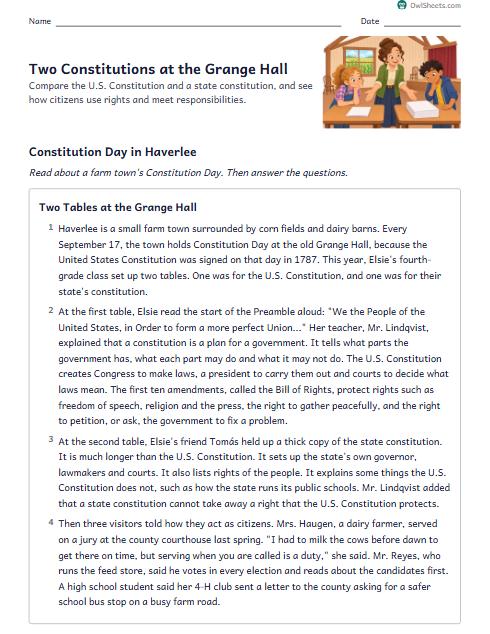
Two Constitutions at the Grange Hall
Grade 4 · CIV.4.4
14 questionsPremium
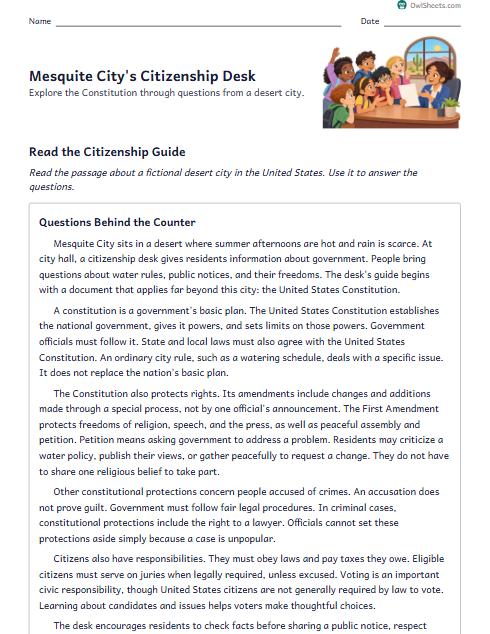
Mesquite City's Citizenship Desk
Grade 4 · CIV.4.4
13 questionsPremium
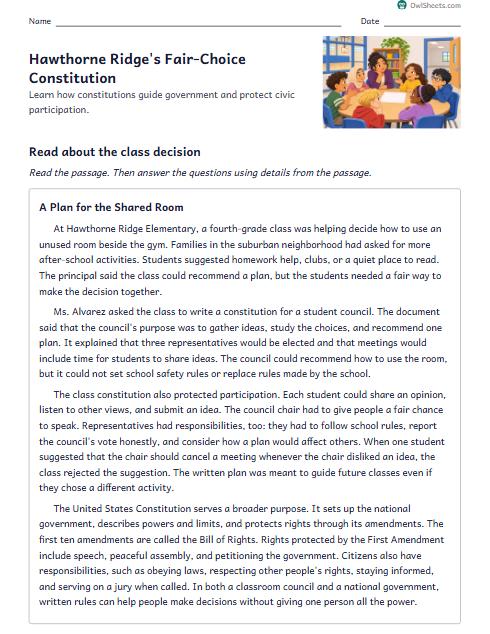
Hawthorne Ridge's Fair-Choice Constitution
Grade 4 · CIV.4.4
15 questionsPremium