Grade 4 · Social StudiesCIV.4.4Premium
Mesquite City's Citizenship Desk
Use a desert city's citizenship guide to explain constitutional government, protected freedoms, and citizens' responsibilities.
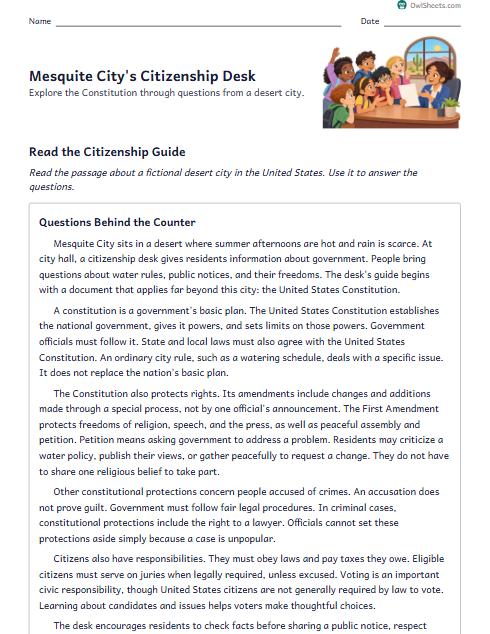
Preview
OwlSheets.com
Mesquite City's Citizenship Desk
Explore the Constitution through questions from a desert city.

Read the Citizenship Guide
Read the passage about a fictional desert city in the United States. Use it to answer the questions.
Questions Behind the Counter
Mesquite City sits in a desert where summer afternoons are hot and rain is scarce. At city hall, a citizenship desk gives residents information about government. People bring questions about water rules, public notices, and their freedoms. The desk's guide begins with a document that applies far beyond this city: the United States Constitution.
A constitution is a government's basic plan. The United States Constitution establishes the national government, gives it powers, and sets limits on those powers. Government officials must follow it. State and local laws must also agree with the United States Constitution. An ordinary city rule, such as a watering schedule, deals with a specific issue. It does not replace the nation's basic plan.
The Constitution also protects rights. Its amendments include changes and additions made through a special process, not by one official's announcement. The First Amendment protects freedoms of religion, speech, and the press, as well as peaceful assembly and petition. Petition means asking government to address a problem. Residents may criticize a water policy, publish their views, or gather peacefully to request a change. They do not have to share one religious belief to take part.
Other constitutional protections concern people accused of crimes. An accusation does not prove guilt. Government must follow fair legal procedures. In criminal cases, constitutional protections include the right to a lawyer. Officials cannot set these protections aside simply because a case is unpopular.
Citizens also have responsibilities. They must obey laws and pay taxes they owe. Eligible citizens must serve on juries when legally required, unless excused. Voting is an important civic responsibility, though United States citizens are not generally required by law to vote. Learning about candidates and issues helps voters make thoughtful choices.
The desk encourages residents to check facts before sharing a public notice, respect other people's freedoms, and use peaceful ways to seek changes. During a dry month, residents might obey the current watering rule while petitioning for a different schedule. Paying taxes owed helps fund public services, even when a taxpayer disagrees with a government decision.
- A. Which evenings may residents water their yards?
- B. What time should city sprinklers turn off?
- C. Which month needs an extra watering day?
- D. What powers and limits does the national government have?
- A. Constitutional protections expire when officials change.
- B. Local rules need approval from each resident.
- C. Local rules must agree with the Constitution.
- D. Constitutional protections apply to national officials instead.
The preview shows the first questions. Unlock the worksheet to see all of it.
Related worksheets
Two Work Orders for Selwick Island
Grade 4 · CIV.4.4
14 questionsPremium
Election Day at Willowglass Pool
Grade 4 · CIV.4.4
13 questionsFree
Science Center Surveys and Constitutional Rights
Grade 4 · CIV.4.4
14 questionsPremium
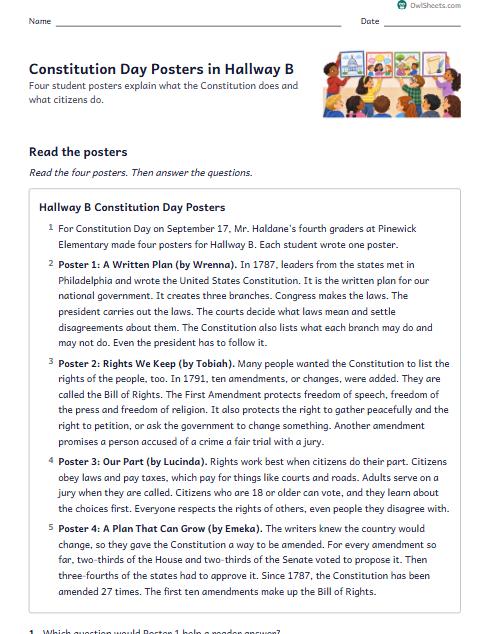
Constitution Day Posters in Hallway B
Grade 4 · CIV.4.4
13 questionsPremium
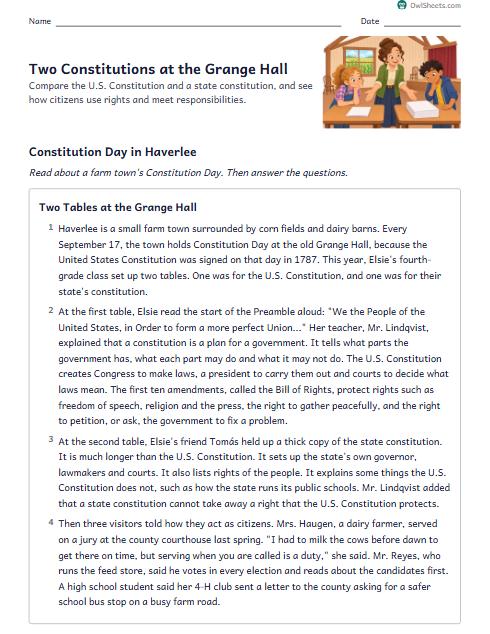
Two Constitutions at the Grange Hall
Grade 4 · CIV.4.4
14 questionsPremium
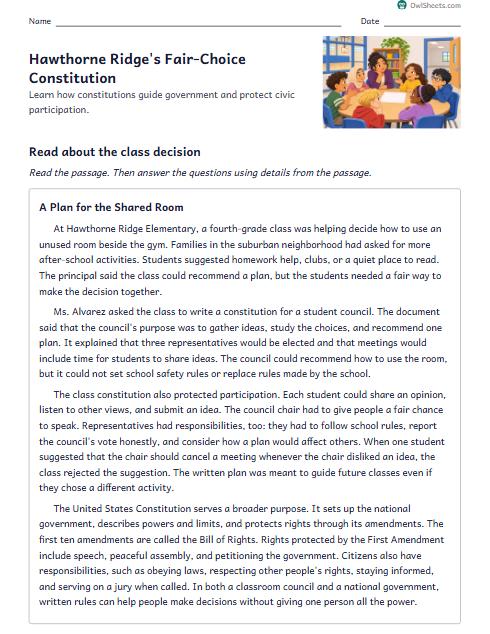
Hawthorne Ridge's Fair-Choice Constitution
Grade 4 · CIV.4.4
15 questionsPremium