Grade 4 · Social StudiesHIS.4.3Premium
An Apple Packer's Diary, 1886
Use a fictional 1886 diary to explain how canals, railroads, the telegraph, and printing machines changed American life.

Preview
OwlSheets.com
An Apple Packer's Diary, 1886
Read how inventions changed work, trade, and family life.
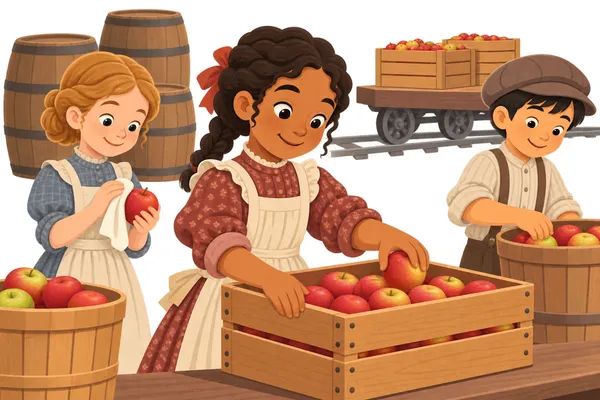
Read the Diary
Read this fictional diary set in Rochester, New York, in 1886. The writer and business are invented; the inventions and their uses are historically accurate.
Ruth Bell's Packing-Room Diary
October 14, 1886 — Rochester, New York. This morning our packing room smelled of apples. We pack fresh fruit and dried apple slices for buyers in other towns. Father remembers when his family's customers lived mostly nearby. Today I nailed labels onto crates addressed to people I have never met.
Several barrels of dried apples went to the Erie Canal wharf. The canal opened in 1825, connecting the Hudson River with Lake Erie. A horse walking beside the water pulled today's boat. The boat carried a heavy load for less money than hauling it over roads by wagon. Its journey would be slower than a train's, but these dried apples did not need to arrive quickly. When the canal freezes, boats cannot use it.
Our fresh apples went to the railroad station instead. The buyer wanted them soon, before they spoiled. Railroads reach many inland towns away from canals and rivers. They carry passengers as well as freight. My cousin arrived by train last week to seek work here. Yet a railroad is not a promise that everything will go smoothly: a delayed train left yesterday's workers waiting with loaded carts.
At noon, a telegraph messenger brought a buyer's request for six more crates. At the telegraph office, an operator had received electrical signals through a wire and written down the message. We began packing before a letter could have arrived. Still, the message brought neither apples nor money into our room. We needed a train to carry the crates to the buyer.
After supper I collected our newspaper advertisement from the printer. His steam-powered press turned out many copies much faster than an older hand-operated press. Readers in several towns would see our offer of dried apples. The printer said that powered presses also helped publishers make more newspapers and books. Reading those pages, people could learn about events far from home.
We have more orders this autumn, and the owner has hired two more packers. Father welcomes the wages, but he says the workday now follows the boat's departure and the train's timetable. A late message can change our afternoon. I wonder which matters more to our business: a boat carrying barrels, a train carrying crates, a wire carrying words, or a press spreading news of what we sell.
- A. The buyer needs the fastest available delivery.
- B. The boat can reach towns without waterways.
- C. The heavy goods can travel cheaply without rushing.
- D. The boat can keep running when the water freezes.
- A. Fresh fruit became less likely to spoil in storage.
- B. Fruit sellers had fewer reasons to check departure times.
- C. Railroad freight cost less than canal freight on this trip.
- D. Faster shipping could help sellers reach distant buyers.
The preview shows the first questions. Unlock the worksheet to see all of it.
Related worksheets
A Timeline of American Connections
Grade 4 · HIS.4.3
15 questionsPremium
Mina's Museum of Moving Ideas
Grade 4 · HIS.4.3
15 questionsFree
When Distance Got Smaller
Grade 4 · HIS.4.3
14 questionsPremium
Mulberry Loop: Comparing Two Homelands
Grade 4 · HIS.4.1
14 questionsPremium
Canal-Side Signs: Desert and Wetland
Grade 4 · HIS.4.1
14 questionsPremium
The Hearthspan Crossing Report
Grade 4 · HIS.4.2
13 questionsPremium