
WorksheetPremium
Fossil Clues Beneath the Soccer Field
Compare fossil evidence from two sites beneath a soccer field to describe long-ago living things and environments.
Grade 3ScienceInteractive · Printable
Aligned to3-LS4-1
Or unlock every Premium worksheet with Premium
What’s included
- Single worksheet
- Auto-graded online
- 1 NGSS standard
- Printable answer key
- 13 questions
- Classroom-ready
Details
- Format
- Interactive · Printable
- Grade
- Grade 3
- Subject
- Science
- Question types
- Fill in the blank, Multiple choice, Circle the answer, Sorting, Short answer
About this worksheet
What students practice
- Students use fossil features to describe living things from long ago.
- Students compare fossil evidence to infer past environments at two sites.
- Students distinguish supported fossil claims from claims that need more evidence.
How to use
Read the site report and compare the graphs together. Have students answer independently, then discuss which fossil clues support each environmental claim.
Curriculum
NGSS standard covered
Use fossils to describe living things and environments from long ago.
Preview
OwlSheets.com
Fossil Clues Beneath the Soccer Field
Compare two fossil sites to investigate life long ago.
Examine the Records
Read the report and study both graphs. Use the evidence to answer the questions.
Two Sites, One New Field
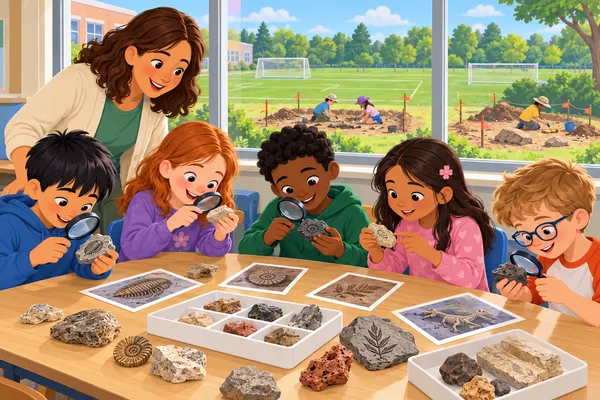
Workers are preparing a new school soccer field. They uncover natural rock at two places: Site A near the west goal and Site B near the east goal. Scientists photograph fossils still fixed in the rock, not in loose gravel brought from somewhere else. Students study the photographs safely in their classroom. Today, the field is dry land with grass. Neither site is covered by a sea.
Fossils are remains or signs of living things from long ago. At Site A, scientists find shell fossils with curved ridges and coral fossils with branching shapes. At Site B, they find leaf prints with many small leaflets and fossil stumps with roots spreading beneath them. The scientists identify these stumps as standing where the plants grew.
The class uses a guide to compare the fossils with living things today. The matching sea clams are animals that live in salt water. The matching branching corals are animals that live in shallow salt water. The matching leafy plants and rooted trees grow on land. Similar shapes can help scientists investigate past living things and their surroundings.
Scientists count fossil finds in one equally sized patch of rock at each site. A find may be just part of a living thing. The graphs show their records. These small patches do not preserve everything that once lived nearby, and the report gives no ages for the rocks.
The preview shows the first questions. Unlock the worksheet to see all of it.
Related worksheets
 Worksheet
Grade 3
Zara's Platform Fossil Journal
Life Science · 3-LS4-1
Premium14 questions
 Worksheet
Grade 3
Fossils at the High-Cloud Station
Life Science · 3-LS4-1
Premium15 questions
 Worksheet
Grade 3
Fossil Clues at the Bike Co-op
Life Science · 3-LS4-1
Premium14 questions
 Worksheet
Grade 3
Fossil Records in the Pantry Stone
Life Science · 3-LS4-1
Premium14 questions
 Worksheet
Grade 3
Fossil Survey from the Shore Overlook
Life Science · 3-LS4-1
Premium14 questions
 Worksheet
Grade 3
Fossil Display Plans at the Winter Library
Life Science · 3-LS4-1
Premium13 questions