
WorksheetPremium
Fossil Survey from the Shore Overlook
Compare a class's fossil survey results to describe ancient organisms and environments near a present-day beach and tide pools.
Grade 3ScienceInteractive · Printable
Aligned to3-LS4-1
Or unlock every Premium worksheet with Premium
What’s included
- Single worksheet
- Auto-graded online
- 1 NGSS standard
- Printable answer key
- 14 questions
- Classroom-ready
Details
- Format
- Interactive · Printable
- Grade
- Grade 3
- Subject
- Science
- Question types
- Fill in the blank, Multiple choice, Matching, Circle the answer, Sorting, Short answer
About this worksheet
What students practice
- Students use fossil features to describe organisms that lived long ago.
- Students compare fossil survey results to infer two ancient environments.
- Students support environmental claims with evidence and identify what fossils do not show.
How to use
Read the investigation and fossil guide together. Keep both graphs available as students work, then discuss the evidence in their final explanations.
Curriculum
NGSS standard covered
Use fossils to describe living things and environments from long ago.
Preview
OwlSheets.com
Fossil Survey from the Shore Overlook
Investigate fossil clues to two long-ago environments.
Investigate the Fossil Finds
Read the class investigation. Use the fossil guide and both graphs to answer the questions.
Two Rock Faces beside the Sea
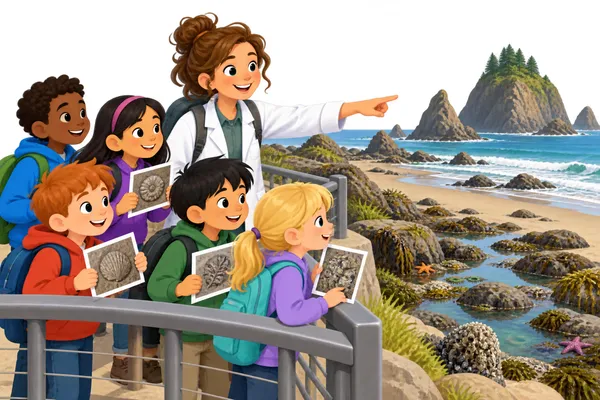
A third-grade class visits a shore overlook above a beach and tide pools. Students stay behind the railing, away from waves and cliffs. A fossil scientist shares close-up photographs of two nearby rock faces: West Face and East Face. Fossils are remains or traces of living things from long ago. These rocks formed long before the overlook existed.
The class follows four steps. Step 1: Choose photographs showing the same amount of rock surface at each face. Step 2: Study each set for ten minutes using the same fossil guide. Only the rock face being studied changes. Step 3: Mark each clear fossil find once and count finds by kind. Step 4: Graph the results and compare the clues. Unclear marks are left out of the counts.
The guide describes trilobites as ocean animals with hard outer coverings and many body sections. No trilobites are alive today. Sea lilies were animals attached to the ocean floor by stems. Their living relatives are also ocean animals. Despite their name and shape, sea lilies were not flowers. Fern fossils show divided leaves with veins. The guide also identifies branching root traces, left where plants once grew in soil.
At East Face, the scientist confirms that the root traces remain in the soil where the plants grew. Leaves can wash into water, but these roots were not washed there. The graphs show only the clear finds in the selected photographs, not every organism that once lived nearby. The scientist cannot tell which rock face formed first. Neither the photographs nor the guide reveals the organisms' original colors.
The preview shows the first questions. Unlock the worksheet to see all of it.
Related worksheets
 Worksheet
Grade 3
Zara's Platform Fossil Journal
Life Science · 3-LS4-1
Premium14 questions
 Worksheet
Grade 3
Fossils at the High-Cloud Station
Life Science · 3-LS4-1
Premium15 questions
 Worksheet
Grade 3
Fossil Clues at the Bike Co-op
Life Science · 3-LS4-1
Premium14 questions
 Worksheet
Grade 3
Fossil Records in the Pantry Stone
Life Science · 3-LS4-1
Premium14 questions
 Worksheet
Grade 3
Fossil Display Plans at the Winter Library
Life Science · 3-LS4-1
Premium13 questions
 Worksheet
Grade 3
Fossil Predictions at the Farm Windmill
Life Science · 3-LS4-1
Premium14 questions