Grade 3 · Social StudiesHIS.3.1
Saltwell's Firehouse Map Files
Use an invented town's firehouse records and described maps to explain its founding, eastward growth, and changing fire protection.
Preview
OwlSheets.com
Saltwell's Firehouse Map Files
Use town records and map clues to explain growth and change.
Open the Town Records
Read this invented town history. Circle answers unless another direction is given.
A Folder from Saltwell's Fire Station
Saltwell is an invented town. Its story begins in 1872, when workers opened salt works beside salty springs. At the works, workers heated salty water until salt remained. They sold the salt for cooking and preserving food. Workers and their families built homes nearby instead of traveling from far away each day. These homes formed the town's first neighborhood.
In 1900, residents built a small fire station between the salt works and the first homes. Volunteer firefighters kept a horse-drawn fire wagon there. The building stood close to both the workplace and the neighborhood. At that time, the town had not spread beyond this small area.
In 1925, the salt works began filling larger orders and hired more workers. Families arriving for these jobs needed places to live. There was little space left among the first homes, but flat land farther east had room for houses. By 1940, a second neighborhood stood there. The salt works remained at its original site, and the first neighborhood remained in use.
By 1955, firefighters used motor trucks instead of the old wagon. Their garage was crowded, and the eastern homes were much farther from the station than the first homes were. In 1960, the town opened a larger station between the two neighborhoods. The old station stopped sending out firefighters, although its building remained standing. The salt works did not move or add jobs that year. The new station had wider doors, more equipment space, and a different location from the old one.
- A. Families settled near work that used the salty springs.
- B. Families settled there to work at the new fire station.
- C. Families settled beside the larger station's truck garage.
- D. Families settled in the eastern neighborhood's new houses.
The first neighborhood continued to be used.The fire station once held a horse-drawn wagon.The new station had wider doors.Another neighborhood appeared farther east.
- A. The salt works had moved to the eastern land.
- B. The larger fire station had already opened there.
- C. The eastern land offered space the older area lacked.
- D. The first neighborhood had lost its nearby jobs.
- A. The works replaced homes; the station created a new neighborhood.
- B. The works moved east; the station brought families back west.
- C. The works attracted workers; the station served the spread-out town.
- D. The works reduced jobs; the station hired the arriving workers.
Compare the Map Files
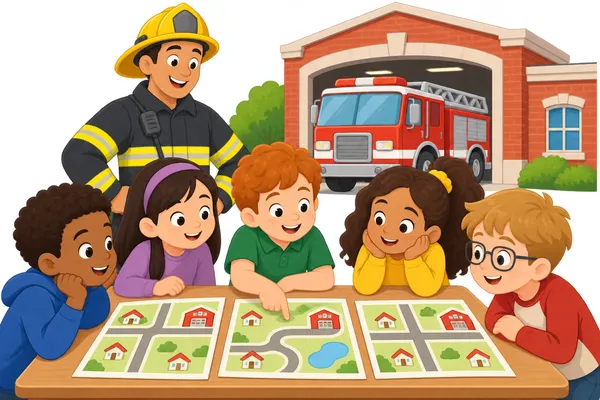
Use these maps described in words. You may sketch them before answering. All five places lie along the same straight east–west street. Each block is the same length. The maps show locations, not numbers of people or houses.
Salt Works is at the west end. First Homes is two blocks east of Salt Works.
Keep both places from Map A. Add Old Station halfway between Salt Works and First Homes.
Keep the places from Map B. Add East Homes four blocks east of First Homes.
Keep the places from Map C. Mark Old Station closed. Add New Station halfway between First Homes and East Homes.
- A. It stood between the workplace and the homes shown there.
- B. It stood between the two neighborhoods shown on that map.
- C. It stood west of the workplace, away from the homes.
- D. It stood east of the homes, where new land was available.
- A. It moved into First Homes while keeping the same distance from Salt Works.
- B. It moved closer to East Homes and now lies between the two neighborhoods.
- C. It moved closer to Salt Works and farther from East Homes.
- D. It moved beyond East Homes and farther from both neighborhoods.
Salt Works stays at the west end.East Homes appears four blocks east of First Homes.Old Station stands west of First Homes.New Station appears between First Homes and East Homes.
- A. How many people lived in the town in 1940?
- B. Which station was marked closed in 1960?
- C. Which neighborhood lay farther east in 1940?
- D. Which places appeared on the earliest map?
- A. New Station moved west when Salt Works opened in 1900.
- B. Old Station opened first, and Salt Works followed in 1940.
- C. The town began at East Homes and spread west before 1872.
- D. Salt Works and First Homes came first; eastern places came later.
Use the History
Apply what you learned to new cases. Then explain a claim using Saltwell's records.
- A. Replace New Station's doors with wider ones.
- B. Reopen Old Station west of the first homes.
- C. Move the salt works into the northern homes.
- D. Add a fire station near the northern homes.
- A. Whether the garage has doors tall enough for the trucks
- B. Whether town records show an increase in residents
- C. Whether the larger garage holds the new equipment
- D. Whether the old trucks were shorter than the new trucks
- A. A town's first neighborhood moves when new jobs appear.
- B. Available building land helps shape where new homes go.
- C. A larger fire station is needed before families can arrive.
- D. New neighborhoods usually form west of their workplaces.
Related worksheets
A Letter from Waverock Light
Grade 3 · HIS.3.1
14 questionsPremium
A Capital Takes Shape
Grade 3 · HIS.3.1
14 questionsPremium
Bellridge Then and Now
Grade 3 · HIS.3.1
13 questionsPremium
Cattail Crossing Through Time
Grade 3 · HIS.3.1
15 questionsPremium
Stonebridge Across the Years
Grade 3 · HIS.3.1
14 questionsPremium
How Brasswell Became a Town
Grade 3 · HIS.3.1
14 questionsPremium