
Worksheet
Family Traits at the Discovery Pavilion
Compare pea plant and guinea pig family records to find evidence of inherited traits and differences among offspring.
Grade 3ScienceInteractive · Printable
Aligned to3-LS3-1
What’s included
- Single worksheet
- Auto-graded online
- 1 NGSS standard
- Printable answer key
- 13 questions
- Classroom-ready
Details
- Format
- Interactive · Printable
- Grade
- Grade 3
- Subject
- Science
- Question types
- Fill in the blank, Multiple choice, Circle the answer, Sorting, Short answer
About this worksheet
What students practice
- Students use family data to support that plants and animals get traits from their parents.
- Students compare offspring data to identify trait variation within groups.
How to use
Read the investigation together, then have students use the graphs independently. Discuss how family resemblance and differences can occur together.
Curriculum
NGSS standard covered
Use data to show that plants and animals get traits from their parents and that traits vary in a group.
Preview
OwlSheets.com
Family Traits at the Discovery Pavilion
Use family records to compare traits in plants and animals.
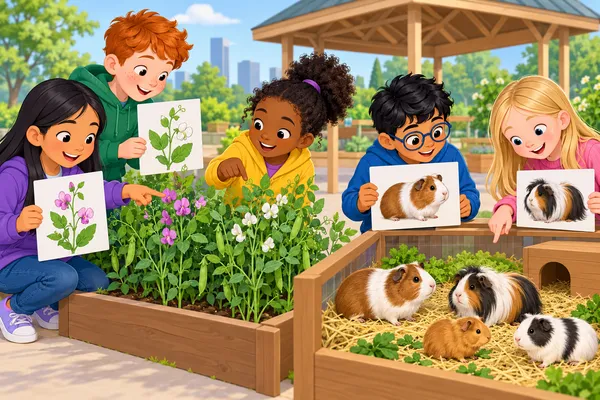
Investigate Plant Families
Read the class investigation. Use the plant graph and parent records to answer the questions.
A Class Checks Family Records
A class visited a city park's discovery pavilion to investigate family traits. A trait is a feature of a living thing, such as flower color or coat pattern. Offspring are the young of parents. Park staff shared photographs and records of pea plants and guinea pigs.
Step 1: Students checked the family labels in the staff records. They used these labels to identify each offspring's parents rather than guessing from how it looked.
Step 2: Students compared fully open pea flowers. In Family P, one parent had purple flowers and the other had white flowers. Both parents in Family Q had white flowers. The class recorded one flower color for each offspring plant.
Step 3: Students examined guinea pig photographs. Family R had one black parent with white patches and one solid-black parent. Family S had one brown parent with white patches and one solid-brown parent. Students recorded each offspring's coat.
Step 4: Students counted offspring with each trait and made graphs. They compared families, not different care treatments. Within each kind of living thing, staff kept care the same. Students did not change food, water, or growing conditions.
- A. Both families have two flower colors.
- B. Only Family Q has two flower colors.
- C. Only Family P has two flower colors.
- D. Neither family has two flower colors.
How many more Family P offspring have purple flowers than white flowers? offspring plants
Family P has eight offspring plants in total.Family P has a purple-flowered parent and six purple-flowered offspring.Family Q has white-flowered parents and eight white-flowered offspring.The class counted the same number of offspring in P and Q.
- A. White appears in a parent and two offspring, even though purple is more common.
- B. Only the most common flower color can be a trait shared with a parent.
- C. The two white-flowered offspring probably came from Q because Q has more white flowers.
- D. The purple-flowered parent means every offspring in P must have purple flowers.
- A. Count the same Family P plants again without adding new records.
- B. Record flower colors from more plants without checking their families.
- C. Photograph more parent plants without recording any of their offspring.
- D. Compare flower colors in more known parent-and-offspring pea families.
Investigate Animal Families
Use the guinea pig graph and the parent records in the investigation. A patched coat has white patches; a solid coat has no white patches.
- A. Family R and Family S each have six offspring in the graph.
- B. A brown-and-white parent in S has three brown-and-white offspring.
- C. Family R has more patched offspring than Family S has.
- D. Family S has equal numbers of patched and solid-coated offspring.
Combine both families. How many offspring have white patches on their coats? offspring
| Supported by the graph | Not supported by the graph |
|---|---|
Think Across the Records
Use both investigations to judge claims and apply what the class found.
- A. The class recorded eight offspring plants in Family Q.
- B. Both parent plants in Family Q had white flowers.
- C. Six offspring plants in Family P had purple flowers.
- D. The class checked flowers only after they opened fully.
- A. Check staff records to find out who its parents are.
- B. Add it to R because a matching coat proves its family.
- C. Add it to whichever family has fewer patched offspring.
- D. Compare its coat with the flower colors in Family P.
- A. Two white-flowered parents have six offspring, all with white flowers.
- B. A purple-flowered parent and a white-flowered parent have six purple-flowered offspring.
- C. Six offspring have two flower colors, but their parents' flower colors were not recorded.
- D. Purple- and white-flowered parents have three purple and three white offspring.
Related worksheets
 Worksheet
Grade 3
A Family-Trait Display for the Reef Aquarium
Life Science · 3-LS3-1
Premium15 questions
 Worksheet
Grade 3
Trait Clues at the Red Mesa Field Station
Life Science · 3-LS3-1
Premium15 questions
 Worksheet
Grade 3
Trait Evidence in the Reef Aquarium
Life Science · 3-LS3-1
Premium14 questions
 Worksheet
Grade 3
Family-Trait Displays at the Croquet Lawn
Life Science · 3-LS3-1
Premium14 questions
 Worksheet
Grade 3
Trait Forecasts on the Backyard Screened Porch
Life Science · 3-LS3-1
Premium14 questions
 Worksheet
Grade 3
Pack Goats and Pea Family Records
Life Science · 3-LS3-1
Premium13 questions