
WorksheetPremium
Family-Trait Displays at the Croquet Lawn
Judge sports-day display designs using snapdragon and gerbil family data as evidence of inherited traits and variation.
Grade 3ScienceInteractive · Printable
Aligned to3-LS3-1
Or unlock every Premium worksheet with Premium
What’s included
- Single worksheet
- Auto-graded online
- 1 NGSS standard
- Printable answer key
- 14 questions
- Classroom-ready
Details
- Format
- Interactive · Printable
- Grade
- Grade 3
- Subject
- Science
- Question types
- Fill in the blank, Multiple choice, Circle the answer, Sorting, Short answer
About this worksheet
What students practice
- Students use plant and animal family data as evidence that offspring get traits from their parents.
- Students identify trait variation among offspring within a family.
- Students evaluate display designs for accurate evidence of family resemblance and trait variation.
How to use
Read the family records together. Have students evaluate the displays independently, then discuss which designs show both resemblance and variation.
Curriculum
NGSS standard covered
Use data to show that plants and animals get traits from their parents and that traits vary in a group.
Preview
OwlSheets.com
Family-Trait Displays at the Croquet Lawn
Compare family data to choose accurate display designs.
Choose a Plant Display
Read the project notes. Use the parent records and graph to judge the plant displays.
A Sports-Day Display Challenge
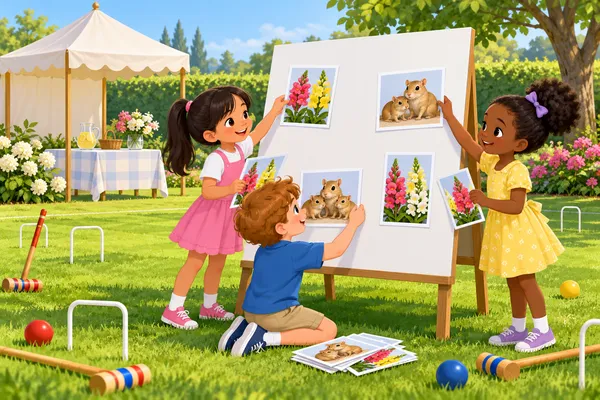
At a community croquet lawn, a science club is designing a display beside the score tent. Nia wants visitors waiting between games to compare living things and their families. The club uses photographs and family records, not live animals. A trait is a feature, such as flower color or fur color. Offspring are the young of parents.
First, the club checks family labels supplied by plant growers and animal caretakers. The labels identify each offspring's parents. Students do not guess family membership from appearance. They compare fully open snapdragon flowers and adult gerbil coats, so they compare traits at similar stages.
Snapdragon Family A has one red-flowered parent and one pink-flowered parent. Family B has one pink-flowered parent and one white-flowered parent. Gerbil Family C has one black-coated parent and one golden-coated parent. Both parents in Family D have golden coats.
Next, the club records one flower color or coat color for each offspring and counts the results. Caretakers provided the same care within each kind of living thing; this was not a test of different food or growing conditions. The graphs show the recorded offspring. The club's display needs to show parent traits and differences among offspring without hiding less common traits.
- A. A has red and white offspring; B has pink and white offspring.
- B. A has red and pink offspring; B has red and white offspring.
- C. A has pink and white offspring; B has red and pink offspring.
- D. A has red and pink offspring; B has pink and white offspring.
The preview shows the first questions. Unlock the worksheet to see all of it.
Related worksheets
 Worksheet
Grade 3
A Family-Trait Display for the Reef Aquarium
Life Science · 3-LS3-1
Premium15 questions
 Worksheet
Grade 3
Trait Clues at the Red Mesa Field Station
Life Science · 3-LS3-1
Premium15 questions
 Worksheet
Grade 3
Trait Evidence in the Reef Aquarium
Life Science · 3-LS3-1
Premium14 questions
 Worksheet
Grade 3
Trait Forecasts on the Backyard Screened Porch
Life Science · 3-LS3-1
Premium14 questions
 Worksheet
Grade 3
Pack Goats and Pea Family Records
Life Science · 3-LS3-1
Premium13 questions
 Worksheet
Grade 3
Snails and Clover at the Tent Loop
Life Science · 3-LS3-1
Premium13 questions