
WorksheetPremium
Trait Forecasts on the Backyard Screened Porch
Use snapdragon and pet mouse family records to predict traits, compare offspring, and explain family resemblance and variation.
Grade 3ScienceInteractive · Printable
Aligned to3-LS3-1
Or unlock every Premium worksheet with Premium
What’s included
- Single worksheet
- Auto-graded online
- 1 NGSS standard
- Printable answer key
- 14 questions
- Classroom-ready
Details
- Format
- Interactive · Printable
- Grade
- Grade 3
- Subject
- Science
- Question types
- Fill in the blank, Multiple choice, Circle the answer, Sorting, Short answer
About this worksheet
What students practice
- Students use parent and offspring data to support that plants and animals inherit traits.
- Students identify trait variation within families and across groups.
- Students use family evidence to make predictions without claiming exact future results.
How to use
Read the records together and check the graph labels. Have students explain which evidence supports each prediction and why predictions are not promises.
Curriculum
NGSS standard covered
Use data to show that plants and animals get traits from their parents and that traits vary in a group.
Preview
OwlSheets.com
Trait Forecasts on the Backyard Screened Porch
Use family evidence to make and check predictions.
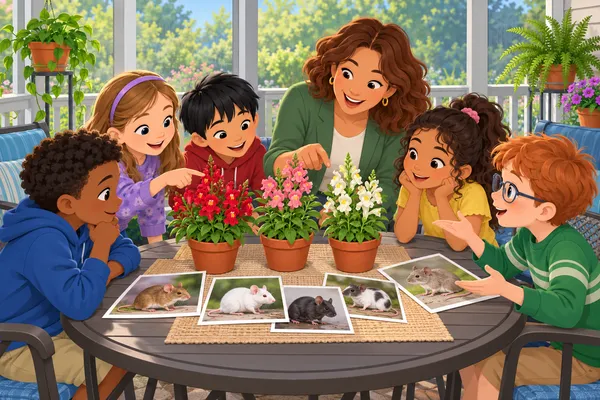
Forecast the Flowers
Read the records. Use the parent information and flower graph to answer the questions.
The Porch Prediction Club
On a backyard screened porch, Imani starts a prediction club. Her aunt brings records from snapdragon plants and pet mice she has raised. The club studies traits: features such as flower color and fur color. Offspring are the young of parents. Members use the records to predict what later offspring might look like.
First, members check the family labels. Snapdragon Family J has one red-flowered parent and one pink-flowered parent. Family K has one pink-flowered parent and one white-flowered parent. Members compare flowers after they open fully. They record one flower color for each offspring plant. The graph shows nine offspring plants from each family.
Next, members examine mouse family records and photographs. Family M has one black parent with white patches and one solid-brown parent. Its graph shows eight young. Family N has two solid-brown parents. Its six recorded young also have solid-brown coats. A solid coat has no white patches.
These are family observations, not a test of different care. Within each kind of living thing, care was kept the same. Members did not change food, water, or growing conditions. They counted traits and kept the parent labels beside their results. They will check their predictions when more offspring records arrive.
- A. Red
- B. White
- C. Both red and white
- D. Pink
The preview shows the first questions. Unlock the worksheet to see all of it.
Related worksheets
 Worksheet
Grade 3
A Family-Trait Display for the Reef Aquarium
Life Science · 3-LS3-1
Premium15 questions
 Worksheet
Grade 3
Trait Clues at the Red Mesa Field Station
Life Science · 3-LS3-1
Premium15 questions
 Worksheet
Grade 3
Trait Evidence in the Reef Aquarium
Life Science · 3-LS3-1
Premium14 questions
 Worksheet
Grade 3
Family-Trait Displays at the Croquet Lawn
Life Science · 3-LS3-1
Premium14 questions
 Worksheet
Grade 3
Pack Goats and Pea Family Records
Life Science · 3-LS3-1
Premium13 questions
 Worksheet
Grade 3
Snails and Clover at the Tent Loop
Life Science · 3-LS3-1
Premium13 questions