
WorksheetPremium
A Shelter Plan for the Forest Campsite
Evaluate campsite habitat solutions using pill bug observations, two graphs, and goals for wildlife and campers.
Grade 3ScienceInteractive · Printable
Aligned to3-LS4-4
Or unlock every Premium worksheet with Premium
What’s included
- Single worksheet
- Auto-graded online
- 1 NGSS standard
- Printable answer key
- 13 questions
- Classroom-ready
Details
- Format
- Interactive · Printable
- Grade
- Grade 3
- Subject
- Science
- Question types
- Fill in the blank, Multiple choice, Circle the answer, Sorting, Short answer
About this worksheet
What students practice
- Students connect a change in leaf cover with changes in the number of pill bugs observed.
- Students use investigation results and campsite goals to judge a habitat solution.
- Students support a solution choice with evidence and identify a useful follow-up check.
How to use
Read the investigation together and review both graphs. Have students evaluate the plans independently, then discuss the evidence and limits of one check.
Curriculum
NGSS standard covered
Judge a solution to a problem caused when an environment changes and the living things there change.
Preview
OwlSheets.com
A Shelter Plan for the Forest Campsite
Use a camping investigation to judge a habitat solution.
An Environment Changes
Read about the class camping trip. Use the investigation and graphs to answer the questions.
What Happened at the Campsite?
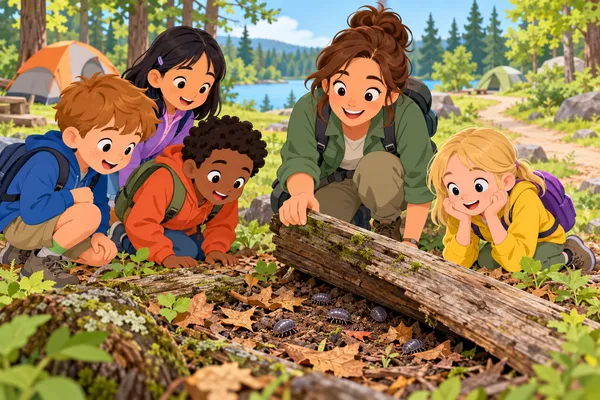
On a class camping trip, Nia noticed pill bugs in fallen leaves near the tents. Pill bugs eat dead plant material. They can lose water and dry out, so damp shelters are important to them. Leaves can provide food and cover.
Camp workers raked leaves away to enlarge a resting area beside the tents. Before the raking, a teacher counted pill bugs under a flat observation board there. Two days after raking, the teacher checked the same board again, at the same time of morning. The first graph shows these counts.
The class wanted a solution that would help pill bugs without blocking campers. Their goals were to see at least 8 pill bugs under an observation board during a check and to keep the walking path clear.
Step 1: With a teacher, students marked three equally sized patches beside the resting area, away from the walking path. All had similar shade and damp soil. All had been raked.
Step 2: An adult used leaves from the raked pile. The adult left one patch bare, added a thin leaf layer to another, and added a thick leaf layer to the third. Leaf-layer thickness was the change being tested.
Step 3: The class put an identical observation board in each patch. Low rope markers surrounded every patch. No pill bugs were moved.
Step 4: After two days, the teacher gently lifted each board once on the same morning. Students counted the pill bugs underneath. The teacher carefully replaced each board. These counts show pill bugs seen during one check, not every pill bug living nearby.
- A. More pill bugs were seen after their leaf cover was removed.
- B. Fewer pill bugs were seen after the walking path was blocked.
- C. Fewer pill bugs were seen after their leaf cover was removed.
- D. The same number of pill bugs was seen before and after raking.
The preview shows the first questions. Unlock the worksheet to see all of it.
Related worksheets
 Worksheet
Grade 3
Frog Plans at the Maple Sugar Shack
Life Science · 3-LS4-4
Premium14 questions
 Worksheet
Grade 3
Bee Planters by the Observatory Roof
Life Science · 3-LS4-4
Premium15 questions
 Worksheet
Grade 3
Runoff Around the Planetarium Dome
Life Science · 3-LS4-4
Premium15 questions
 Worksheet
Grade 3
Hay Harvest and Hiding Places
Life Science · 3-LS4-4
Premium14 questions
 Worksheet
Grade 3
Grasshopper Plans at the Cricket Field
Life Science · 3-LS4-4
Premium14 questions
 Worksheet
Grade 3
A Way Through the Backyard Fence
Life Science · 3-LS4-4
Premium13 questions