
WorksheetPremium
Warthogs on the Grassland: Read It Again
Read a short text about warthogs, then use context and rereading to catch and fix words a young reader misread.
Grade 2ELAInteractive · Printable
Aligned toRF.2.4.c
Or unlock every Premium worksheet with Premium
What’s included
- Single worksheet
- Auto-graded online
- 1 Common Core standard
- Printable answer key
- 9 questions
- Classroom-ready
Details
- Format
- Interactive · Printable
- Grade
- Grade 2
- Subject
- ELA
- Question types
- Fill in the blank, Multiple choice, Matching, Circle the answer, Sorting, Short answer
About this worksheet
What students practice
- Students use context to notice when a word they read does not make sense.
- Students reread a sentence to fix a misread word.
- Students reread a paragraph to confirm what the text says.
How to use
Read the warthog passage together first. Then have students read each of Keola's sentences aloud, ask "Does that make sense?" and reread the passage to fix it.
Curriculum
Common Core standard covered
Use context to confirm or fix word recognition and understanding, rereading as needed.
Preview
OwlSheets.com
Warthogs on the Grassland: Read It Again
Use the rest of the sentence to fix a word that does not make sense.
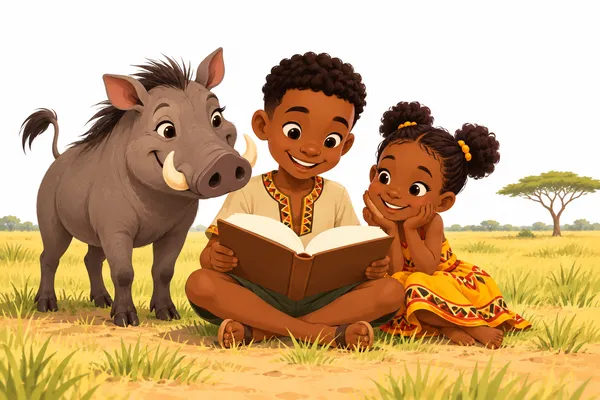
Read about warthogs
Read the passage carefully.
Warthogs on the Grassland
1Warthogs are wild pigs that live on the grassy plains of Africa. They have gray skin, a long face, and a stiff mane of hair down their backs. Two pairs of curved tusks stick out from the sides of their mouths.
2Warthogs eat mostly grass. To reach the short grass, a warthog kneels down on its front knees. Thick pads of skin on its knees keep them safe while it eats. It also digs up roots with its snout.
3At night, warthogs sleep in holes in the ground. Often they use old holes that other animals dug. A warthog backs into its hole tail first. That way, its tusks face out toward the opening.
4When a warthog runs, it holds its thin tail straight up in the air. The tail looks like a little flag waving above the grass. This may help the young ones follow their mother through the tall grass.
The preview shows the first questions. Unlock the worksheet to see all of it.
Related worksheets
 Worksheet
Grade 2
The Spoon Wind Chime: Does It Make Sense?
Foundational Skills · RF.2.4.c
Premium9 questions
 Worksheet
Grade 2
Beep, Beep! A Hearing Check Play
Foundational Skills · RF.2.4.c
Premium9 questions
 Worksheet
Grade 2
Curds and Wheels: Reread Lena's Letter
Foundational Skills · RF.2.4.c
Premium9 questions
 Worksheet
Grade 2
Penguin Facts: Does It Make Sense?
Foundational Skills · RF.2.4.c
Premium9 questions
 Worksheet
Grade 2
Leaf Pile Poem: Rhyme and Reread
Foundational Skills · RF.2.4.c
Free9 questions
 Worksheet
Grade 2
Fix the Word at the Flower Shop
Foundational Skills · RF.2.4.c
Premium9 questions