
WorksheetPremium
Keeping Playground Ground in Place
Compare playground model tests to choose ways to slow sand movement caused by wind and water.
Grade 2ScienceInteractive · Printable
Aligned to2-ESS2-1
Or unlock every Premium worksheet with Premium
What’s included
- Single worksheet
- Auto-graded online
- 1 NGSS standard
- Printable answer key
- 13 questions
- Classroom-ready
Details
- Format
- Interactive · Printable
- Grade
- Grade 2
- Subject
- Science
- Question types
- Fill in the blank, Multiple choice, Circle the answer, Sorting, Short answer
About this worksheet
What students practice
- Students compare test results for ways to slow land changes caused by wind and water.
- Students use evidence to choose and improve ways to keep playground ground in place.
How to use
Read the passage together and review the graph scales. Have students compare the designs, then use test results to explain their choices.
Curriculum
NGSS standard covered
Compare ways to slow or stop wind or water from changing the shape of the land.
Preview
OwlSheets.com
Keeping Playground Ground in Place
Compare ways to protect the ground from wind and water.
Water on the Playground
Read about the tests. Use the water graph to answer questions 1–5.
A Plan for the Ground Beside the Slide
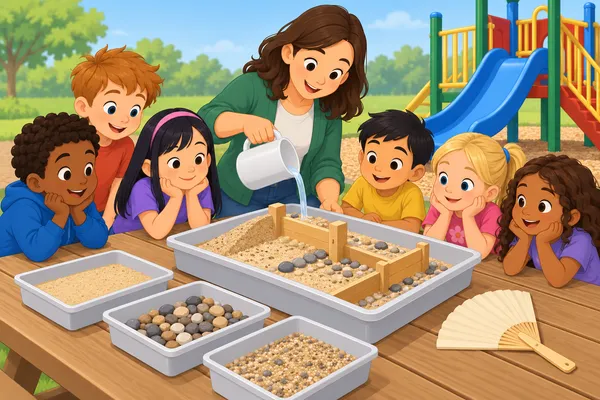
Rain had made little channels in the sandy ground beside a playground slide. On dry days, wind carried sand onto the path. The school wanted to keep more sand in place.
The class watched an adult test small models outdoors. Each tray started with the same amount of sand and the same slope. For the water test, the adult poured one cup of water onto the top of each slope over ten seconds. The trays had bare sand, a pebble cover, or a low wood barrier across the slope.
For the wind test, fresh trays had bare sand, a pebble cover, or a low fence facing the wind. The adult used a hand fan at the same distance for twenty gentle strokes each time.
A larger tray caught sand that left each model. The class let wet sand dry in the air. They measured the sand with the same small scoop. The graphs show how many level scoops moved out of each model.
- A. More sand was carried away.
- B. The tray started with less sand.
- C. More sand stayed in place.
- D. The water made new sand.
The preview shows the first questions. Unlock the worksheet to see all of it.
Related worksheets
 Worksheet
Grade 2
The Open House Slope Test
Earth & Space Science · 2-ESS2-1
Premium16 questions
 Worksheet
Grade 2
Covers for the Recycling Center Berm
Earth & Space Science · 2-ESS2-1
Premium14 questions
 Worksheet
Grade 2
Sand Shields at Desert Station
Earth & Space Science · 2-ESS2-1
Premium15 questions
 Worksheet
Grade 2
Ground Plans for the Garden Wheelbarrow Bay
Earth & Space Science · 2-ESS2-1
Premium14 questions
 Worksheet
Grade 2
Ground Guards for the River Rowing Club
Earth & Space Science · 2-ESS2-1
Premium14 questions
 Worksheet
Grade 2
Ground Plans for the Rainforest Nut Shed
Earth & Space Science · 2-ESS2-1
Premium14 questions