
Worksheet
Earth Water Search at the Jump-Rope Circle
Investigate Earth's water using place reports and a playground ice observation. Identify water locations and compare solid and liquid water.
Grade 2ScienceInteractive · Printable
Aligned to2-ESS2-3
What’s included
- Single worksheet
- Auto-graded online
- 1 NGSS standard
- Printable answer key
- 13 questions
- Classroom-ready
Details
- Format
- Interactive · Printable
- Grade
- Grade 2
- Subject
- Science
- Question types
- Multiple choice, Circle the answer, Sorting, Short answer
About this worksheet
What students practice
- Students use observations to identify places where water is found on Earth.
- Students compare evidence of solid and liquid water in different places.
How to use
Read the investigation and reports together. Have students point to evidence for their answers, then explain how the tray observations connect to lake ice.
Curriculum
NGSS standard covered
Find where water is on Earth and that it can be solid or liquid.
Preview
OwlSheets.com
Earth Water Search at the Jump-Rope Circle
Use observations to find water and describe its form.
Water in Different Places
Read the class investigation. Use the reports to answer the questions.
The Jump-Rope Circle Investigation
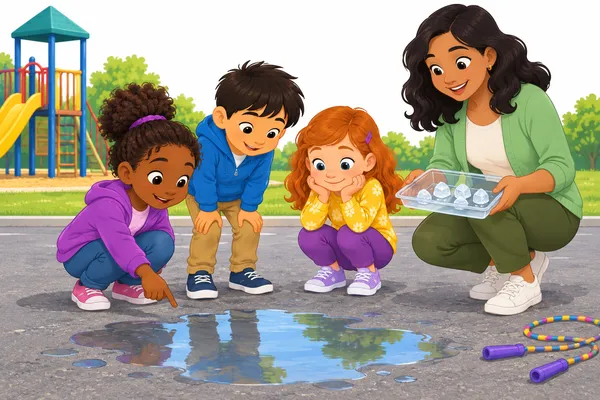
At the playground's jump-rope circle, Nia's class noticed a puddle. They wondered where else water could be found on Earth. They made a plan.
Step 1: Look at the puddle without stepping in it. Step 2: Read picture reports from other places. Step 3: Ask the same two questions about each place: Where is the water? What form is it in? Step 4: Compare the evidence. Ice and snow are solid water. Water that pours or drips is liquid.
These were the class's reports:
Ocean: Waves splash against a rocky shore.
River: Water flows between two banks and around rocks.
Lake: A hard layer of ice covers the top. Water from beneath the ice pours from a researcher's sampler.
Glacier: A thick mass of hard ice rests on a mountain slope.
Below ground: Water fills spaces between grains of sand. It drips from a well's pump.
Hill: Snow covers the grassy top.
Playground: Puddle water runs into a shallow crack beside the jump-rope circle.
- A. The glacier and the hill
- B. The river and the glacier
- C. The ocean and the river
- D. The hill and the ocean
- A. Its water is solid from top to bottom.
- B. Its top layer is liquid, with ice beneath.
- C. Its water is liquid from top to bottom.
- D. Its top layer is solid, with liquid beneath.
| Solid water | Liquid water |
|---|---|
- A. Both are water, but they are in different forms.
- B. Both are liquid water, but they are in different places.
- C. Both are solid water, but they are in different places.
- D. Both are on Earth, but the glacier is rock instead of water.
Watch the Water
Read what the class did next. Use the starting and ending observations as evidence.
A Tray Beside the Circle
The lake report gave the class another question: What might happen to ice on a warmer day? Their teacher brought plain ice from a freezer to the playground. No one tasted the ice or the water.
Step 1: The teacher placed two small ice pieces in a clear tray beside the jump-rope circle. At the start, the pieces were hard. No liquid was visible.
Step 2: The class left the tray in the warm air for 20 minutes. They kept the same tray and spot and added nothing.
Step 3: They counted the hard pieces again and looked for liquid. They found zero hard pieces. A pool of water moved when the teacher gently tipped the tray.
- A. Liquid water changed into solid water.
- B. Solid water changed into liquid water.
- C. Solid water broke into smaller hard pieces.
- D. Liquid water stayed in the same form.
The tray started with two ice pieces.A pool moved when the tray was tipped.The tray stayed beside the jump-rope circle.Zero hard pieces remained in the tray.
- A. The reports showed where water is found on Earth.
- B. The tray showed how deep Earth's rivers are.
- C. The reports showed how long the tray took to warm.
- D. The tray showed where Earth's glaciers are found.
Check Ideas About Earth's Water
Use the investigation and reports to check ideas and consider new evidence.
- A. The hill report, because snow covers the grassy top
- B. The glacier report, because thick ice rests on a slope
- C. The ocean report, because waves splash a rocky shore
- D. The below-ground report, because water fills spaces in sand
- A. Solid water and dry rock
- B. Liquid water and dry rock
- C. Solid water and liquid water
- D. Dry rock and empty space
- A. A chart of jump-rope lengths and colors
- B. A report showing water bubbling from a spring
- C. A list of trays used in the ice observation
- D. A drawing showing the playground's game lines
How deep is the river?Can water be found below the ground?How many lakes are on Earth?Can one lake have both solid and liquid water?
Related worksheets
 Worksheet
Grade 2
The Tree Nursery Water Journal
Earth & Space Science · 2-ESS2-3
Premium14 questions
 Worksheet
Grade 2
The Reading Garden Pond Map
Earth & Space Science · 2-ESS2-3
Premium15 questions
 Worksheet
Grade 2
Water Signs for the Backyard Feeder
Earth & Space Science · 2-ESS2-3
Premium14 questions
 Worksheet
Grade 2
Water Clues in the Globe Alcove
Earth & Space Science · 2-ESS2-3
Premium13 questions
 Worksheet
Grade 2
Water Predictions at the Dog-Walking Gate
Earth & Space Science · 2-ESS2-3
Premium13 questions
 Worksheet
Grade 2
An Oasis Team's Water Notebook
Earth & Space Science · 2-ESS2-3
Premium13 questions