
Worksheet
Bug Hunt Compound Word Riddles
Join two cousins on a backyard bug hunt. Solve riddles and use the two small words in compound words like anthill and grasshopper to find their meanings.
Grade 2ELAInteractive · Printable
Aligned toL.2.4.d
What’s included
- Single worksheet
- Auto-graded online
- 1 Common Core standard
- Printable answer key
- 9 questions
- Classroom-ready
Details
- Format
- Interactive · Printable
- Grade
- Grade 2
- Subject
- ELA
- Question types
- Fill in the blank, Multiple choice, Matching, Circle the answer, Sorting, Short answer
About this worksheet
What students practice
- Students use the meanings of two smaller words to predict the meaning of a compound word.
- Students use the second word of a compound word to tell what kind of thing it names.
- Students choose a sentence that uses a compound word correctly.
How to use
Do the first riddle together and point out how the two small words give the answer. Then let students work on their own and share how they solved the open question.
Curriculum
Common Core standard covered
Use the meanings of the individual words to predict the meaning of a compound word, such as birdhouse or bookshelf.
Preview
OwlSheets.com
Bug Hunt Compound Word Riddles
Solve riddles and use word parts to find what compound words mean.
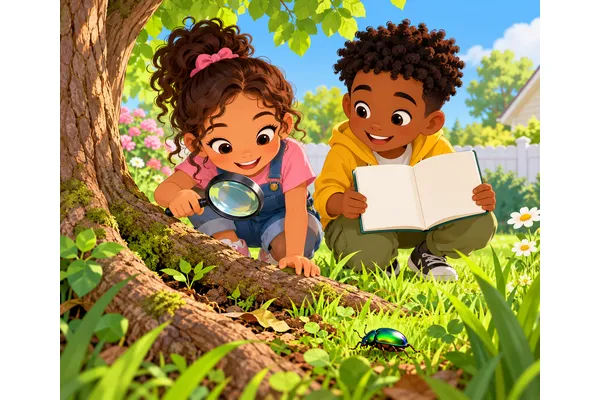
Riddles on the bug hunt
Jaylen and his cousin Rosa go on a bug hunt in the backyard. A compound word is one word made from two smaller words.
I am a small hill of dirt that ants build. What am I?
I am a worm that lives in the earth. What am I?
I am a web that a spider spins. What am I?
I am a bee that makes honey. What am I?
- A. a frog that hops in a pond
- B. a tool that cuts tall grass
- C. an insect that hops in the grass
- D. a bird that eats seeds in grass
- A. a bee that is bigger than the rest
- B. a flower that bees like to visit
- C. a sting from a buzzing bee
- D. a home where many bees live
- A. the hard outside part of an egg
- B. a seashell shaped like an egg
- C. a bird that lays blue eggs
- D. a nest that holds a bird's eggs
Two words, one meaning
Think about what each small word means. Then answer the questions.
- wild + flower
- rain + drop
- foot + print
- tree + top
- A. the top part of a tree
- B. a mark left by a foot
- C. a flower that grows wild
- D. a drop of rain
| A living thing | A place |
|---|---|
- A. The anthill hopped away when Rosa came close.
- B. The anthill buzzed from one flower to the next.
- C. Rosa watched ants carry crumbs into the anthill.
- D. The anthill spun a sticky web on the fence.
bluebirdbirdbathbirdseedblackbirdsongbirdbirdcage
Related worksheets
 Worksheet
Grade 2
Who Rang the Doorbell?
Language · L.2.4.d
Premium8 questions
 Worksheet
Grade 2
Hattie's Day at the Warehouse
Language · L.2.4.d
Premium11 questions
 Worksheet
Grade 2
Compound Words on Cleaning Day
Language · L.2.4.d
Premium10 questions
 Worksheet
Grade 2
Compound Words at the Beach
Language · L.2.4.d
Premium11 questions
 Worksheet
Grade 2
Ezra's Yo-Yo Club Flyer: Check It in the Dictionary
Language · L.2.2.e
Premium11 questions
 Worksheet
Grade 2
A Saturday at Willow Creek Sanctuary
Language · L.2.1.a
Premium9 questions