
WorksheetPremium
Material Clues at the Art Table
Use art room observations to compare and sort materials by color, texture, hardness, and flexibility.
Grade 2ScienceInteractive · Printable
Aligned to2-PS1-1
Or unlock every Premium worksheet with Premium
What’s included
- Single worksheet
- Auto-graded online
- 1 NGSS standard
- Printable answer key
- 13 questions
- Classroom-ready
Details
- Format
- Interactive · Printable
- Grade
- Grade 2
- Subject
- Science
- Question types
- Fill in the blank, Multiple choice, Matching, Circle the answer, Sorting, Short answer
About this worksheet
What students practice
- Students sort art materials by observed color, texture, hardness, and flexibility.
- Students use observations to compare materials that share some properties but differ in others.
- Students explain a material choice using evidence about its properties.
How to use
Read the sample notes together and keep them visible throughout the worksheet. Students can work with a partner to explain their sorting rules before recording answers.
Curriculum
NGSS standard covered
Sort materials by properties such as color, texture, hardness and flexibility.
Preview
OwlSheets.com
Material Clues at the Art Table
Use observations to sort art materials.
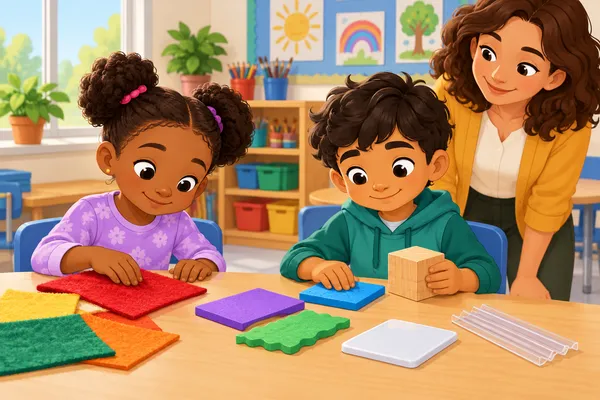
Notice the Properties
Read the art room notes. Use them to answer each question. You may look back at the notes at any time.
Art Room Sample Notes
Nia and Omar are choosing materials for a classroom collage. Their teacher checks six samples for safe handling. The children look at each sample's color and gently feel its texture. They press each sample the same gentle way to check hardness. A soft sample dents under the press; a hard sample does not. Then they gently try to bend each sample to check flexibility. They do not force any sample to bend. They use the same tests for every sample and record what happens.
Sample A: Red felt. Fuzzy texture. Soft. Bends easily.
Sample B: Blue felt. Fuzzy texture. Soft. Bends easily.
Sample C: Yellow craft foam. Smooth texture. Soft. Bends easily.
Sample D: Red plastic tile. Smooth texture. Hard. Does not bend in the gentle test.
Sample E: Blue wooden block. Rough texture. Hard. Does not bend in the gentle test.
Sample F: Yellow plastic strip. Smooth texture. Hard. Bends easily.
- Sample A: felt
- Sample C: craft foam
- Sample E: wooden block
- A. Rough
- B. Fuzzy
- C. Smooth
- A. Sample B: blue felt
- B. Sample D: red plastic tile
- C. Sample E: blue wooden block
- D. Sample F: yellow plastic strip
The preview shows the first questions. Unlock the worksheet to see all of it.
Related worksheets
 Worksheet
Grade 2
The Bridge Walkway Material Journal
Physical Science · 2-PS1-1
Premium16 questions
 Worksheet
Grade 2
Materials for the Mountain Weather Station
Physical Science · 2-PS1-1
Premium14 questions
 Worksheet
Grade 2
Sorting Samples at the Rocky Coast Lighthouse
Physical Science · 2-PS1-1
Premium15 questions
 Worksheet
Grade 2
Predicting the Playground Treasure Sort
Physical Science · 2-PS1-1
Premium14 questions
 Worksheet
Grade 2
Material Choices at the City Key Shop
Physical Science · 2-PS1-1
Free13 questions
 Worksheet
Grade 2
Sorting the School Garden Scarecrow Basket
Physical Science · 2-PS1-1
Premium13 questions