
Worksheet
Trains for People and Goods
Grade 1 reading practice: compare two short texts about trains, one on passenger trains and one on freight trains, to see how they are alike and different.
Grade 1ELAInteractive · Printable
Aligned toRI.1.9
What’s included
- Single worksheet
- Auto-graded online
- 1 Common Core standard
- Printable answer key
- 9 questions
- Classroom-ready
Details
- Format
- Interactive · Printable
- Grade
- Grade 1
- Subject
- ELA
- Question types
- Fill in the blank, Multiple choice, Circle the answer, Sorting, Short answer
About this worksheet
What students practice
- Students tell how two texts on the same topic are alike.
- Students tell how two texts on the same topic are different.
How to use
Read both texts aloud and ask what each one tells about trains. Then let students sort the details and answer the questions, rereading either text as needed.
Curriculum
Common Core standard covered
Tell how two texts on the same topic are alike and different, for example in their illustrations, descriptions, or steps.
Preview
OwlSheets.com
Trains for People and Goods
Compare two texts about trains.
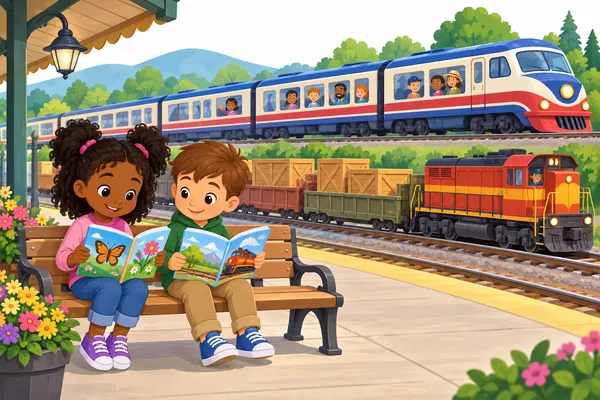
Read two texts
Read both texts. Think about how they are alike and how they are different.
Text A: Trains That Carry People
Some trains carry people. A passenger train has cars with seats and big windows. An engine at the front pulls the cars along the tracks. Riders sit down and look outside as the train rolls past towns and fields. The train stops at stations so people can get on and off. Many people ride a train to go to school, go to work, or visit family.
Text B: Trains That Carry Goods
Some trains carry goods. Goods are things like grain, coal and boxes. This kind of train is called a freight train. A freight train has no seats for riders. Workers load the goods into the cars. An engine at the front pulls the cars along the tracks. The train rolls past towns and fields to bring the goods to a new place.
Alike and different
Compare Text A and Text B.
- A. Trains
- B. Buses
- C. Boats
- D. Planes
- A. Both tell about riders who look out of windows.
- B. Both tell about an engine that pulls the cars.
- C. Both tell about workers who load the cars.
- D. Both tell about trains that stop at stations.
- A. Text A is about trains with engines. Text B is about trains with no engines.
- B. Text A is about trains on tracks. Text B is about trains on roads.
- C. Text A is about trains for people. Text B is about trains for goods.
- D. Text A is about old trains. Text B is about new trains.
| Only Text A | Only Text B | Both texts |
|---|---|---|
Text A tells about trains that carry . Text B tells about trains that carry .
A passenger train has cars with seats and big windows.An engine at the front pulls the cars along the tracks.Riders sit down and look outside as the train rolls past towns and fields.The train stops at stations so people can get on and off.
- A. A train stops at stations.
- B. An engine pulls the cars.
- C. Riders look out of big windows.
- D. Workers load goods into the cars.
- A. Text A
- B. Text B
- C. Neither text
Related worksheets
 Worksheet
Grade 1
Deer in Summer and Winter
Reading: Informational Text · RI.1.9
Premium10 questions
 Worksheet
Grade 1
Two Ways to Make Oatmeal
Reading: Informational Text · RI.1.9
Premium10 questions
 Worksheet
Grade 1
A Lobster's Shell and Claws
Reading: Informational Text · RI.1.7
Premium9 questions
 Worksheet
Grade 1
All About Alpacas
Reading: Informational Text · RI.1.2
Premium9 questions
 Worksheet
Grade 1
Swans on the Lake
Reading: Informational Text · RI.1.2
Premium10 questions
 Worksheet
Grade 1
Gorilla Families: Pictures and Words
Reading: Informational Text · RI.1.7
Premium10 questions