
Worksheet
Rose's One-Room School Letter
Read a letter from 1910 and study an artifact, an old photograph and a family story to learn about school long ago.
Grade 1Social StudiesInteractive · Printable
Aligned toHIS.1.4
What’s included
- Single worksheet
- Auto-graded online
- 1 C3 Framework standard
- Printable answer key
- 14 questions
- Classroom-ready
Details
- Format
- Interactive · Printable
- Grade
- Grade 1
- Subject
- Social Studies
- Question types
- Fill in the blank, Multiple choice, Circle the answer, Short answer
About this worksheet
What students practice
- Students use an artifact, old photograph and family story as clues about life in the past.
- Students make careful claims about a past school using evidence from several sources.
How to use
Read the letter and clue cards aloud. Ask students to point to the source that supports each answer before they write.
Curriculum
C3 Framework standard covered
Use artifacts, old photographs and stories to learn how people lived in the past.
Preview
OwlSheets.com
Rose's One-Room School Letter
Use old clues to learn about school long ago.
Read Rose's letter
Listen as your teacher reads the letter. Then answer the questions.
A Letter from 1910
Letter, October 12, 1910
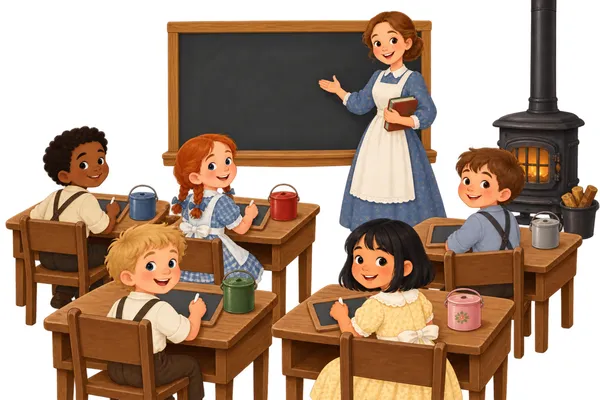
Dear Aunt May, Our school is a little building with one room. Miss Bell writes our lessons on a chalkboard. I carry a slate and a small slate pencil.
At recess, we play outside. At noon, I eat the lunch I brought from home. A black wood stove keeps the room warm.
Your niece, Rose
Artifact card:A small slate board has a wooden frame. A child could write on it and wipe it clean.
Old photograph card:Children sit at desks. A teacher stands near a chalkboard, and a wood stove is in the corner.
Family story card:Rose's granddaughter says Rose remembered older students helping younger children read. She also remembered that children brought lunches from home.
- A. Writing and wiping away schoolwork
- B. Keeping the school room warm
- C. Carrying lunch from home
- D. Calling children in from recess
- A. Children played outside at recess.
- B. Children brought food from home.
- C. Children sat at desks in the room.
- D. Miss Bell wrote on a chalkboard.
Rose wrote the letter in the year .
She carried a slate.She rode a train to school.She bought lunch at school.She ate lunch from home.
- A. The school had a wood stove.
- B. Older students helped younger readers.
- C. Miss Bell taught every subject outside.
- D. Rose wrote all lessons on paper.
Use the clues
Use details from the letter and the three clue cards.
- A. Students used computers for lessons.
- B. Students did all their work outside.
- C. Students shared one large lunch.
- D. Students could write and erase schoolwork.
Rose went to a one-room school.Every school in 1910 looked the same.Rose used a computer to write.Older students sometimes helped younger readers.
- A. School lunches were the same for every child.
- B. All children in the country used slates.
- C. Some children at that school used slates and brought lunch.
- D. Children did not learn to read at that time.
- A. Each source can give a different detail.
- B. One source can tell us about every school.
- C. The photograph tells us who wrote the letter.
- D. The artifact tells us what every child ate.
Rose went to a school.
- A. No schools had desks in 1910.
- B. Rose's school had no lessons.
- C. Every child in 1910 carried a slate.
- D. Rose's school had one room and used slates.
- A. The old photograph
- B. The family story
- C. Rose's lunch
- D. The year on the letter
- A. The artifact card
- B. The family story card
- C. The old photograph card
- D. The date on the letter
Related worksheets
 Worksheet
Grade 1
Elena's Cable Car Letter
History · HIS.1.4
Premium15 questions
 Worksheet
Grade 1
Laundry Clues: Then and Now
History · HIS.1.4
Premium15 questions
 Worksheet
Grade 1
Bessie's Flight Through Time
History · HIS.1.1
Premium15 questions
 Worksheet
Grade 1
Luis's Repair Shop Timeline
History · HIS.1.1
Premium14 questions
 Worksheet
Grade 1
Jane Addams: A Life of Helping
History · HIS.1.3
Premium15 questions
 Worksheet
Grade 1
History Hall: Then and Now
History · HIS.1.3
Premium15 questions