
WorksheetPremium
Family Patterns Under the Planetarium Sky
Use planetarium animal-show observations to find patterns in how penguin and meerkat parents and young respond to changes.
Grade 1ScienceInteractive · Printable
Aligned to1-LS1-2
Or unlock every Premium worksheet with Premium
What’s included
- Single worksheet
- Auto-graded online
- 1 NGSS standard
- Printable answer key
- 15 questions
- Classroom-ready
Details
- Format
- Interactive · Printable
- Grade
- Grade 1
- Subject
- Science
- Question types
- Fill in the blank, Multiple choice, Matching, Circle the answer, Sorting, Short answer
About this worksheet
What students practice
- Students identify repeated patterns in how animal parents and young behave.
- Students explain how parent-and-young behavior can help young animals survive.
- Students use observations to predict what an animal parent or young animal may do next.
How to use
Read the planetarium notes aloud. Ask students to point to an observation that supports each answer, and accept dictated sentences for written responses.
Curriculum
NGSS standard covered
Find patterns in how parents and their young behave that help the young survive.
Preview
OwlSheets.com
Family Patterns Under the Planetarium Sky
Use animal observations to find patterns that help young animals survive.
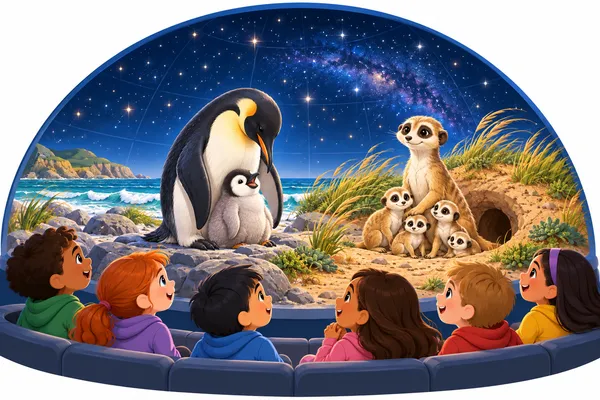
Notes from the animal dome
Listen to the planetarium notes. Use the observations to answer the questions.
The Starry Animal Dome
1A class watched two short animal clips in the planetarium's Starry Animal Dome. They watched a penguin family and a meerkat family. Each family was shown in two clips.
2In both penguin clips, an adult penguin returned from the sea. The chick peeped and walked toward the adult. The adult fed the chick. In one clip, strong wind began. The adult turned toward the wind, and the chick stepped behind the adult. When the wind stopped, the chick came out.
3In both meerkat clips, pups played near their burrow. When a hawk's shadow appeared, a parent gave an alarm call. The pups ran into the burrow. When the shadow was gone, the parent gave a softer call. The pups came out and stayed close to the parent.
4The class wrote down what changed, what happened next, and how the parent and young acted together.
- A. The chick began to peep.
- B. The adult returned from the sea.
- C. Strong wind began to blow.
- D. The wind stopped blowing.
The adult penguin turned toward the wind, and the chick stepped behind it.The penguin adult returned from the sea.A meerkat parent gave an alarm call, and the pups ran into the burrow.The pups played near their burrow.
The preview shows the first questions. Unlock the worksheet to see all of it.
Related worksheets
 Worksheet
Grade 1
Wildlife Clues at the Ski Lodge
Life Science · 1-LS1-2
Premium15 questions
 Worksheet
Grade 1
Family Patterns by the Bike Shop
Life Science · 1-LS1-2
Premium15 questions
 Worksheet
Grade 1
Animal Families at Aspen Turn
Life Science · 1-LS1-2
Premium14 questions
 Worksheet
Grade 1
Pup Care at Shell Point
Life Science · 1-LS1-2
Premium14 questions
 Worksheet
Grade 1
Kitten Care at the Winter Rescue
Life Science · 1-LS1-2
Premium10 questions
 Worksheet
Grade 1
Mother and Foal Watch
Life Science · 1-LS1-2
Premium13 questions