Grade 7 · Social StudiesGEO.7.1Premium
Rain, Frost and Planting Time: Climate Data for Three Homelands
Grade 7 geography: rainfall and height data for the Petén, the Valley of Mexico and Cusco explain milpas, chinampas, terraces and chuño.
Preview
OwlSheets.com
Rain, Frost and Planting Time: Climate Data for Three Homelands
Read rainfall and height data to explain how Maya, Mexica and Inca farmers adapted to and changed their lands.
Three homelands
Read the passage. Then answer the questions. You will need the table in the next section for question 3.
Farming with the Rain
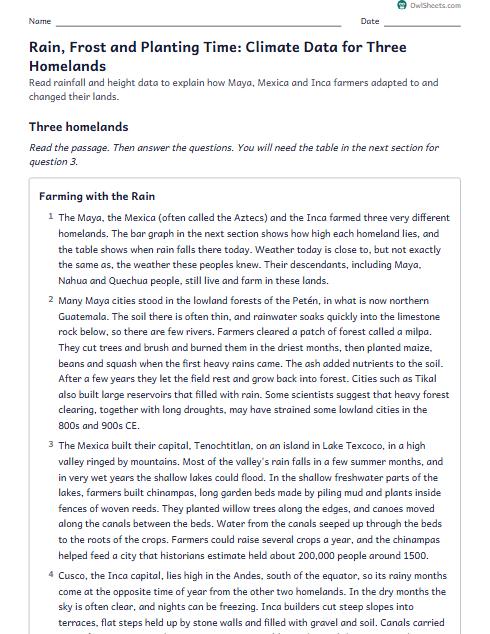
1The Maya, the Mexica (often called the Aztecs) and the Inca farmed three very different homelands. The bar graph in the next section shows how high each homeland lies, and the table shows when rain falls there today. Weather today is close to, but not exactly the same as, the weather these peoples knew. Their descendants, including Maya, Nahua and Quechua people, still live and farm in these lands.
2Many Maya cities stood in the lowland forests of the Petén, in what is now northern Guatemala. The soil there is often thin, and rainwater soaks quickly into the limestone rock below, so there are few rivers. Farmers cleared a patch of forest called a milpa. They cut trees and brush and burned them in the driest months, then planted maize, beans and squash when the first heavy rains came. The ash added nutrients to the soil. After a few years they let the field rest and grow back into forest. Cities such as Tikal also built large reservoirs that filled with rain. Some scientists suggest that heavy forest clearing, together with long droughts, may have strained some lowland cities in the 800s and 900s CE.
3The Mexica built their capital, Tenochtitlan, on an island in Lake Texcoco, in a high valley ringed by mountains. Most of the valley's rain falls in a few summer months, and in very wet years the shallow lakes could flood. In the shallow freshwater parts of the lakes, farmers built chinampas, long garden beds made by piling mud and plants inside fences of woven reeds. They planted willow trees along the edges, and canoes moved along the canals between the beds. Water from the canals seeped up through the beds to the roots of the crops. Farmers could raise several crops a year, and the chinampas helped feed a city that historians estimate held about 200,000 people around 1500.
4Cusco, the Inca capital, lies high in the Andes, south of the equator, so its rainy months come at the opposite time of year from the other two homelands. In the dry months the sky is often clear, and nights can be freezing. Inca builders cut steep slopes into terraces, flat steps held up by stone walls and filled with gravel and soil. Canals carried water from streams to the terraces so crops could grow beyond the rainy months. Families planted many kinds of potatoes, and some kinds could survive frost. They also made chuño by leaving potatoes outside on freezing nights, pressing out the water and drying them in the sun, and chuño could be stored for years.
- A. The ash had to wash away before planting could start.
- B. Maize grows best when it is planted in the driest months.
- C. Cut brush dries out and burns well when little rain falls.
- D. Burning in dry months made the rainy season start sooner.
- A. The canals around the bed kept its soil wet from below.
- B. Winter is the wettest season in the Valley of Mexico.
- C. The willow trees shaded the bed so it never dried out.
- D. He burned the bed each winter to add ash to the soil.
The preview shows the first questions. Unlock the worksheet to see all of it.
Related worksheets
Plazas, Lake Fields and Stone Steps: Dispatches from Tikal, Mixquic and Pisac
Grade 7 · GEO.7.1
14 questionsPremium
Aqueducts, Famine and Floods: Shaping Three Homelands
Grade 7 · GEO.7.1
14 questionsPremium
Staircase Fields and Bird Islands: Garcilaso on Inca Farming
Grade 7 · GEO.7.1
14 questionsPremium
Forest Farmers or Land Builders? Two Views of the Maya
Grade 7 · GEO.7.1
14 questionsPremium
Canals, Chinampas and Channels: An Archaeologist's Notebook
Grade 7 · GEO.7.1
12 questionsPremium
Five Stops in Maya Lands: Hills, Swamps and Wells
Grade 7 · GEO.7.1
11 questionsPremium