Grade 7 · Social StudiesGEO.7.1Premium
Aqueducts, Famine and Floods: Shaping Three Homelands
Grade 7 geography: a timeline from Maya reservoirs to Mexica aqueducts and Inca terraces shows how three peoples adapted to and changed their lands.
Preview
OwlSheets.com
Aqueducts, Famine and Floods: Shaping Three Homelands
Use a dated timeline to see how the Maya, Mexica and Inca adapted to their lands and changed them.
Three homelands
Read the passage. Then answer the questions.
Water, Slopes and Frost
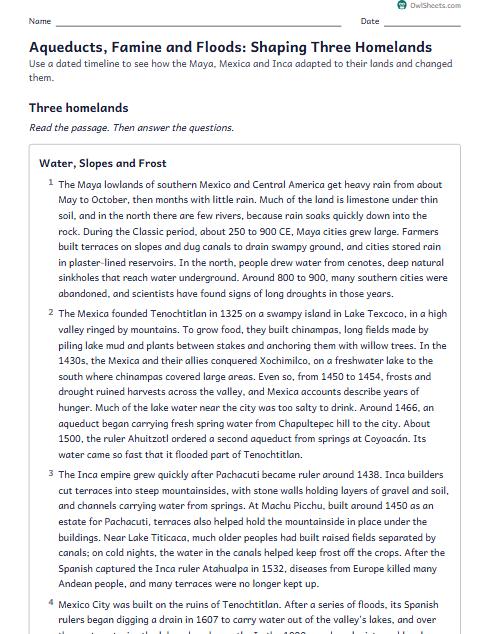
1The Maya lowlands of southern Mexico and Central America get heavy rain from about May to October, then months with little rain. Much of the land is limestone under thin soil, and in the north there are few rivers, because rain soaks quickly down into the rock. During the Classic period, about 250 to 900 CE, Maya cities grew large. Farmers built terraces on slopes and dug canals to drain swampy ground, and cities stored rain in plaster-lined reservoirs. In the north, people drew water from cenotes, deep natural sinkholes that reach water underground. Around 800 to 900, many southern cities were abandoned, and scientists have found signs of long droughts in those years.
2The Mexica founded Tenochtitlan in 1325 on a swampy island in Lake Texcoco, in a high valley ringed by mountains. To grow food, they built chinampas, long fields made by piling lake mud and plants between stakes and anchoring them with willow trees. In the 1430s, the Mexica and their allies conquered Xochimilco, on a freshwater lake to the south where chinampas covered large areas. Even so, from 1450 to 1454, frosts and drought ruined harvests across the valley, and Mexica accounts describe years of hunger. Much of the lake water near the city was too salty to drink. Around 1466, an aqueduct began carrying fresh spring water from Chapultepec hill to the city. About 1500, the ruler Ahuitzotl ordered a second aqueduct from springs at Coyoacán. Its water came so fast that it flooded part of Tenochtitlan.
3The Inca empire grew quickly after Pachacuti became ruler around 1438. Inca builders cut terraces into steep mountainsides, with stone walls holding layers of gravel and soil, and channels carrying water from springs. At Machu Picchu, built around 1450 as an estate for Pachacuti, terraces also helped hold the mountainside in place under the buildings. Near Lake Titicaca, much older peoples had built raised fields separated by canals; on cold nights, the water in the canals helped keep frost off the crops. After the Spanish captured the Inca ruler Atahualpa in 1532, diseases from Europe killed many Andean people, and many terraces were no longer kept up.
4Mexico City was built on the ruins of Tenochtitlan. After a series of floods, its Spanish rulers began digging a drain in 1607 to carry water out of the valley's lakes, and over the next centuries the lakes shrank greatly. In the 1980s, archaeologists and local farmers near Lake Titicaca rebuilt some of the old raised fields and found that they still protected crops from frost.
- A. A spring fed by snow melting on nearby mountains
- B. A reservoir the Maya dug and lined to hold river water
- C. A canal the Maya dug to drain water from a swamp
- D. A cenote that reaches water soaked down through the rock
- A. Its salty lake could be drained to make dry farmland.
- B. Its steep slopes were ready to be cut into terraces.
- C. Its many chinampas could grow food for Tenochtitlan.
- D. Its springs could fill the aqueduct from Chapultepec.
The preview shows the first questions. Unlock the worksheet to see all of it.
Related worksheets
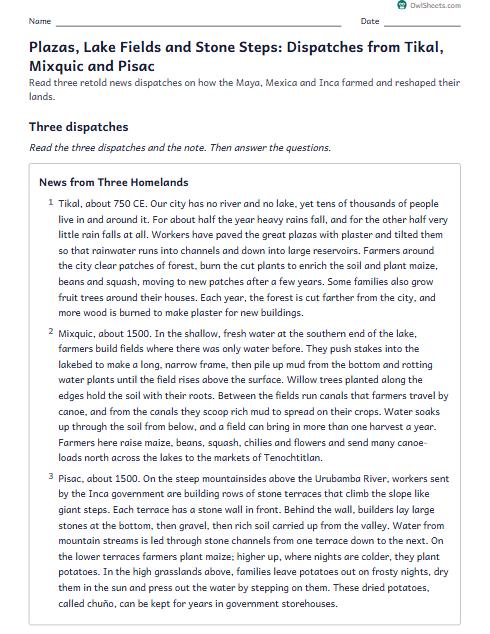
Plazas, Lake Fields and Stone Steps: Dispatches from Tikal, Mixquic and Pisac
Grade 7 · GEO.7.1
14 questionsPremium
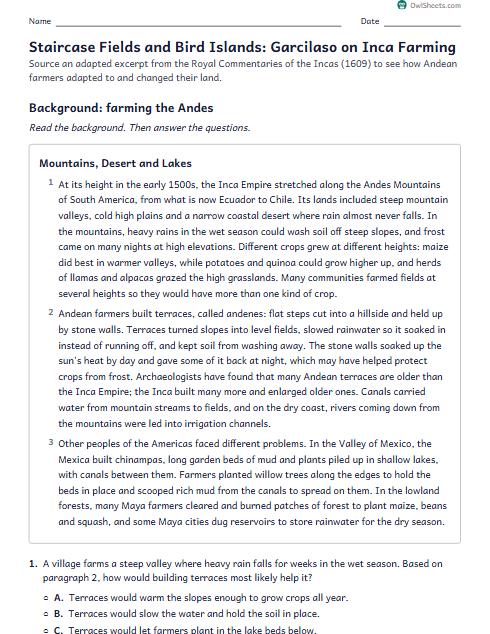
Staircase Fields and Bird Islands: Garcilaso on Inca Farming
Grade 7 · GEO.7.1
14 questionsPremium
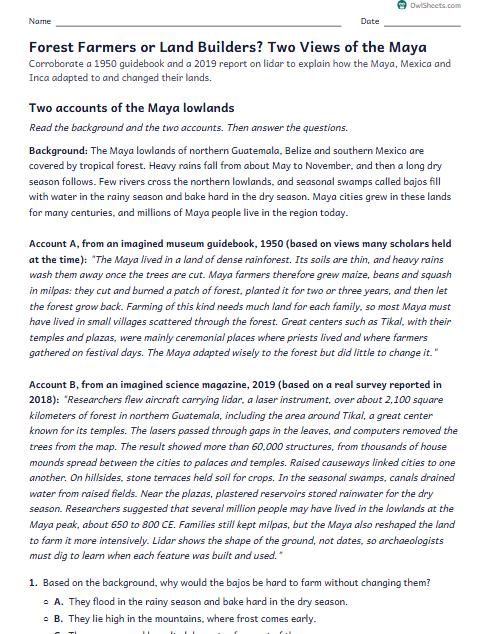
Forest Farmers or Land Builders? Two Views of the Maya
Grade 7 · GEO.7.1
14 questionsPremium
Rain, Frost and Planting Time: Climate Data for Three Homelands
Grade 7 · GEO.7.1
14 questionsPremium
Canals, Chinampas and Channels: An Archaeologist's Notebook
Grade 7 · GEO.7.1
12 questionsPremium
Five Stops in Maya Lands: Hills, Swamps and Wells
Grade 7 · GEO.7.1
11 questionsPremium