Grade 7 · Social StudiesHIS.7.5Premium
From Abbey Lists to Plague Fields: A Historian's Notes Across France
Grade 7 history: field notes from four French sites trace feudal bonds, manor duties, a crusade port and the Black Death in Avignon.
Preview
OwlSheets.com
From Abbey Lists to Plague Fields: A Historian's Notes Across France
Follow field notes from Paris, Coucy, Aigues-Mortes and Avignon to see how medieval society changed.
Read the field notes
Read the historian's field notes and the graph. Then answer the questions.
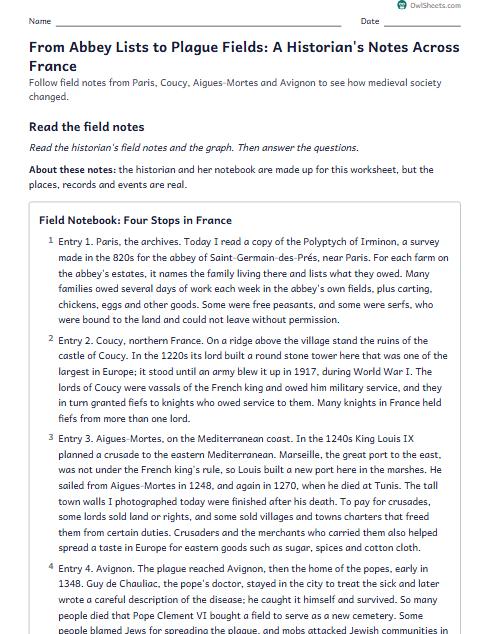
Field Notebook: Four Stops in France
1Entry 1. Paris, the archives. Today I read a copy of the Polyptych of Irminon, a survey made in the 820s for the abbey of Saint-Germain-des-Prés, near Paris. For each farm on the abbey's estates, it names the family living there and lists what they owed. Many families owed several days of work each week in the abbey's own fields, plus carting, chickens, eggs and other goods. Some were free peasants, and some were serfs, who were bound to the land and could not leave without permission.
2Entry 2. Coucy, northern France. On a ridge above the village stand the ruins of the castle of Coucy. In the 1220s its lord built a round stone tower here that was one of the largest in Europe; it stood until an army blew it up in 1917, during World War I. The lords of Coucy were vassals of the French king and owed him military service, and they in turn granted fiefs to knights who owed service to them. Many knights in France held fiefs from more than one lord.
3Entry 3. Aigues-Mortes, on the Mediterranean coast. In the 1240s King Louis IX planned a crusade to the eastern Mediterranean. Marseille, the great port to the east, was not under the French king's rule, so Louis built a new port here in the marshes. He sailed from Aigues-Mortes in 1248, and again in 1270, when he died at Tunis. The tall town walls I photographed today were finished after his death. To pay for crusades, some lords sold land or rights, and some sold villages and towns charters that freed them from certain duties. Crusaders and the merchants who carried them also helped spread a taste in Europe for eastern goods such as sugar, spices and cotton cloth.
4Entry 4. Avignon. The plague reached Avignon, then the home of the popes, early in 1348. Guy de Chauliac, the pope's doctor, stayed in the city to treat the sick and later wrote a careful description of the disease; he caught it himself and survived. So many people died that Pope Clement VI bought a field to serve as a new cemetery. Some people blamed Jews for spreading the plague, and mobs attacked Jewish communities in several cities. Clement issued orders saying that Jews were not to blame, since they were dying of the plague too.
5Entry 5. Avignon, the numbers. Historians estimate that Europe lost about a third of its people between 1347 and 1351 (see the graph). The plague did not go away. It came back again and again over the next hundred years.
6Entry 6. Thinking about what changed. In the decades after 1348, so many workers had died that many lords in France struggled to farm their own fields. Surviving peasants could move to manors that offered better terms. Many lords turned weekly work duties into rents paid in money, and serfdom slowly faded in much of France. Anger over taxes and the damage of war also boiled over in 1358, when peasants in northern France rose in a revolt called the Jacquerie.
The preview shows the first questions. Unlock the worksheet to see all of it.
Related worksheets
The Paris Herald, 1348: Doctors, Knights and Empty Fields
Grade 7 · HIS.7.5
13 questionsPremium
A Banner, a Charter and a Wage Law: A Gallery of Medieval Castile
Grade 7 · HIS.7.5
14 questionsPremium
Counting England, 1086–1450: Domesday, Crusade Taxes and the Plague
Grade 7 · HIS.7.5
14 questionsPremium
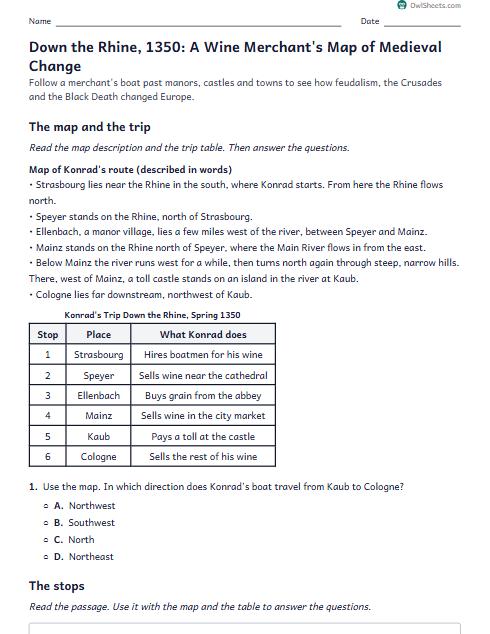
Down the Rhine, 1350: A Wine Merchant's Map of Medieval Change
Grade 7 · HIS.7.5
14 questionsPremium
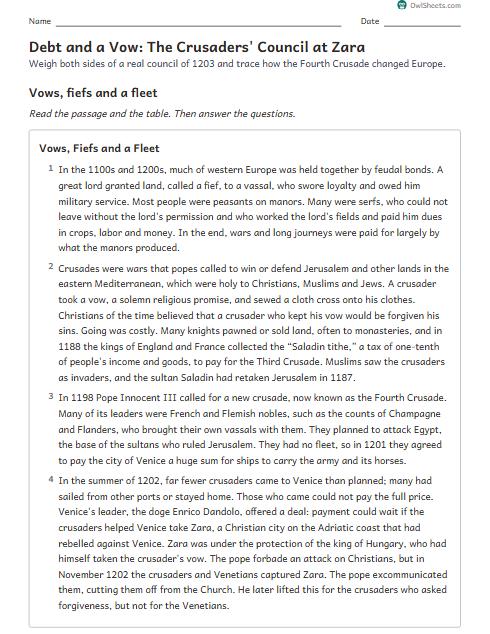
Debt and a Vow: The Crusaders' Council at Zara
Grade 7 · HIS.7.5
12 questionsPremium
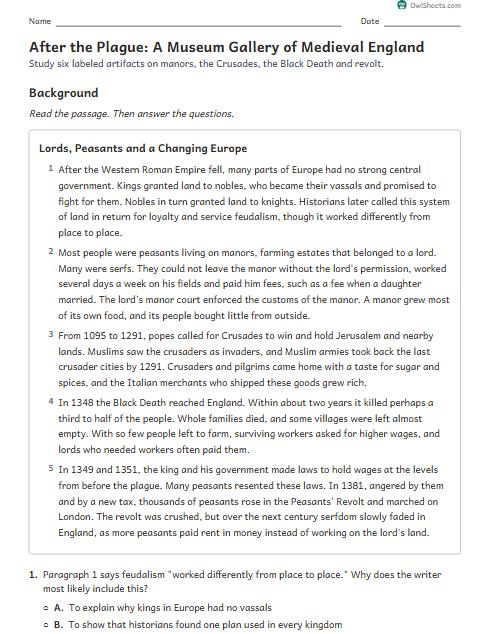
After the Plague: A Museum Gallery of Medieval England
Grade 7 · HIS.7.5
11 questionsFree