Grade 7 · Social StudiesHIS.7.5Premium
A Banner, a Charter and a Wage Law: A Gallery of Medieval Castile
Grade 7 history: seven gallery cases from medieval Castile, from a frontier charter to a plague-year wage law, show feudalism, crusades and the Black Death.
Preview
OwlSheets.com
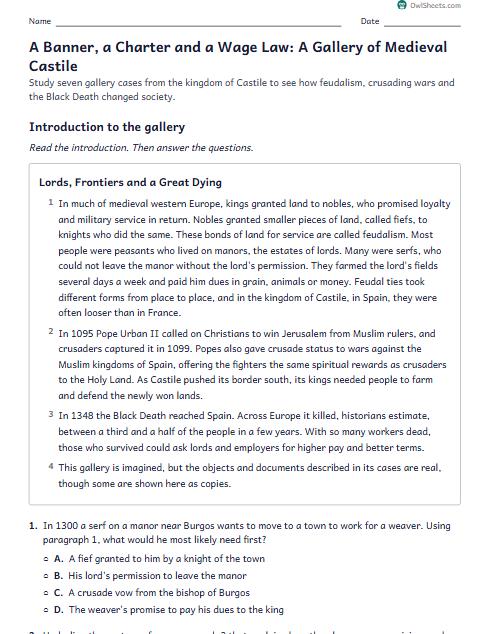
A Banner, a Charter and a Wage Law: A Gallery of Medieval Castile
Study seven gallery cases from the kingdom of Castile to see how feudalism, crusading wars and the Black Death changed society.
Introduction to the gallery
Read the introduction. Then answer the questions.
Lords, Frontiers and a Great Dying
1In much of medieval western Europe, kings granted land to nobles, who promised loyalty and military service in return. Nobles granted smaller pieces of land, called fiefs, to knights who did the same. These bonds of land for service are called feudalism. Most people were peasants who lived on manors, the estates of lords. Many were serfs, who could not leave the manor without the lord's permission. They farmed the lord's fields several days a week and paid him dues in grain, animals or money. Feudal ties took different forms from place to place, and in the kingdom of Castile, in Spain, they were often looser than in France.
2In 1095 Pope Urban II called on Christians to win Jerusalem from Muslim rulers, and crusaders captured it in 1099. Popes also gave crusade status to wars against the Muslim kingdoms of Spain, offering the fighters the same spiritual rewards as crusaders to the Holy Land. As Castile pushed its border south, its kings needed people to farm and defend the newly won lands.
3In 1348 the Black Death reached Spain. Across Europe it killed, historians estimate, between a third and a half of the people in a few years. With so many workers dead, those who survived could ask lords and employers for higher pay and better terms.
4This gallery is imagined, but the objects and documents described in its cases are real, though some are shown here as copies.
- A. A fief granted to him by a knight of the town
- B. His lord's permission to leave the manor
- C. A crusade vow from the bishop of Burgos
- D. The weaver's promise to pay his dues to the king
In 1348 the Black Death reached Spain.Across Europe it killed, historians estimate, between a third and a half of the people in a few years.With so many workers dead, those who survived could ask lords and employers for higher pay and better terms.
The preview shows the first questions. Unlock the worksheet to see all of it.
Related worksheets
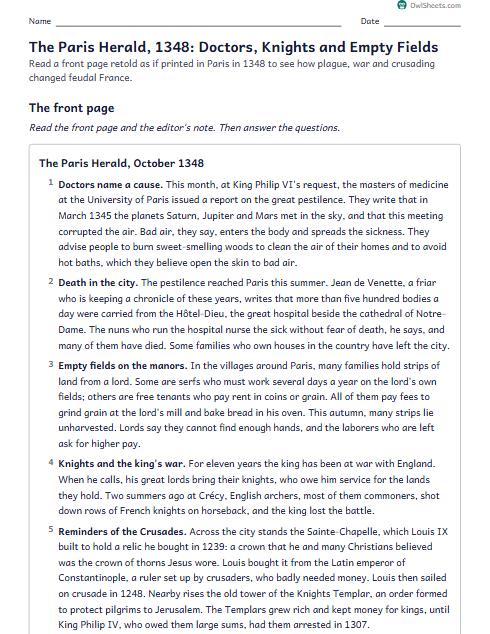
The Paris Herald, 1348: Doctors, Knights and Empty Fields
Grade 7 · HIS.7.5
13 questionsPremium
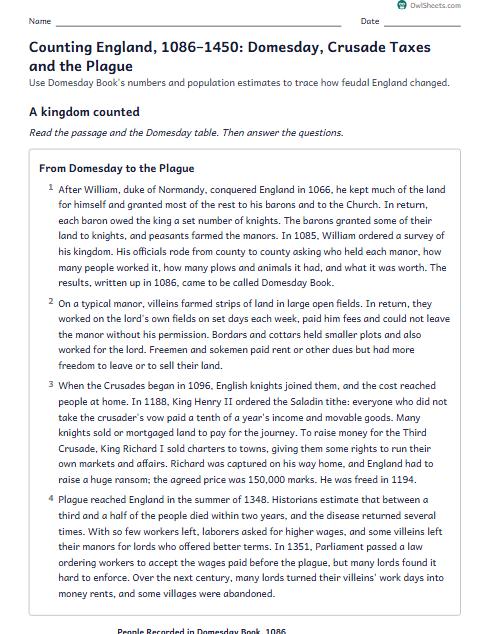
Counting England, 1086–1450: Domesday, Crusade Taxes and the Plague
Grade 7 · HIS.7.5
14 questionsPremium
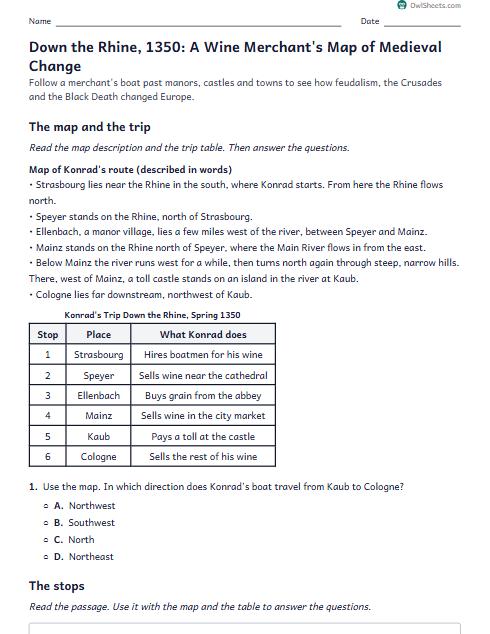
Down the Rhine, 1350: A Wine Merchant's Map of Medieval Change
Grade 7 · HIS.7.5
14 questionsPremium
From Abbey Lists to Plague Fields: A Historian's Notes Across France
Grade 7 · HIS.7.5
14 questionsPremium
Debt and a Vow: The Crusaders' Council at Zara
Grade 7 · HIS.7.5
12 questionsPremium
After the Plague: A Museum Gallery of Medieval England
Grade 7 · HIS.7.5
11 questionsFree