Grade 6 · Social StudiesGEO.6.2Premium
West from Tyre: A Phoenician Voyage to Gadir, About 650 BCE
Grade 6 geography: sail with a Phoenician trading ship from Tyre to Gadir to see how mountains, sea and desert shaped trade, contact and conflict.
Preview
OwlSheets.com
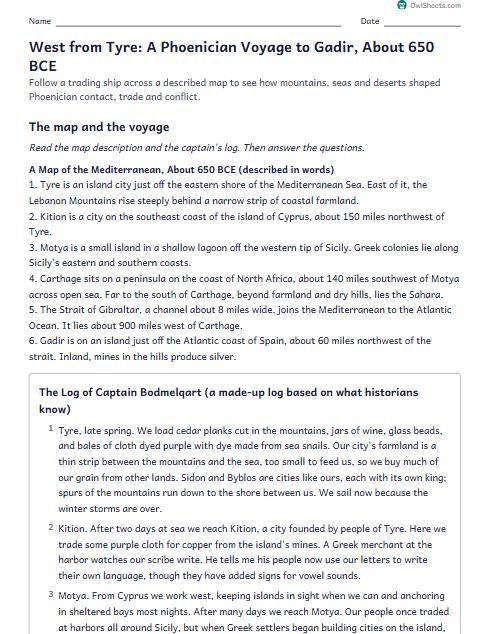
West from Tyre: A Phoenician Voyage to Gadir, About 650 BCE
Follow a trading ship across a described map to see how mountains, seas and deserts shaped Phoenician contact, trade and conflict.
The map and the voyage
Read the map description and the captain's log. Then answer the questions.
1. Tyre is an island city just off the eastern shore of the Mediterranean Sea. East of it, the Lebanon Mountains rise steeply behind a narrow strip of coastal farmland.
2. Kition is a city on the southeast coast of the island of Cyprus, about 150 miles northwest of Tyre.
3. Motya is a small island in a shallow lagoon off the western tip of Sicily. Greek colonies lie along Sicily's eastern and southern coasts.
4. Carthage sits on a peninsula on the coast of North Africa, about 140 miles southwest of Motya across open sea. Far to the south of Carthage, beyond farmland and dry hills, lies the Sahara.
5. The Strait of Gibraltar, a channel about 8 miles wide, joins the Mediterranean to the Atlantic Ocean. It lies about 900 miles west of Carthage.
6. Gadir is on an island just off the Atlantic coast of Spain, about 60 miles northwest of the strait. Inland, mines in the hills produce silver.
The Log of Captain Bodmelqart (a made-up log based on what historians know)
1Tyre, late spring. We load cedar planks cut in the mountains, jars of wine, glass beads, and bales of cloth dyed purple with dye made from sea snails. Our city's farmland is a thin strip between the mountains and the sea, too small to feed us, so we buy much of our grain from other lands. Sidon and Byblos are cities like ours, each with its own king; spurs of the mountains run down to the shore between us. We sail now because the winter storms are over.
2Kition. After two days at sea we reach Kition, a city founded by people of Tyre. Here we trade some purple cloth for copper from the island's mines. A Greek merchant at the harbor watches our scribe write. He tells me his people now use our letters to write their own language, though they have added signs for vowel sounds.
3Motya. From Cyprus we work west, keeping islands in sight when we can and anchoring in sheltered bays most nights. After many days we reach Motya. Our people once traded at harbors all around Sicily, but when Greek settlers began building cities on the island, ours gathered here in the west, where the crossing to Carthage is shortest. Greek and Phoenician ships pass each other warily.
4Carthage. This daughter city of Tyre has grown rich. Its farmers grow grain and olives on the coastal plain. Merchants say that to the south the land turns to dry hills and then to the great desert, where wells are few and far apart. Only small amounts of goods from beyond the desert ever reach the city.
5The strait. For many days we follow the African coast west. At the Pillars of Melqart, which the Greeks call the Pillars of Heracles, the sea narrows to a channel. A strong current pours in from the ocean, so we wait at anchor for a steady east wind to carry us out.
6Gadir. At last we reach Gadir, where our people built a temple to Melqart, the god of Tyre, long ago. Traders from inland bring silver from the hills. We will carry it home to Tyre, where it is worth far more than the wine and cloth we gave for it.
- A. Northwest across open sea
- B. North along the coast of Spain
- C. East over the Lebanon Mountains
- D. Southwest along the coast of Africa
The preview shows the first questions. Unlock the worksheet to see all of it.
Related worksheets
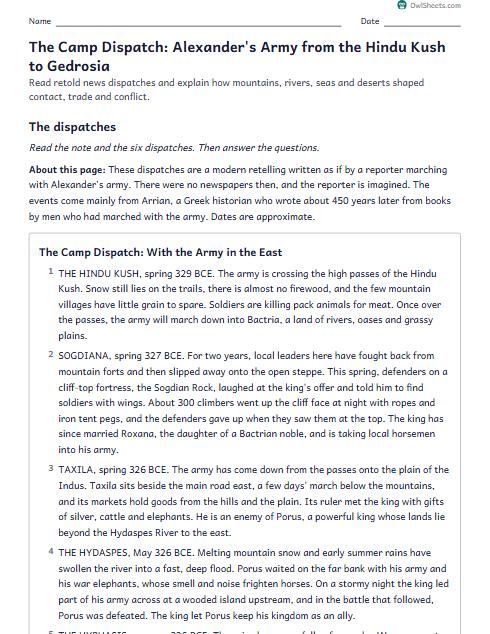
The Camp Dispatch: Alexander's Army from the Hindu Kush to Gedrosia
Grade 6 · GEO.6.2
14 questionsPremium
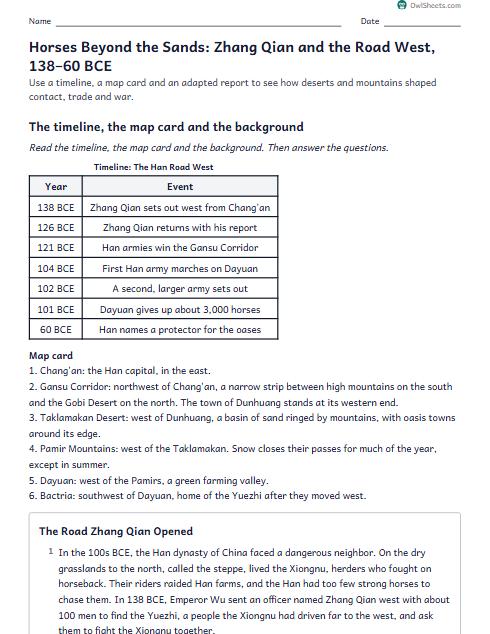
Horses Beyond the Sands: Zhang Qian and the Road West, 138–60 BCE
Grade 6 · GEO.6.2
14 questionsPremium
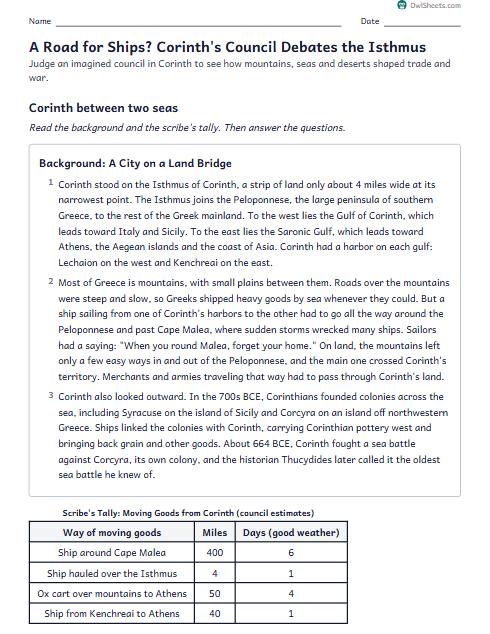
A Road for Ships? Corinth's Council Debates the Isthmus
Grade 6 · GEO.6.2
14 questionsPremium
Passes, Seas and Sands: An Exhibit from Greece to China
Grade 6 · GEO.6.2
13 questionsPremium
The March of the Ten Thousand: Sourcing Xenophon
Grade 6 · GEO.6.2
11 questionsFree
Petra and the Incense Road: Two Accounts That Disagree
Grade 6 · GEO.6.2
10 questionsPremium