Grade 6 · Social StudiesGEO.6.2Premium
Passes, Seas and Sands: An Exhibit from Greece to China
Grade 6 geography: tour six exhibit cases from Greece to Han China to explain how mountains, seas and deserts shaped ancient contact and trade.
Preview
OwlSheets.com
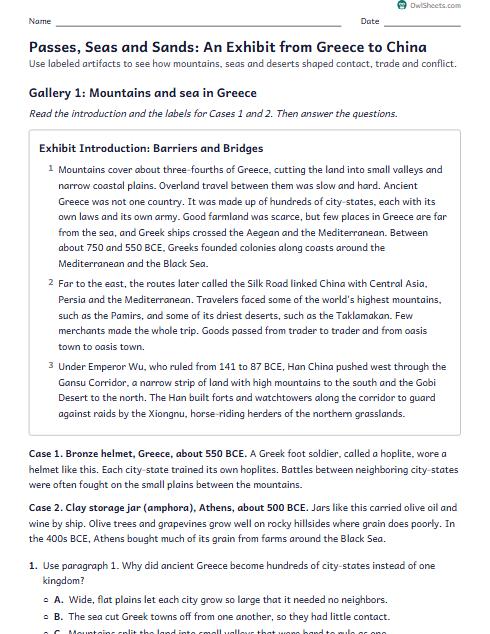
Passes, Seas and Sands: An Exhibit from Greece to China
Use labeled artifacts to see how mountains, seas and deserts shaped contact, trade and conflict.
Gallery 1: Mountains and sea in Greece
Read the introduction and the labels for Cases 1 and 2. Then answer the questions.
Exhibit Introduction: Barriers and Bridges
1Mountains cover about three-fourths of Greece, cutting the land into small valleys and narrow coastal plains. Overland travel between them was slow and hard. Ancient Greece was not one country. It was made up of hundreds of city-states, each with its own laws and its own army. Good farmland was scarce, but few places in Greece are far from the sea, and Greek ships crossed the Aegean and the Mediterranean. Between about 750 and 550 BCE, Greeks founded colonies along coasts around the Mediterranean and the Black Sea.
2Far to the east, the routes later called the Silk Road linked China with Central Asia, Persia and the Mediterranean. Travelers faced some of the world's highest mountains, such as the Pamirs, and some of its driest deserts, such as the Taklamakan. Few merchants made the whole trip. Goods passed from trader to trader and from oasis town to oasis town.
3Under Emperor Wu, who ruled from 141 to 87 BCE, Han China pushed west through the Gansu Corridor, a narrow strip of land with high mountains to the south and the Gobi Desert to the north. The Han built forts and watchtowers along the corridor to guard against raids by the Xiongnu, horse-riding herders of the northern grasslands.
The preview shows the first questions. Unlock the worksheet to see all of it.
Related worksheets
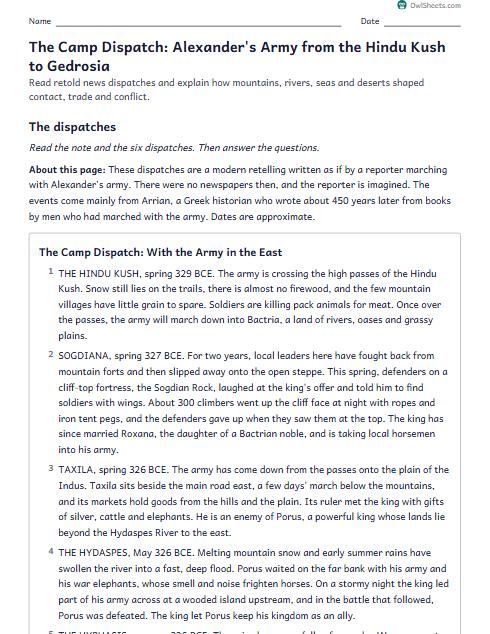
The Camp Dispatch: Alexander's Army from the Hindu Kush to Gedrosia
Grade 6 · GEO.6.2
14 questionsPremium
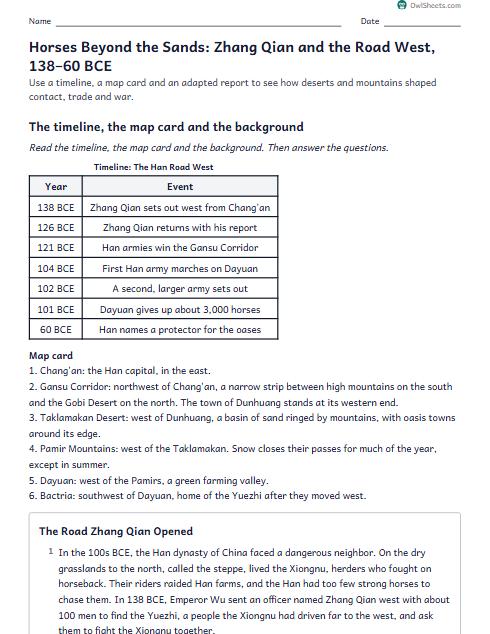
Horses Beyond the Sands: Zhang Qian and the Road West, 138–60 BCE
Grade 6 · GEO.6.2
14 questionsPremium
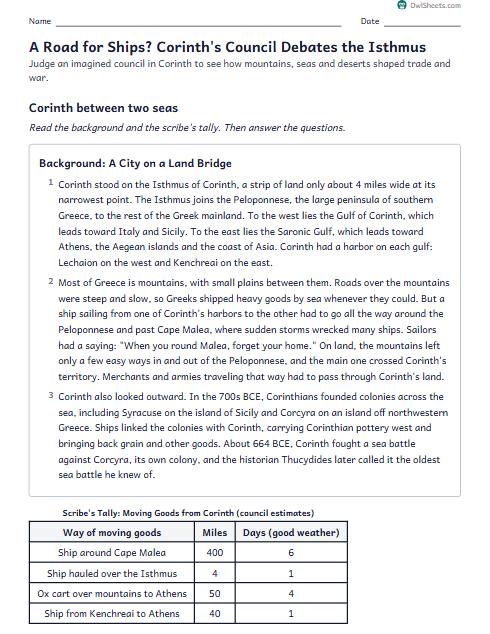
A Road for Ships? Corinth's Council Debates the Isthmus
Grade 6 · GEO.6.2
14 questionsPremium
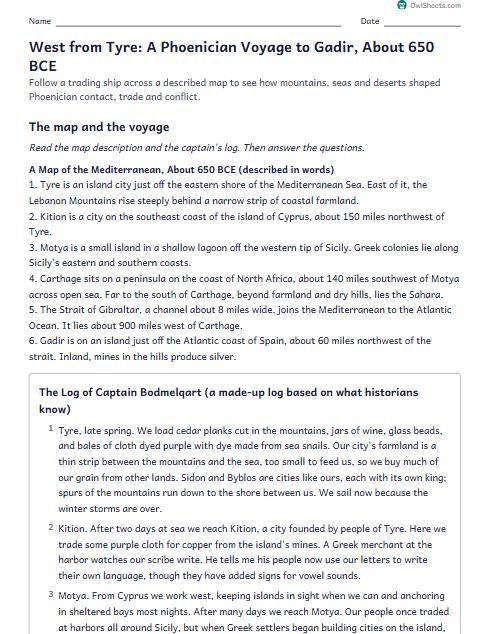
West from Tyre: A Phoenician Voyage to Gadir, About 650 BCE
Grade 6 · GEO.6.2
13 questionsPremium
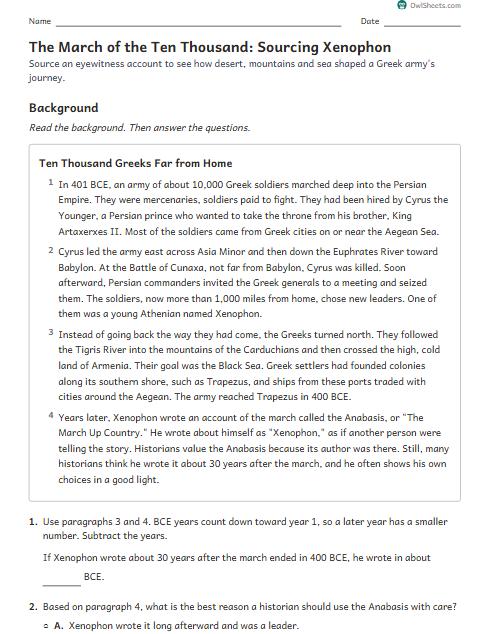
The March of the Ten Thousand: Sourcing Xenophon
Grade 6 · GEO.6.2
11 questionsFree
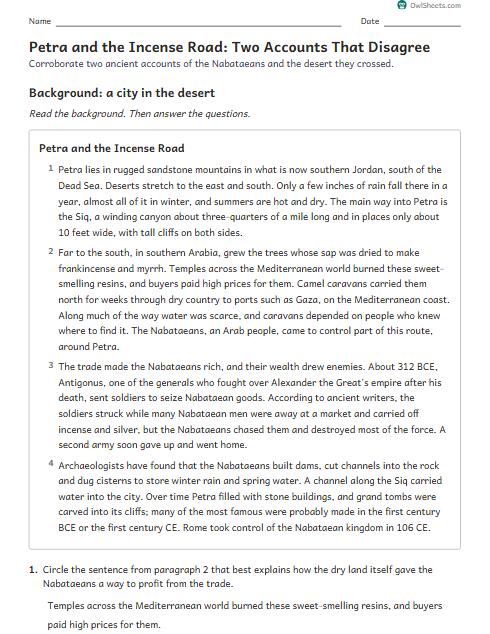
Petra and the Incense Road: Two Accounts That Disagree
Grade 6 · GEO.6.2
10 questionsPremium