Grade 6 · Social StudiesGEO.6.2Premium
The Camp Dispatch: Alexander's Army from the Hindu Kush to Gedrosia
Grade 6 geography: follow retold news dispatches from Alexander's march east and explain how mountains, rivers, seas and deserts shaped contact and conflict.
Preview
OwlSheets.com
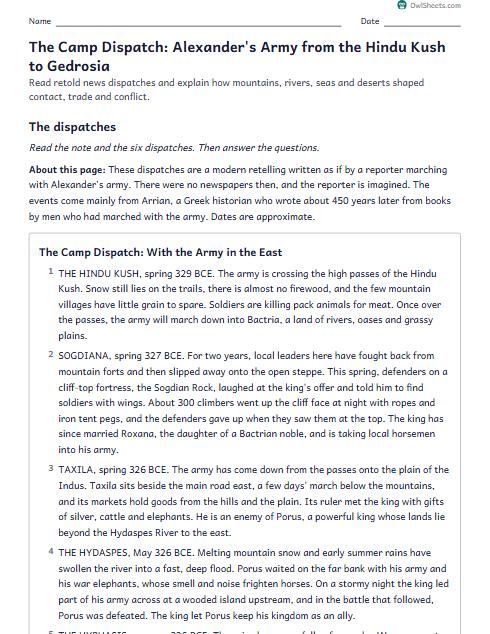
The Camp Dispatch: Alexander's Army from the Hindu Kush to Gedrosia
Read retold news dispatches and explain how mountains, rivers, seas and deserts shaped contact, trade and conflict.
The dispatches
Read the note and the six dispatches. Then answer the questions.
The Camp Dispatch: With the Army in the East
1THE HINDU KUSH, spring 329 BCE. The army is crossing the high passes of the Hindu Kush. Snow still lies on the trails, there is almost no firewood, and the few mountain villages have little grain to spare. Soldiers are killing pack animals for meat. Once over the passes, the army will march down into Bactria, a land of rivers, oases and grassy plains.
2SOGDIANA, spring 327 BCE. For two years, local leaders here have fought back from mountain forts and then slipped away onto the open steppe. This spring, defenders on a cliff-top fortress, the Sogdian Rock, laughed at the king's offer and told him to find soldiers with wings. About 300 climbers went up the cliff face at night with ropes and iron tent pegs, and the defenders gave up when they saw them at the top. The king has since married Roxana, the daughter of a Bactrian noble, and is taking local horsemen into his army.
3TAXILA, spring 326 BCE. The army has come down from the passes onto the plain of the Indus. Taxila sits beside the main road east, a few days' march below the mountains, and its markets hold goods from the hills and the plain. Its ruler met the king with gifts of silver, cattle and elephants. He is an enemy of Porus, a powerful king whose lands lie beyond the Hydaspes River to the east.
4THE HYDASPES, May 326 BCE. Melting mountain snow and early summer rains have swollen the river into a fast, deep flood. Porus waited on the far bank with his army and his war elephants, whose smell and noise frighten horses. On a stormy night the king led part of his army across at a wooded island upstream, and in the battle that followed, Porus was defeated. The king let Porus keep his kingdom as an ally.
5THE HYPHASIS, summer 326 BCE. The rains have now fallen for weeks. Weapons rust, clothes rot, and the soldiers, many years from home, have refused to march farther east, where they hear of kingdoms with even larger armies and thousands of elephants. The king has agreed to turn back.
6THE INDUS DELTA, autumn 325 BCE. The army has come down the Indus to the sea, partly by boat and partly on foot. The admiral Nearchus will take the fleet west along the coast toward Persia once the season's winds turn. The king is leading most of the army overland through Gedrosia, a desert with few wells, though old stories say earlier armies that tried it were nearly wiped out.
- A. The high, snowy passes had few villages and little grain to take.
- B. The king had ordered the army to leave its pack animals behind.
- C. The rivers in the passes were too high for supply boats to use.
- D. Bactrian horsemen had burned the fields beside the mountain trails.
The preview shows the first questions. Unlock the worksheet to see all of it.
Related worksheets
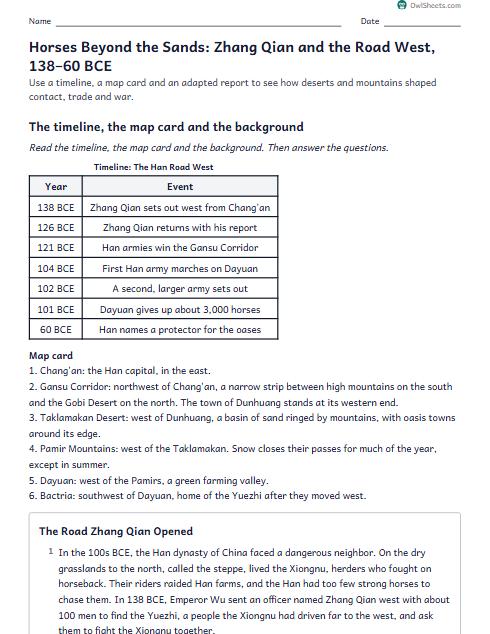
Horses Beyond the Sands: Zhang Qian and the Road West, 138–60 BCE
Grade 6 · GEO.6.2
14 questionsPremium
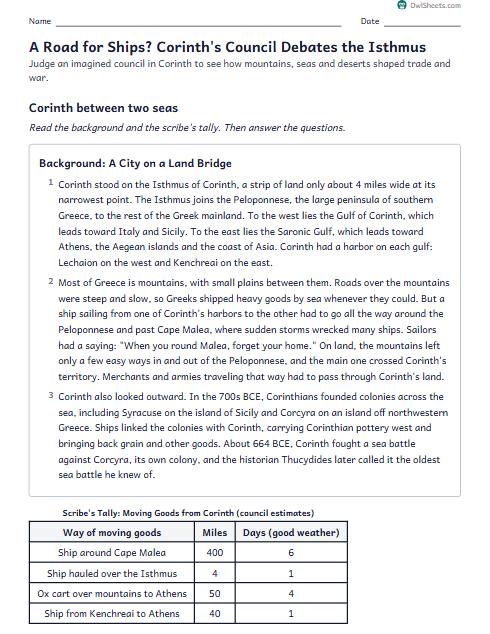
A Road for Ships? Corinth's Council Debates the Isthmus
Grade 6 · GEO.6.2
14 questionsPremium
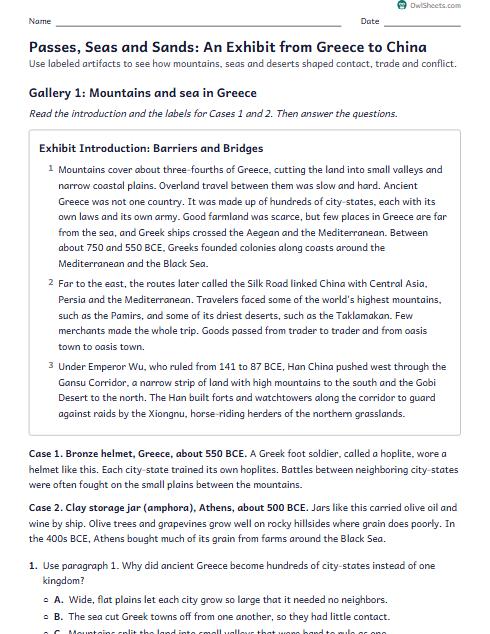
Passes, Seas and Sands: An Exhibit from Greece to China
Grade 6 · GEO.6.2
13 questionsPremium
West from Tyre: A Phoenician Voyage to Gadir, About 650 BCE
Grade 6 · GEO.6.2
13 questionsPremium
The March of the Ten Thousand: Sourcing Xenophon
Grade 6 · GEO.6.2
11 questionsFree
Petra and the Incense Road: Two Accounts That Disagree
Grade 6 · GEO.6.2
10 questionsPremium