Grade 5 · Social StudiesECO.5.4
Following Aldercap's Winter Tax Dollars
Trace how a snowy northern town collects taxes and pays for winter services using a passage, collection records and new situations.
Preview
OwlSheets.com
Following Aldercap's Winter Tax Dollars
Trace money from tax payments to shared winter services.
From Payments to Public Work
Read about the fictional northern town of Aldercap. Use the passage to answer the questions.
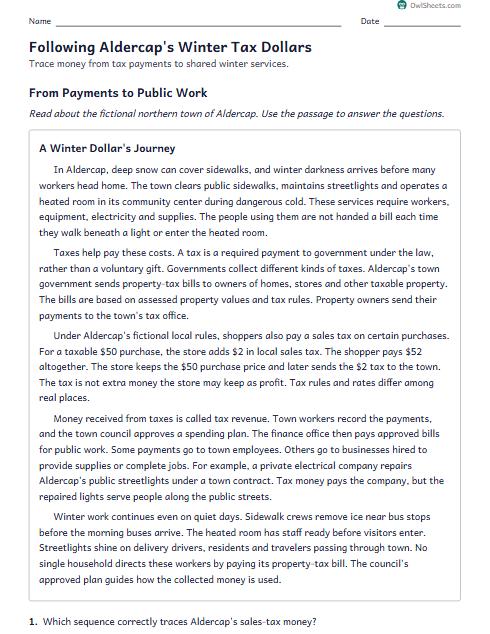
A Winter Dollar's Journey
In Aldercap, deep snow can cover sidewalks, and winter darkness arrives before many workers head home. The town clears public sidewalks, maintains streetlights and operates a heated room in its community center during dangerous cold. These services require workers, equipment, electricity and supplies. The people using them are not handed a bill each time they walk beneath a light or enter the heated room.
Taxes help pay these costs. A tax is a required payment to government under the law, rather than a voluntary gift. Governments collect different kinds of taxes. Aldercap's town government sends property-tax bills to owners of homes, stores and other taxable property. The bills are based on assessed property values and tax rules. Property owners send their payments to the town's tax office.
Under Aldercap's fictional local rules, shoppers also pay a sales tax on certain purchases. For a taxable $50 purchase, the store adds $2 in local sales tax. The shopper pays $52 altogether. The store keeps the $50 purchase price and later sends the $2 tax to the town. The tax is not extra money the store may keep as profit. Tax rules and rates differ among real places.
Money received from taxes is called tax revenue. Town workers record the payments, and the town council approves a spending plan. The finance office then pays approved bills for public work. Some payments go to town employees. Others go to businesses hired to provide supplies or complete jobs. For example, a private electrical company repairs Aldercap's public streetlights under a town contract. Tax money pays the company, but the repaired lights serve people along the public streets.
Winter work continues even on quiet days. Sidewalk crews remove ice near bus stops before the morning buses arrive. The heated room has staff ready before visitors enter. Streetlights shine on delivery drivers, residents and travelers passing through town. No single household directs these workers by paying its property-tax bill. The council's approved plan guides how the collected money is used.
- A. Shopper → town → store → private purchase
- B. Store → sidewalk crew → shopper → town
- C. Shopper → store → town → approved public work
- D. Town → shopper → store → sidewalk crew
- A. Send the $50 purchase price to the town.
- B. Keep the $2 tax and return the purchase price.
- C. Record the $52 as a property-tax payment.
- D. Separate the $2 tax that must go to the town.
The town sends property-tax bills to owners of taxable property.Crews remove ice near bus stops before the morning buses arrive.Stores send the sales tax they collect to the town.The heated room has staff ready before visitors enter.
- A. The town pays for work serving the public streets.
- B. The town buys lights for the company's private office.
- C. The company collects property taxes from street users.
- D. The company gives the town a voluntary winter gift.
- A. The size of the tax bill sets each crew's daily route.
- B. The approved public spending plan guides the crew's work.
- C. The first property owner to pay chooses the crew's work.
- D. The store collecting sales tax chooses the crew's jobs.
| Tax money entering | Payment for public work |
|---|---|
- A. The gift pays for a service, while taxes pay for goods.
- B. The gift goes to the town, while taxes go to stores.
- C. The gift is a choice, while taxes are required by law.
- D. The gift supports winter work, while taxes support summer work.
Check the Records and Apply the Ideas
Use these fictional records and the passage. Each row describes the same collection period.
| Tax | Expected revenue | Received so far | Still to arrive |
|---|---|---|---|
| Property tax | $180,000 | $150,000 | $30,000 |
| Local sales tax | $60,000 | $45,000 | $15,000 |
$
- A. Add the expected amounts; those include money not received.
- B. Add the received amounts; those include future tax payments.
- C. Subtract property tax; that money belongs to property owners.
- D. Subtract sales tax; that money belongs to collecting stores.
- A. Total expected tax revenue will rise to $255,000.
- B. Total tax revenue received will rise to $210,000.
- C. Property-tax collections will rise to $165,000.
- D. Total tax revenue received will rise to $240,000.
- A. Step users have bought separate services from the business.
- B. The business has replaced the town as the tax collector.
- C. The business has made a voluntary donation to the town.
- D. A private business is carrying out tax-funded public work.
A list of residents' favorite winter sportsA ledger showing property-tax and sales-tax payments receivedPaid invoices for public sidewalk crews and streetlight repairsA calendar showing the dates of winter holidays
Related worksheets
Two Jobs Behind the County Fair
Grade 5 · ECO.5.4
13 questionsPremium
Bellwether Town's Shared Services
Grade 5 · ECO.5.4
15 questionsPremium
Fairground Funds in Two Counties
Grade 5 · ECO.5.4
15 questionsPremium
Two Park Jobs, One Bike Goal
Grade 5 · ECO.5.3
13 questionsPremium
Tuesday Mornings at the Fernhill School Bank
Grade 5 · ECO.5.3
13 questionsFree
Ice Pop Carts on Larkin Avenue
Grade 5 · ECO.5.2
14 questionsPremium