Grade 4 · Social StudiesCIV.4.2Premium
Wolverine Gap Picks a Capitol Tour
A mountain-town class follows one state law through the legislature, the governor and the state courts, then votes on which capitol tour to take.
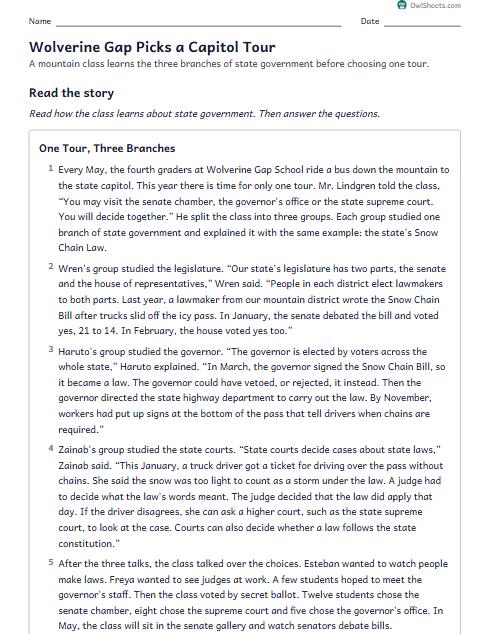
Preview
OwlSheets.com
Wolverine Gap Picks a Capitol Tour
A mountain class learns the three branches of state government before choosing one tour.
Read the story
Read how the class learns about state government. Then answer the questions.
One Tour, Three Branches
1Every May, the fourth graders at Wolverine Gap School ride a bus down the mountain to the state capitol. This year there is time for only one tour. Mr. Lindgren told the class, “You may visit the senate chamber, the governor's office or the state supreme court. You will decide together.” He split the class into three groups. Each group studied one branch of state government and explained it with the same example: the state's Snow Chain Law.
2Wren's group studied the legislature. “Our state's legislature has two parts, the senate and the house of representatives,” Wren said. “People in each district elect lawmakers to both parts. Last year, a lawmaker from our mountain district wrote the Snow Chain Bill after trucks slid off the icy pass. In January, the senate debated the bill and voted yes, 21 to 14. In February, the house voted yes too.”
3Haruto's group studied the governor. “The governor is elected by voters across the whole state,” Haruto explained. “In March, the governor signed the Snow Chain Bill, so it became a law. The governor could have vetoed, or rejected, it instead. Then the governor directed the state highway department to carry out the law. By November, workers had put up signs at the bottom of the pass that tell drivers when chains are required.”
4Zainab's group studied the state courts. “State courts decide cases about state laws,” Zainab said. “This January, a truck driver got a ticket for driving over the pass without chains. She said the snow was too light to count as a storm under the law. A judge had to decide what the law's words meant. The judge decided that the law did apply that day. If the driver disagrees, she can ask a higher court, such as the state supreme court, to look at the case. Courts can also decide whether a law follows the state constitution.”
5After the three talks, the class talked over the choices. Esteban wanted to watch people make laws. Freya wanted to see judges at work. A few students hoped to meet the governor's staff. Then the class voted by secret ballot. Twelve students chose the senate chamber, eight chose the supreme court and five chose the governor's office. In May, the class will sit in the senate gallery and watch senators debate bills.
- A. To help the class vote on whether to keep the law
- B. To prove that the governor wrote the law for the pass
- C. To show that one branch did all the work on the law
- D. To show how each branch had a different job with one law
| State legislature | Governor and state agencies | State courts |
|---|---|---|
The preview shows the first questions. Unlock the worksheet to see all of it.
Related worksheets
Two Gardens, One State Program
Grade 4 · CIV.4.2
13 questionsPremium
Redwillow Ranch's State-Work Map
Grade 4 · CIV.4.2
14 questionsPremium
Coppercrumb's State Government Requests
Grade 4 · CIV.4.2
13 questionsPremium
State News at the Library
Grade 4 · CIV.4.2
13 questionsFree
Talia's Oakview Branch Guide
Grade 4 · CIV.4.2
15 questionsPremium
Pinecrest's Trail Safety Bill
Grade 4 · CIV.4.2
14 questionsPremium