Grade 4 · Social StudiesCIV.4.2
State News at the Library
Investigate fictional news reports at a public library to compare the legislature, governor, and state courts.
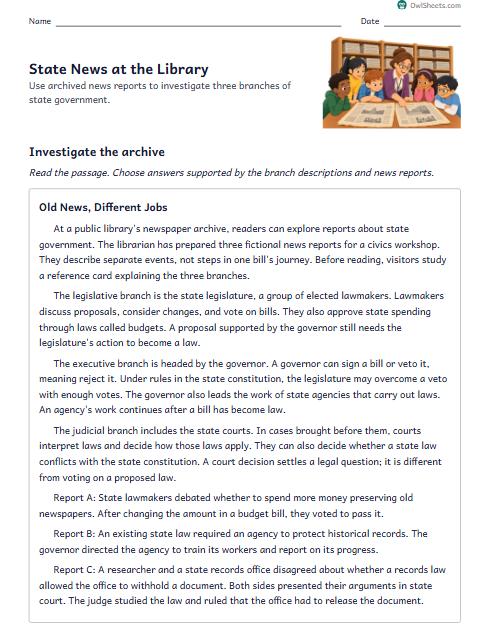
Preview
OwlSheets.com
State News at the Library
Use archived news reports to investigate three branches of state government.

Investigate the archive
Read the passage. Choose answers supported by the branch descriptions and news reports.
Old News, Different Jobs
At a public library's newspaper archive, readers can explore reports about state government. The librarian has prepared three fictional news reports for a civics workshop. They describe separate events, not steps in one bill's journey. Before reading, visitors study a reference card explaining the three branches.
The legislative branch is the state legislature, a group of elected lawmakers. Lawmakers discuss proposals, consider changes, and vote on bills. They also approve state spending through laws called budgets. A proposal supported by the governor still needs the legislature's action to become a law.
The executive branch is headed by the governor. A governor can sign a bill or veto it, meaning reject it. Under rules in the state constitution, the legislature may overcome a veto with enough votes. The governor also leads the work of state agencies that carry out laws. An agency's work continues after a bill has become law.
The judicial branch includes the state courts. In cases brought before them, courts interpret laws and decide how those laws apply. They can also decide whether a state law conflicts with the state constitution. A court decision settles a legal question; it is different from voting on a proposed law.
Report A: State lawmakers debated whether to spend more money preserving old newspapers. After changing the amount in a budget bill, they voted to pass it.
Report B: An existing state law required an agency to protect historical records. The governor directed the agency to train its workers and report on its progress.
Report C: A researcher and a state records office disagreed about whether a records law allowed the office to withhold a document. Both sides presented their arguments in state court. The judge studied the law and ruled that the office had to release the document.
- A. Lawmakers Train Workers to Preserve Newspapers
- B. Lawmakers Approve Money for Newspaper Preservation
- C. Lawmakers Rule on Newspaper Records Dispute
- D. Lawmakers Direct Agency's Preservation Work
- A. It describes voting on money in a budget bill.
- B. It describes deciding the meaning of a disputed law.
- C. It describes changing the wording of a proposed law.
- D. It describes carrying out a law already in place.
The document was held by a state records office.Both sides presented arguments to the court.The person requesting the document was a researcher.The judge studied the law before issuing a ruling.
- A. Report A describes agency work; Report B describes a vote.
- B. Report A describes a vote; Report B describes agency work.
- C. Both reports describe judges explaining an existing law.
- D. Both reports describe a governor approving a new bill.
- A. The governor asks an agency to organize its files.
- B. The researcher asks the librarian for another newspaper.
- C. The judge compares the law with the state constitution.
- D. The legislature debates the cost of storing records.
- A. They show branch jobs without suggesting each law needs a court case.
- B. They prove that a governor's duties end when a bill is signed.
- C. They show that lawmakers carry out the programs they approve.
- D. They prove that state courts approve each agency's daily work.
Check the workshop notes
Apply what you learned to new notes and reports. For the final answer, support your claim with evidence.
- A. Whether the legislature passed a budget providing the money
- B. Whether the governor ruled on a case about the recordings
- C. Whether a judge chose workers to preserve the recordings
- D. Whether the agency voted to create a state budget
- A. The courts took over the governor's power to sign bills.
- B. The governor's agency changed the legislature's vote count.
- C. The legislature used its power to overcome the rejection.
- D. The legislature used a court ruling to train agency workers.
The governor directed an agency to follow a records law.A state court passed a budget for preserving newspapers.The legislature settled a court case by issuing a judge's ruling.State lawmakers considered changes to a proposed records bill.
- A. Debating the bill; voting to approve its spending
- B. Signing the bill; directing the agency's work
- C. Hearing a case; explaining how the law applies
- D. Changing the bill; ruling on a legal challenge
- A. A proposal setting the legislature's preservation budget
- B. A signature approving a records bill passed by lawmakers
- C. An order directing the governor's daily agency work
- D. A ruling explaining how a records law applies in a case
- A. Report C's judge resolves a dispute; Report B's agency performs required work.
- B. Report A's lawmakers approve spending; Report B's governor leads an agency.
- C. Report A's lawmakers change an amount; Report C's researcher requests a document.
- D. Report B's agency trains workers; Report A's lawmakers debate a budget.
Related worksheets
Two Gardens, One State Program
Grade 4 · CIV.4.2
13 questionsPremium
Redwillow Ranch's State-Work Map
Grade 4 · CIV.4.2
14 questionsPremium
Coppercrumb's State Government Requests
Grade 4 · CIV.4.2
13 questionsPremium
Wolverine Gap Picks a Capitol Tour
Grade 4 · CIV.4.2
14 questionsPremium
Talia's Oakview Branch Guide
Grade 4 · CIV.4.2
15 questionsPremium
Pinecrest's Trail Safety Bill
Grade 4 · CIV.4.2
14 questionsPremium