Grade 3 · Social StudiesECO.3.4Premium
Game Orders at the Postal Counter
Analyze a class's mail-order game project to explain why communities and countries trade and identify imports and exports.
Preview
OwlSheets.com
Game Orders at the Postal Counter
Use a class decision and mailing records to explain trade.
A Class Weighs Its Choices
Read the story. Circle answers or select evidence as directed.
The Rainy-Day Game Shelf
At Ternvale School in the United States, a third-grade class invented a word-riddle card game. Families helped prepare decks for a school sale. The school owned the decks and kept the sale money for its rainy-day game shelf. After the sale, 24 decks remained.
The class shared a description of its game with other schools and clubs. A club in another US town ordered six decks. A school in the United Kingdom ordered twelve decks for students practicing English. Both buyers offered to pay the school money. Neither offered another game in exchange.
Meanwhile, younger children using Ternvale's game shelf had trouble holding the small pieces in its jigsaw puzzles. The nearby game shop stocked puzzles with small pieces. A Canadian company offered sturdy puzzles with much larger pieces. Its puzzles cost more than the nearby shop's puzzles, but the school had enough money for either choice.
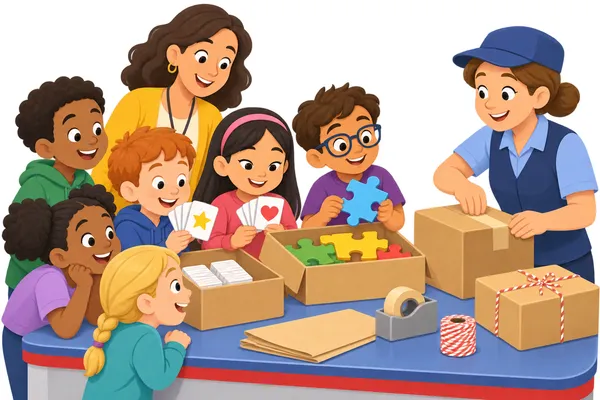
The teacher arranged a class visit to the post office. At the parcel counter, students compared mailing costs and delivery choices. They learned that they could mail the card decks to both customers and still afford four Canadian puzzles. After discussing the choices, the class agreed to accept both orders and buy the large-piece puzzles.
The teacher handled the school's payments and parcels. Buying and selling goods is trade. Goods bought from another country and brought into your country are imports. Goods sold and sent from your country to another country are exports. A sale between two US communities stays within the same country.
- A. It let the buyers make the school's remaining games.
- B. It showed that people in Ternvale had stopped buying games.
- C. It let the school avoid paying to send the games.
- D. It connected the school with more customers for its remaining games.
Younger children had trouble holding small puzzle pieces.The Canadian puzzles had a higher price.Families helped prepare the word-riddle decks.The Canadian company offered puzzles with much larger pieces.
The preview shows the first questions. Unlock the worksheet to see all of it.
Related worksheets
A Computer's Journey to Our Lab
Grade 3 · ECO.3.4
13 questionsPremium
Crafts Across Borders at Rellwick
Grade 3 · ECO.3.4
13 questionsPremium
Upstream, Downstream: Two River Towns Trade
Grade 3 · ECO.3.4
13 questionsPremium
The Honey Barn at Quillon County Fair
Grade 3 · ECO.3.4
13 questionsPremium
A Neighborhood Workshop Connected to the World
Grade 3 · ECO.3.4
13 questionsFree
Trade from Mirage Mesa
Grade 3 · ECO.3.4
14 questionsPremium