Grade 3 · Social StudiesECO.3.4Premium
A Computer's Journey to Our Lab
Follow computer parts across borders and use a school lab letter to explain community trade, imports, and exports.
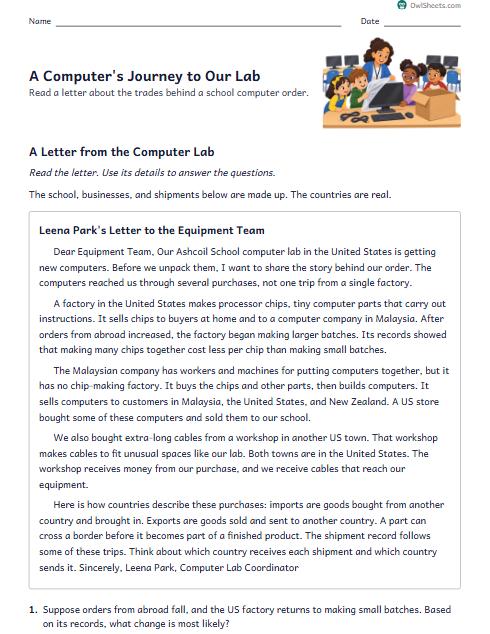
Preview
OwlSheets.com
A Computer's Journey to Our Lab
Read a letter about the trades behind a school computer order.

A Letter from the Computer Lab
Read the letter. Use its details to answer the questions.
Leena Park's Letter to the Equipment Team
Dear Equipment Team, Our Ashcoil School computer lab in the United States is getting new computers. Before we unpack them, I want to share the story behind our order. The computers reached us through several purchases, not one trip from a single factory.
A factory in the United States makes processor chips, tiny computer parts that carry out instructions. It sells chips to buyers at home and to a computer company in Malaysia. After orders from abroad increased, the factory began making larger batches. Its records showed that making many chips together cost less per chip than making small batches.
The Malaysian company has workers and machines for putting computers together, but it has no chip-making factory. It buys the chips and other parts, then builds computers. It sells computers to customers in Malaysia, the United States, and New Zealand. A US store bought some of these computers and sold them to our school.
We also bought extra-long cables from a workshop in another US town. That workshop makes cables to fit unusual spaces like our lab. Both towns are in the United States. The workshop receives money from our purchase, and we receive cables that reach our equipment.
Here is how countries describe these purchases: imports are goods bought from another country and brought in. Exports are goods sold and sent to another country. A part can cross a border before it becomes part of a finished product. The shipment record follows some of these trips. Think about which country receives each shipment and which country sends it. Sincerely, Leena Park, Computer Lab Coordinator
- A. Each chip would cost more to make.
- B. The factory would gain more foreign buyers.
- C. The factory would make more chips per batch.
- D. Each chip would cost less to make.
The preview shows the first questions. Unlock the worksheet to see all of it.
Related worksheets
Game Orders at the Postal Counter
Grade 3 · ECO.3.4
13 questionsPremium
Crafts Across Borders at Rellwick
Grade 3 · ECO.3.4
13 questionsPremium
Upstream, Downstream: Two River Towns Trade
Grade 3 · ECO.3.4
13 questionsPremium
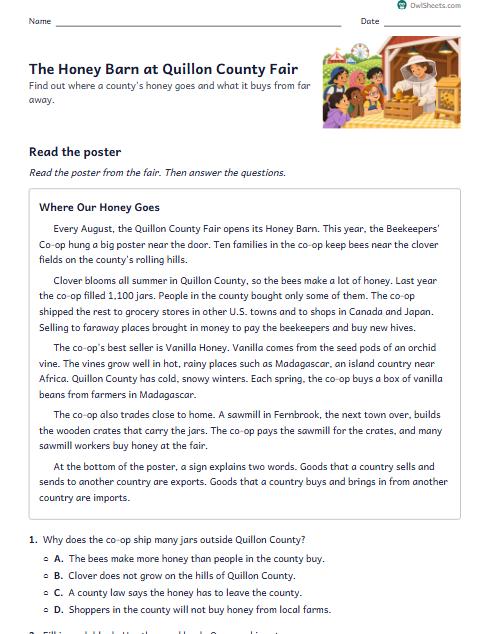
The Honey Barn at Quillon County Fair
Grade 3 · ECO.3.4
13 questionsPremium
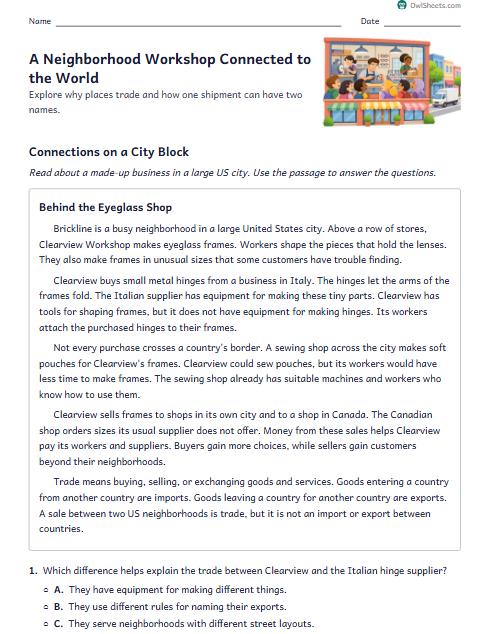
A Neighborhood Workshop Connected to the World
Grade 3 · ECO.3.4
13 questionsFree
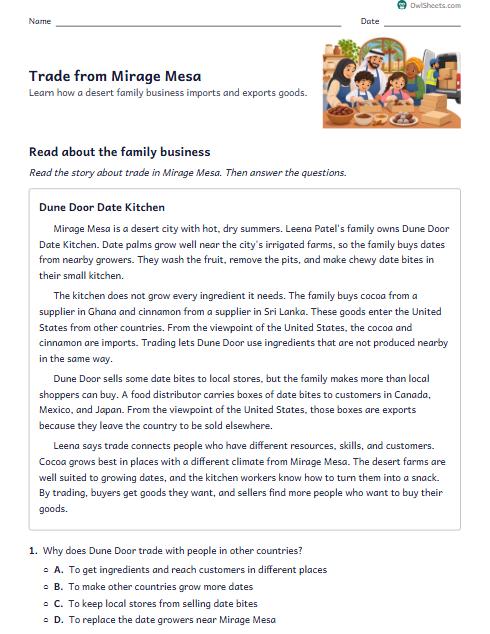
Trade from Mirage Mesa
Grade 3 · ECO.3.4
14 questionsPremium