Grade 3 · Social StudiesECO.3.4
A Neighborhood Workshop Connected to the World
Explore community and international trade through a city eyeglass workshop, shipping records, and new trade situations.
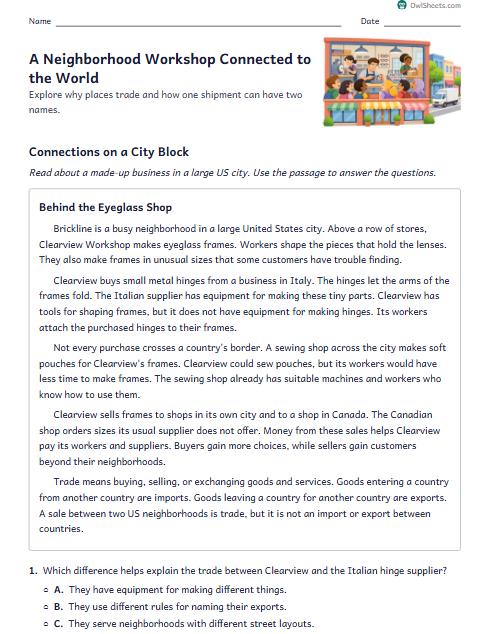
Preview
OwlSheets.com
A Neighborhood Workshop Connected to the World
Explore why places trade and how one shipment can have two names.
Connections on a City Block
Read about a made-up business in a large US city. Use the passage to answer the questions.
Behind the Eyeglass Shop
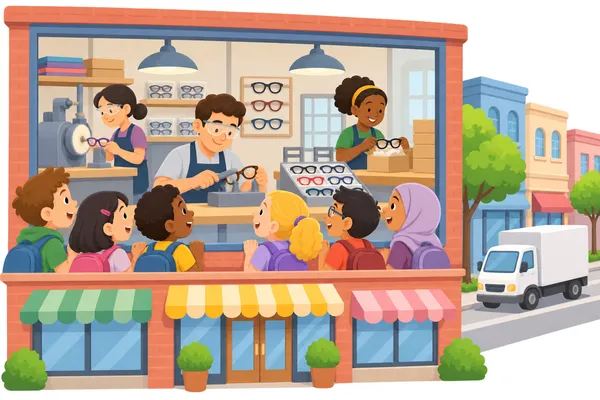
Brickline is a busy neighborhood in a large United States city. Above a row of stores, Clearview Workshop makes eyeglass frames. Workers shape the pieces that hold the lenses. They also make frames in unusual sizes that some customers have trouble finding.
Clearview buys small metal hinges from a business in Italy. The hinges let the arms of the frames fold. The Italian supplier has equipment for making these tiny parts. Clearview has tools for shaping frames, but it does not have equipment for making hinges. Its workers attach the purchased hinges to their frames.
Not every purchase crosses a country's border. A sewing shop across the city makes soft pouches for Clearview's frames. Clearview could sew pouches, but its workers would have less time to make frames. The sewing shop already has suitable machines and workers who know how to use them.
Clearview sells frames to shops in its own city and to a shop in Canada. The Canadian shop orders sizes its usual supplier does not offer. Money from these sales helps Clearview pay its workers and suppliers. Buyers gain more choices, while sellers gain customers beyond their neighborhoods.
Trade means buying, selling, or exchanging goods and services. Goods entering a country from another country are imports. Goods leaving a country for another country are exports. A sale between two US neighborhoods is trade, but it is not an import or export between countries.
- A. They have equipment for making different things.
- B. They use different rules for naming their exports.
- C. They serve neighborhoods with different street layouts.
- D. They sell finished frames in different sizes.
- A. It turns a nearby purchase into an international import.
- B. It removes Clearview's need to pay other businesses.
- C. It leaves Clearview workers more time to make frames.
- D. It gives Clearview equipment for producing metal hinges.
Clearview gets hinges it lacks equipment to make.Clearview's workroom is above a row of stores.The Canadian shop gets sizes its usual supplier lacks.The neighborhood is part of a large US city.
- A. Clearview buys its finished frames from Canadian shops.
- B. Clearview reaches customers both nearby and abroad.
- C. Clearview sells hinges instead of frames in its city.
- D. Clearview sends its city customers to the sewing shop.
Follow the Shipment
Use these made-up shipping records. Think about which country's border the goods cross.
| Goods | Sent from | Delivered to |
|---|---|---|
| Metal hinges | Italy | United States |
| Soft pouches | United States | United States |
| Eyeglass frames | United States | Canada |
- A. Export, because the hinges leave Italy for another country
- B. Import, because Clearview buys rather than makes the hinges
- C. Import, because the hinges enter the United States
- D. Local trade, because the hinges go to one workshop
- A. A US export and a Canadian import
- B. An import for both countries
- C. An export for both countries
- D. A US import and a Canadian export
- A. Whether the pouches arrive in a delivery truck
- B. Whether Clearview pays money for the pouches
- C. Whether the pouches arrive from another country
- D. Whether the sewing shop has different owners
Use the Trade Ideas
Apply what you learned to these new situations.
- A. Each shop needs to use the same tools as the other.
- B. Each shop is giving up selling its own products.
- C. Each shop is importing goods from another country.
- D. Each shop can use what the other is equipped to make.
- A. Buying fruit abroad gives the store heated growing space.
- B. Different growing conditions make buying elsewhere useful.
- C. Both places have the same conditions for growing fruit.
- D. Sending fruit abroad changes imports into local goods.
The cases have blue fabric covers.The cases are shipped from Canada.The business packs the cases on Tuesday.The cases are delivered into the United States.
- A. Trade makes the two communities part of different countries.
- B. Trade requires one community to lack shoe-making skills.
- C. Trade means a community has stopped making that good.
- D. Trade can give buyers choices beyond locally made goods.
Related worksheets
Game Orders at the Postal Counter
Grade 3 · ECO.3.4
13 questionsPremium
A Computer's Journey to Our Lab
Grade 3 · ECO.3.4
13 questionsPremium
Crafts Across Borders at Rellwick
Grade 3 · ECO.3.4
13 questionsPremium
Upstream, Downstream: Two River Towns Trade
Grade 3 · ECO.3.4
13 questionsPremium
The Honey Barn at Quillon County Fair
Grade 3 · ECO.3.4
13 questionsPremium
Trade from Mirage Mesa
Grade 3 · ECO.3.4
14 questionsPremium