
Worksheet
Force Questions at the Corner Bike Shop
Use bike-shop investigation data to ask testable questions about electric and magnetic forces between objects that are not touching.
Grade 3ScienceInteractive · Printable
Aligned to3-PS2-3
What’s included
- Single worksheet
- Auto-graded online
- 1 NGSS standard
- Printable answer key
- 14 questions
- Classroom-ready
Details
- Format
- Interactive · Printable
- Grade
- Grade 3
- Subject
- Science
- Question types
- Fill in the blank, Multiple choice, Matching, Sorting, Short answer
About this worksheet
What students practice
- Students use observations to ask questions about electric and magnetic forces without contact.
- Students identify changes to test when investigating distance, rubbing, materials, and magnet poles.
- Students support a claim about a noncontact force with investigation evidence.
How to use
Read the investigation together and review how each display records five tries. Have students use the evidence to choose and write questions for further tests.
Curriculum
NGSS standard covered
Ask questions about cause and effect in electric and magnetic forces between objects that are not touching.
Preview
OwlSheets.com
Force Questions at the Corner Bike Shop
Use test results to ask questions about pushes and pulls without touching.
A Magnet Near a Paper Clip
Read the investigation. Use the graph to answer questions about the magnet tests.
Science on a Busy Block
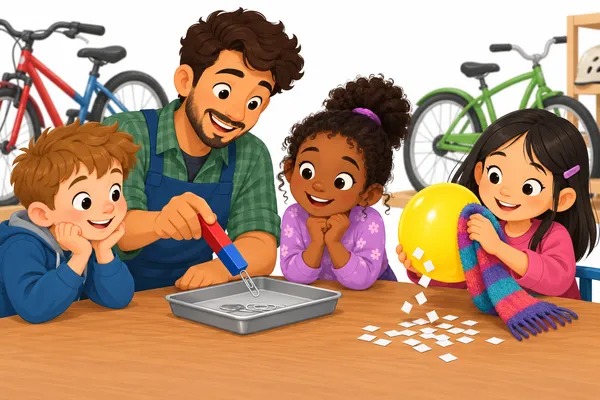
Buses pass, bells ring, and neighbors stop at the corner bike shop. During a neighborhood science afternoon, the shop hosts two small investigations inside, away from street breezes. An adult handles the magnets and keeps them away from mouths and electronic devices.
For the first investigation, the group places a steel paper clip on a smooth tray. They hold a bar magnet still near the clip, leaving a gap. They change only the starting gap. They keep the magnet, clip, tray, and facing end of the magnet the same. At each gap, they make five tries. Each try lasts five seconds. They count a success only if the clip begins moving toward the magnet before the two touch.
For the second investigation, the group uses balloons and tiny paper squares. Rubbing a balloon with a dry wool scarf can give it electric charge. The group changes the number of rubs. They record whether the paper starts moving toward the balloon while a gap remains. Both investigations record motion, not just whether objects eventually touch.
How many more tries were successful at 1 cm than at 3 cm? more tries
- A. 4 cm
- B. 2 cm
- C. 3 cm
- D. 1 cm
- A. To find out how long the magnet stays warm.
- B. To test whether a pull can act without contact.
- C. To make every starting gap exactly the same.
- D. To find out whether the clip changes material.
- A. Use the original magnet at 1 cm and a stronger magnet at 4 cm.
- B. Use the original magnet with a clip and a stronger magnet with a coin.
- C. Use each magnet at 4 cm with the same clip, tray, and facing pole.
- D. Use each magnet at 4 cm, but put the clip on a different tray each time.
| Use the graph | Need a new test |
|---|---|
A Balloon Near Paper
Use the test notes and results. Think about what the group changed and what it could test next.
Rub count | Tries when paper moved toward the balloon before contact
0 rubs | 0 out of 5
10 rubs | 3 out of 5
20 rubs | 5 out of 5
- A. Does the number of rubs affect how often the paper moves?
- B. Does the starting gap affect how often the paper moves?
- C. Does the paper's size affect how often the paper moves?
- D. Does the scarf's material affect how often the paper moves?
- A. More rubs went with fewer successful tries.
- B. Changing the rub count made no difference.
- C. More rubs went with more successful tries.
- D. Only balloons with no rubs had successful tries.
After 10 rubs, in how many of the five tries did the paper move before contact? tries
- A. Use 10 rubs at 1 cm and 20 rubs at 2 cm.
- B. Use small paper at 1 cm and large paper at 2 cm.
- C. Use a wool scarf at 1 cm and a cotton cloth at 2 cm.
- D. Use 20 rubs and the same paper at 1 cm and 2 cm.
Plan the Next Investigation
Use the new observations and the earlier results to choose useful questions and support an explanation.
North facing north: the sliding magnet moves away.
North facing south: the sliding magnet moves closer.
- A. Does changing the gap change how the magnet moves?
- B. Does changing the facing pole change how the magnet moves?
- C. Does changing the tray change how the magnet moves?
- D. Does changing the magnet's size change how the magnet moves?
- Does the starting gap affect whether the steel clip moves?
- Does the object's material affect whether the magnet pulls it?
- Does the facing pole affect whether two magnets move together or apart?
- A. Which magnet end faces the other magnet
- B. The distance between the objects
- C. What the test object is made of
- A. Block drafts; compare still rubbed and unrubbed balloons at one gap.
- B. Blow on the paper while holding a rubbed balloon at the same gap.
- C. Wave both rubbed and unrubbed balloons quickly beside the paper.
- D. Press both rubbed and unrubbed balloons directly against the paper.
Related worksheets
 Worksheet
Grade 3
No-Touch Forces at the Wind Center
Physical Science · 3-PS2-3
Premium15 questions
 Worksheet
Grade 3
The Storm-Cleared Field Journal
Physical Science · 3-PS2-3
Premium14 questions
 Worksheet
Grade 3
Questions at the Banner-Tag Table
Physical Science · 3-PS2-3
Premium15 questions
 Worksheet
Grade 3
No-Touch Tests Beside the Playground Game Grid
Physical Science · 3-PS2-3
Premium14 questions
 Worksheet
Grade 3
No-Touch Questions at the Oxbow Survey Hut
Physical Science · 3-PS2-3
Premium14 questions
 Worksheet
Grade 3
Force Questions for the Garden Harvest Counter
Physical Science · 3-PS2-3
Premium14 questions