
Worksheet
Beaks Built for the Job
Read an original article about bird beaks, find the main idea, recount key details and explain how they support the main idea.
Grade 3ELAInteractive · Printable
Aligned toRI.3.2
What’s included
- Single worksheet
- Auto-graded online
- 1 Common Core standard
- Printable answer key
- 8 questions
- Classroom-ready
Details
- Format
- Interactive · Printable
- Grade
- Grade 3
- Subject
- ELA
- Question types
- Fill in the blank, Multiple choice, Matching, Circle the answer, Short answer
About this worksheet
What students practice
- Students determine the main idea of an informational article.
- Students recount key details and explain how they support the main idea.
How to use
Read the article together, then have students underline the bird and beak shape in each paragraph before they answer the questions.
Curriculum
Common Core standard covered
Determine the main idea of a text, recount its key details, and explain how they support the main idea.
Preview
OwlSheets.com
Beaks Built for the Job
Find the main idea of an article about bird beaks.
Read the article
Read the article. The paragraphs are numbered.
Beaks Built for the Job
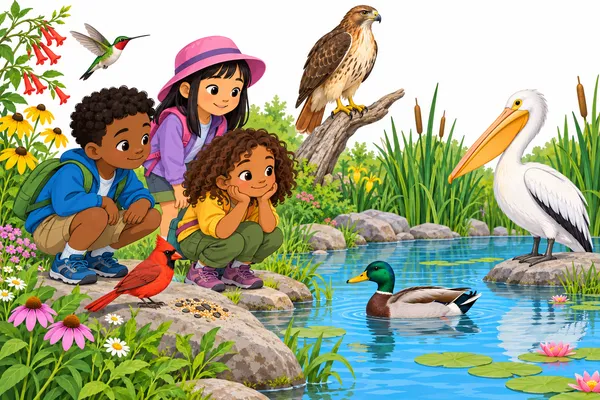
1Have you ever looked closely at a bird's beak? Birds do not have hands or teeth, so they use their beaks to gather and eat food. Beaks come in many shapes and sizes. The shape of a bird's beak helps it eat the kind of food it needs.
2Some birds eat seeds. A cardinal has a short, thick, strong beak. It works like a nutcracker. The cardinal uses it to crack open hard seed shells and get the soft part inside.
3Other birds drink nectar, a sweet liquid inside flowers. A hummingbird has a long, thin beak. It can reach deep inside a narrow flower. Then the hummingbird uses its long tongue to lap up the nectar.
4Hawks and eagles eat meat. Their beaks are sharp and hooked at the tip. A hooked beak helps them tear food into small pieces they can swallow.
5Many ducks find their food in water. A mallard has a wide, flat beak. The duck scoops up water and mud with it. Tiny ridges along the edges of the beak work like a comb. They let the water drain out while they hold in small plants and bugs.
6A pelican has a long beak with a stretchy pouch under it. The pelican scoops up fish and water in the pouch. It lets the water drain out, and then it swallows the fish.
7Seeds, nectar, meat, plants or fish, each bird has a beak that fits its meal. The next time you see a bird, look at its beak. Can you guess what it eats?
Main idea
Use the article to answer each question.
- A. Hummingbirds have the longest beaks of all birds.
- B. Birds use their beaks to build nests in trees.
- C. A bird's beak shape helps it eat the food it needs.
- D. Ducks and pelicans both find their food in water.
Have you ever looked closely at a bird's beak?Birds do not have hands or teeth, so they use their beaks to gather and eat food.Beaks come in many shapes and sizes.The shape of a bird's beak helps it eat the kind of food it needs.
- A. Ducks like to swim in ponds with lots of mud.
- B. A mallard's wide, flat beak helps it strain food from water.
- C. Mallards use their beaks to comb their feathers.
- D. Water drains off a duck's back when it swims.
- A. It explains why hawks and eagles fly so high.
- B. It tells which birds are the biggest hunters.
- C. It describes the colors of hawk and eagle feathers.
- D. It shows how a hooked beak helps a bird eat meat.
- A. The beak is strong enough to break hard shells.
- B. The beak is long enough to reach inside flowers.
- C. The beak is shaped like a hook at the tip.
- D. The beak is wide enough to scoop up mud.
Key details
Recount the key details from the article.
- cardinal
- hummingbird
- hawk
- mallard
- pelican
- A. long, with a stretchy pouch
- B. wide and flat
- C. short, thick and strong
- D. sharp and hooked
- E. long and thin
A cardinal cracks open hard .
A hummingbird reaches into a flower to lap up .
A hawk tears into small pieces.
A pelican scoops up and water in its pouch.
Related worksheets
 Worksheet
Grade 3
Tunnels Take Us Through
Reading: Informational Text · RI.3.2
Premium10 questions
 Worksheet
Grade 3
What Sleep Does for You
Reading: Informational Text · RI.3.2
Premium9 questions
 Worksheet
Grade 3
Hiding in Plain Sight: Animal Camouflage
Reading: Informational Text · RI.3.2
Premium10 questions
 Worksheet
Grade 3
Beavers: Busy Builders
Reading: Informational Text · RI.3.2
Premium10 questions
 Worksheet
Grade 3
Sundials: Telling Time with Shadows
Reading: Informational Text · RI.3.10
Premium11 questions
 Worksheet
Grade 3
Keep Cursive in Our School: What Do You Think?
Reading: Informational Text · RI.3.6
Premium10 questions