Grade 2 · Social StudiesGEO.2.2
Picture the Communities of Wrenhaven
Use a harbor word map and photo notes to compare urban, suburban, and rural homes, jobs, transportation, and land use.
Preview
OwlSheets.com
Picture the Communities of Wrenhaven
Use a word map and photo notes to compare three communities.
Study the Word Map
Read the map and photo notes. Circle the best answer unless the question gives other directions.
Photos for a Wrenhaven Guide
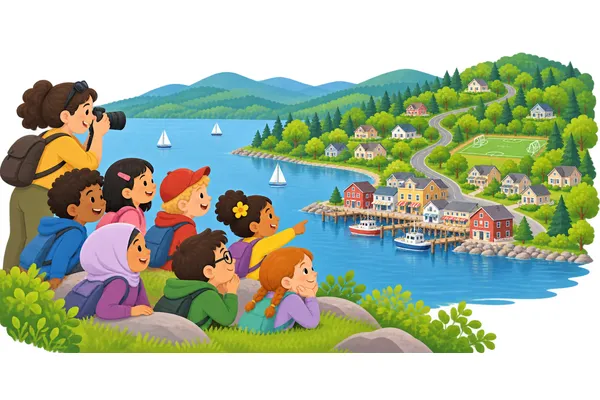
A photographer is making a guide to the made-up lakeside town of Wrenhaven. Her word map has three places. Anchor Center is beside the harbor. West of it is Pinebelt. Farther west is Reed Point. One road joins the three places.
Anchor Center is urban. Tall apartment buildings stand close together. Some have shops below the homes. Workers pack fish near the docks. Others work in offices. Much of the land holds buildings, streets, and docks. Buses stop often, and people walk between nearby places.
Pinebelt is suburban. Rows of houses have small yards. There are also some low apartment buildings. A school, a clinic, and a shopping center serve the neighborhood. Some people work there. Others ride a bus or drive east to jobs in Anchor Center. Parks and playing fields lie between groups of homes.
Reed Point is rural. Houses stand far apart among woods and open land. Workers grow young trees in a tree nursery. Other workers repair fishing boats in wide sheds. Families often drive to stores because the stores are far from their homes.
These notes describe Wrenhaven. Other urban, suburban, and rural communities may look different.
- A. At the houses among Reed Point's woods
- B. At Pinebelt's school beside a playing field
- C. At the houses beside Pinebelt's yards
- D. At Anchor Center's apartments over shops
Apartment buildings stand close together.The community is beside the harbor.Shops are below some of the homes.A road leads west toward Pinebelt.
- A. Pinebelt has rows of homes; Reed Point has more space between homes.
- B. Pinebelt has widely scattered homes; Reed Point has rows of homes.
- C. Pinebelt has homes above shops; Reed Point has tall apartment blocks.
- D. Pinebelt has homes among woods; Reed Point has small yards in rows.
- A. Traveling to a tree nursery in Reed Point
- B. Traveling to an office in Anchor Center
- C. Traveling to a clinic within Pinebelt
- D. Traveling to a boat shed in Reed Point
- A. Its residents work at its neighborhood shopping center.
- B. Its residents work in the shops below their apartments.
- C. Its workers grow young trees and repair fishing boats.
- D. Its workers pack fish beside its tall office buildings.
Pinebelt and Anchor Center both have land used for homes.Reed Point has more closely packed buildings than Anchor Center.Pinebelt's playing fields are places where workers pack fish.Reed Point has woods and open land; Anchor Center has closely built blocks.
- A. Reed Point's shops are below its apartments.
- B. Reed Point's houses are closer together.
- C. Anchor Center's places are closer together.
- D. Anchor Center's homes are farther from stores.
Check New Photo Plans
Use what you learned to check new plans and captions. Circle the best answer unless told otherwise.
- A. More homes on a small piece of land
- B. More large yards beside each family's home
- C. More space between one family's home and another
- D. More land around each home for growing trees
- A. A small yard beside a Pinebelt house
- B. A boat repair site on Reed Point's open land
- C. An office inside an Anchor Center building
- D. A shop below an Anchor Center apartment
- A. Its homes form rows near neighborhood services.
- B. Its homes stand far apart among large woods.
- C. Its homes sit above shops near busy docks.
- D. Its homes are beside wide boat repair sheds.
Show families walking downstairs from homes into shops.Show a family loading groceries into a car for the trip home.Show a road passing open spaces between houses.Show tall apartment buildings filling most of a block.
- A. A Pinebelt store worker and an Anchor Center shop worker
- B. A Pinebelt playing field and a Reed Point wood
- C. A Reed Point house and an Anchor Center apartment
- D. An Anchor Center bus and a Pinebelt car
- A. Some suburban residents also travel by bus.
- B. Some rural residents repair fishing boats.
- C. Some urban residents live above shops.
- D. Some suburban residents work at a clinic.
Related worksheets
Window Crews on Kestrel Island
Grade 2 · GEO.2.2
14 questionsPremium
Hard Hats, Three Building Choices
Grade 2 · GEO.2.2
14 questionsPremium
A Letter from Needlefin Harbor
Grade 2 · GEO.2.2
13 questionsPremium
Two Libraries, Different Delivery Plans
Grade 2 · GEO.2.2
13 questionsPremium
Three Communities Around Gull Bay
Grade 2 · GEO.2.2
14 questionsPremium
County Fair Community Clues
Grade 2 · GEO.2.2
14 questionsPremium