Grade 2 · Social StudiesECO.2.4
Money Day at Pine Hollow Library
Read about a banker's visit to a library, then use a money record to practice earning, spending, saving and keeping money safe in a bank.
Preview
OwlSheets.com
Money Day at Pine Hollow Library
Learn about earning, spending, saving and banks.
Read about Money Day
Read the passage. Then answer the questions.
Money Day at the Library
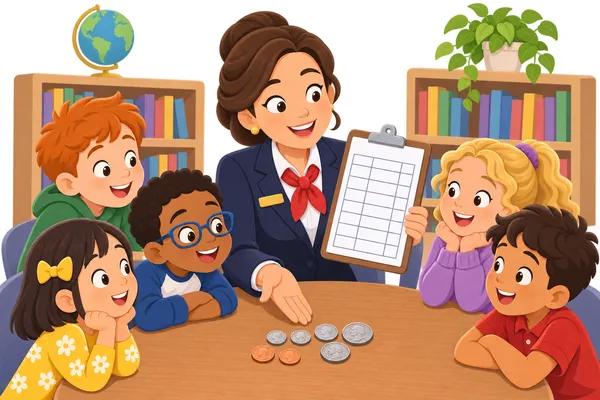
Each spring, Pine Hollow Library holds Money Day. A banker named Mr. Batista visits to teach children about money.
First, he talks about earning. People earn money when they do work. Grown-ups earn money at their jobs. Children can sometimes earn a few dollars by doing extra chores, such as raking leaves for a neighbor.
Next, he talks about spending and saving. Spending is using money to buy goods or services now. Saving is keeping money to use later. Many people save for a big goal, such as a new bike.
Then Mr. Batista shows a picture of a bank. A bank is a safe place to keep money. When you put money into a savings account, the bank keeps it locked up and writes down how much you have. Money in a jar at home can get lost or spent too fast.
Last, the children learn to fill in a money record. It helps them keep track of what they earn, spend and save.
- A. Kip counts the $3 in his jar.
- B. Kip puts $3 in his savings account.
- C. Kip buys a $3 book.
- D. Kip gets $3 for walking a neighbor's dog.
- Earn
- Spend
- Save
- Bank
- A. Keep money to use later
- B. Use money to buy something now
- C. A safe place to keep money
- D. Get money for doing work
- A. The bank guards the money and keeps count of it.
- B. Money in a jar grows bigger by itself.
- C. A jar writes down how much you have.
- D. The bank spends the money for you.
Lu raked leaves and got $6. She $6. Then she bought a $2 snack, so she $2.
Read a money record
Hana, a second grader, filled in a money record after Money Day. Use it to answer the questions.
| Week | Earned | Spent | Saved in bank |
|---|---|---|---|
| Week 1 | $5 | $2 | $3 |
| Week 2 | $4 | $0 | $4 |
| Week 3 | $6 | $3 | ? |
- A. She did not save in any week.
- B. Week 1
- C. Week 2
- D. Week 3
After Week 3, Hana has saved $ in the bank in all.
- A. $10
- B. $22
- C. $2
- D. $12
Make money choices
Use the passage and your own thinking.
| Earning | Spending | Saving |
|---|---|---|
- A. Put it into a savings account.
- B. Carry it to school each day.
- C. Give it to a friend to hold.
- D. Hide it inside a library book.
- A. Children are too young to save money.
- B. Saving can help a person reach a big goal later.
- C. Saved money is best spent the same day.
- D. Saving means buying something right now.
- A. So you can earn money for chores.
- B. So you know how much you have saved.
- C. So the money turns into a bike.
- D. So the library can spend the money.
Related worksheets
The Cargo Watch Class Money Plan
Grade 2 · ECO.2.4
13 questionsPremium
A Letter from the Hospital Linen Room
Grade 2 · ECO.2.4
13 questionsPremium
Money Stops at the Paper Traditions Festival
Grade 2 · ECO.2.4
14 questionsPremium
Money Plans in Mirage Mesa
Grade 2 · ECO.2.4
15 questionsPremium
Money Plans at Kelp Cove
Grade 2 · ECO.2.4
14 questionsPremium
Money Choices at the Library Book Sale
Grade 2 · ECO.2.4
14 questionsPremium