Grade 2 · Social StudiesHIS.2.2
A History Trail at Juniper Spur Ranch
Use a ranch trail map to explore how Joseph Glidden, Alice Evans, and Frederick McKinley Jones helped people.
Preview
OwlSheets.com
A History Trail at Juniper Spur Ranch
Follow a ranch map to discover three Americans' contributions.
Read and Follow the Trail
Read about three Americans. Use the history passage and the map description to answer.
Three Americans Who Solved Problems
Juniper Spur Ranch is a made-up ranch with a history trail. Its displays tell about three real Americans of the past. These people did not work at this ranch.
In 1874, Joseph Glidden received a patent for an improved kind of barbed wire. Others had made barbed wire before him. His design held sharp points firmly on twisted wire. Ranchers could stretch it between posts to fence large areas using less wood. The points discouraged cattle from pushing through.
Alice Evans was a scientist who studied milk. Her research showed that germs in raw, unheated milk could make people sick. She urged people to use pasteurization, which heats milk to kill harmful germs. She did not invent this heating method.
Frederick McKinley Jones, a Black inventor, developed equipment that kept trucks cold inside. Food could spoil on long, warm trips. Refrigerated trucks helped carry fresh food farther. Chilling helps keep food fresh, but it does not replace pasteurization. Milk can be heated first and then kept cold during delivery.
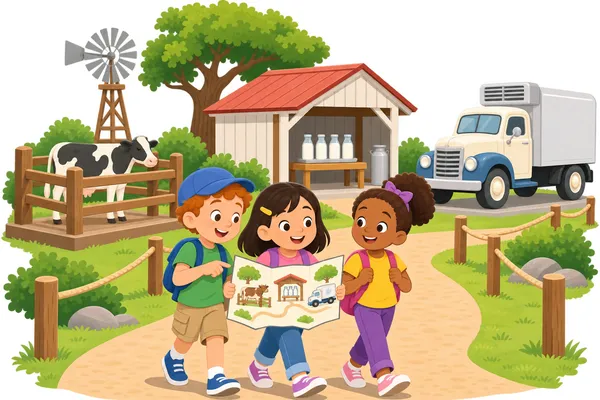
The map shows four places. Visitors start at the gate. The fence pen is west of the gate. It has a barbed-wire fence model. The milk shed is north of the gate. It has a display about heating milk to kill germs. The loading yard is east of the milk shed. It has a refrigerated truck display. These displays are for learning; visitors do not touch the sharp wire.
- A. It shows how heating milk kills germs.
- B. It shows how cold air protects food.
- C. It shows a tool for keeping cattle inside.
- D. It shows a truck for carrying fresh milk.
Wire stretched between posts could fence a large area.Glidden received a patent in 1874.The sharp points discouraged cattle from pushing through.Other people had made barbed wire before Glidden.
- A. Her milk research led to improved wire fences.
- B. Her truck equipment kept milk cold on trips.
- C. Her truck equipment heated milk to kill germs.
- D. Her milk research supported using pasteurization.
- A. It heated food before the truck began its trip.
- B. It kept food cold during a longer truck trip.
- C. It helped the truck travel at a higher speed.
- D. It made more room for food inside the truck.
- A. How to keep fresh food cold while it travels
- B. How to hold sharp points firmly on fence wire
- C. How to use less wood when building a fence
- D. How to heat raw milk to kill harmful germs
Use Their Ideas
Think about how these contributions could help in new situations.
- A. Evans's research about germs in raw milk
- B. Jones's equipment for cooling the inside of trucks
- C. Glidden's design that held wire points firmly
- D. The heating method that Evans urged people to use
- A. Pour the raw milk into smaller bottles.
- B. Carry the raw milk on a shorter trip.
- C. Chill the raw milk for a longer time.
- D. Choose pasteurized milk and keep it cold.
- A. Carry the food in a truck with cooling equipment.
- B. Move the food to the warmest part of the truck.
- C. Make more stops along the same delivery route.
- D. Pack the same truck with more food for each trip.
| Keeping cattle inside a fence | Protecting food for people |
|---|---|
- A. Both people's contributions were skipped before the trip.
- B. Evans's heating advice was followed, but Jones's kind of cooling is missing.
- C. Both people's contributions are working during the trip.
- D. Jones's cooling step is working, but Evans's heating advice was skipped.
Explain the Difference They Made
Use facts from the history passage. For the last answer, use the ranch map description too.
- A. Her research linked germs in raw milk to illness.
- B. The ranch has a milk shed north of its gate.
- C. Pasteurization existed before Evans's research.
- D. Milk can be kept cold during a delivery trip.
Related worksheets
Three Ways to Improve a Train Journey
Grade 2 · HIS.2.2
13 questionsPremium
Whose Work Will the City Remember?
Grade 2 · HIS.2.2
13 questionsPremium
Rosa Parks and the Bus Boycott Timeline
Grade 2 · HIS.2.2
14 questionsPremium
Mary Anderson's Window-Clearing Idea
Grade 2 · HIS.2.2
15 questionsPremium
Numbers for the Sky
Grade 2 · HIS.2.2
14 questionsPremium
Signals, Smoke, and Safer Streets
Grade 2 · HIS.2.2
14 questionsPremium