Grade 2 · Social StudiesGEO.2.3
Landscapes Above the Hospital Beds
Read a nurse’s letter about hospital ceiling paintings, identify seven land and water features, and check plans for new scenes.
Preview
OwlSheets.com
Landscapes Above the Hospital Beds
Use a nurse’s letter to identify land and water features.

Read the letter
Use the feature guide and Nurse Celia’s letter to answer the questions.
Mountains rise high above nearby land and often have steep sides. They do not need snow. Plains are broad areas of mostly level land. Valleys are low areas between hills or mountains; they can be dry. Rivers are water flowing along channels, which can bend. Lakes are bodies of water surrounded by land. Rivers may flow into or out of lakes. Islands are pieces of land surrounded by water. Oceans are huge bodies of salt water.
A Letter from Nurse Celia
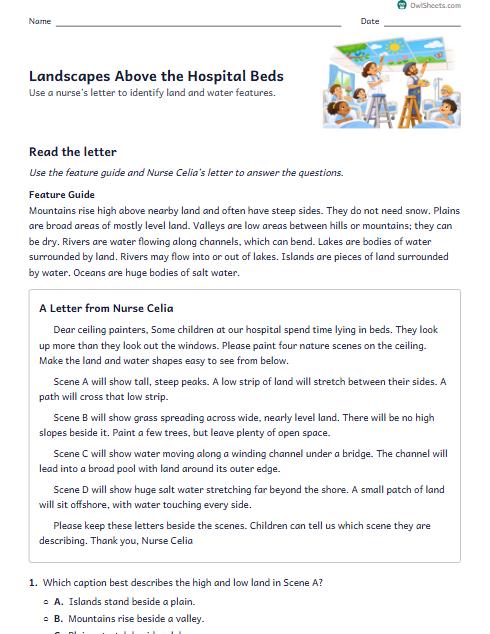
Dear ceiling painters, Some children at our hospital spend time lying in beds. They look up more than they look out the windows. Please paint four nature scenes on the ceiling. Make the land and water shapes easy to see from below.
Scene A will show tall, steep peaks. A low strip of land will stretch between their sides. A path will cross that low strip.
Scene B will show grass spreading across wide, nearly level land. There will be no high slopes beside it. Paint a few trees, but leave plenty of open space.
Scene C will show water moving along a winding channel under a bridge. The channel will lead into a broad pool with land around its outer edge.
Scene D will show huge salt water stretching far beyond the shore. A small patch of land will sit offshore, with water touching every side.
Please keep these letters beside the scenes. Children can tell us which scene they are describing. Thank you, Nurse Celia
- A. Islands stand beside a plain.
- B. Mountains rise beside a valley.
- C. Plains stretch beside a lake.
- D. Valleys rise above an ocean.
- A. The grass has yellow flowers.
- B. The open land has fewer trees.
- C. Higher slopes rise on both sides.
- D. A walking path crosses the grass.
- A. River, lake
- B. Lake, river
- C. Ocean, island
- D. Valley, ocean
LakeIslandOceanValley
- A. A has water on every side; B has a shore.
- B. A has broad level grass; B has steep peaks.
- C. A has a flowing channel; B has a pool.
- D. A has high sides nearby; B has open level land.
Check new painting plans
The hospital painters have ideas for more ceiling scenes. Use the feature guide to check them.
Wide, mostly level sandy land with no hills nearbyA narrow, low strip between two mountain slopesA broad, nearly flat grassy area with no high sides nearbyA grassy peak rising steeply above nearby land
- A. No. An island needs salty water around it.
- B. Yes. The land has water on every side.
- C. No. Land inside a lake is called a valley.
- D. Yes. Any land beside water is an island.
- A. It is a plain because its top has no snow.
- B. It is a valley because its sides are steep.
- C. It needs snow before it can be a mountain.
- D. It can be a mountain without a snowy top.
Lake: A body of water has land around it and a river flowing into it.Island: A flat field has dry land on every side.Plain: A narrow, low strip lies between steep mountain sides.River: Water moves along a channel that bends.
- A. Join it to nearby land with a wide strip of dry land.
- B. Add a group of tall trees in the middle of it.
- C. Make the land rise higher above the water.
- D. Paint more water between it and the shore.
- A. Name it a lake because high slopes surround it.
- B. Name it a river because it lies between slopes.
- C. Name it a valley because a valley can be dry.
- D. Name it a mountain because it is near high land.
Help patients describe the scenes
Use details from Nurse Celia’s letter. Write a sentence or two for each answer.
Related worksheets
Two Film Crews in Wickerlock
Grade 2 · GEO.2.3
13 questionsPremium
The Science Center's Talking Geography Quiz
Grade 2 · GEO.2.3
13 questionsPremium
Sand Table Labels at the Fair
Grade 2 · GEO.2.3
13 questionsPremium
A Winter Geography Journal
Grade 2 · GEO.2.3
14 questionsPremium
Rillstone River Town Map
Grade 2 · GEO.2.3
15 questionsPremium
Land Around Two Farm Towns
Grade 2 · GEO.2.3
13 questionsPremium