Grade 2 · Social StudiesHIS.2.3
A Letter After Crossing to El Paso
Read a fictional historical letter about leaving Mexico in 1915. Use evidence to explain a family's reasons for moving and journey experiences.
Preview
OwlSheets.com
A Letter After Crossing to El Paso
Read a letter about a family's search for safety.
Read the letter
Listen to or read the letter. Use its clues to answer the questions.
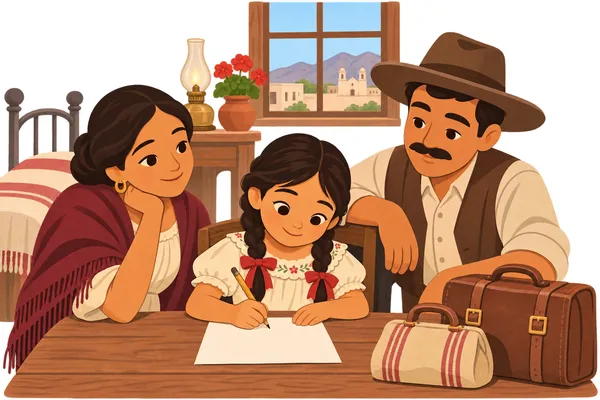
Isabel Writes to Her Cousin
El Paso, Texas, United States — October 1915
Dear Cousin Teresa,
I miss you and our home in Mexico. When fighting came near our town, Mother kept us indoors. Some days our school stayed closed. Father said we would go north, away from the fighting. Mother hoped we could attend school again.
We could carry just two small bags. I left my wooden horse behind and tucked your drawing beside my clothes. Mother sold our heavy table to help pay for the train tickets.
Our train stopped for a long time before reaching Ciudad Juárez, a Mexican city beside the border. We waited on a crowded platform. Mother divided our bread into small pieces because we did not know when we could buy more.
At last we reached Ciudad Juárez. We crossed a bridge into El Paso. My feet hurt, but I held tightly to Mother's hand. The bridge took us from Mexico into the United States.
Now we rent one room. Father is looking for work, and Mother is asking about school. Last night I slept without hearing fighting nearby. I felt glad, but I wished you were here. Please keep writing.
Your cousin, Isabel
- A. A safer place and a chance for school
- B. A family visit and cheaper furniture
- C. A larger home and a shorter train ride
- D. A new farm and a place to sell toys
- A. The family planned to carry more furniture on the train.
- B. The family earned enough money to buy a larger home.
- C. The family sold furniture after reaching the United States.
- D. The family used something they owned to pay for travel.
- A. She needed their food to last through a delay.
- B. She expected a meal at the next stop.
- C. She wanted to leave some on the train.
- D. She was saving it to sell at the bridge.
She packed Teresa's drawing.Her feet hurt at the bridge.She asked Teresa to keep writing.Her family rented one room.
- A. Mother had sold their table before the train trip.
- B. Father still needed work, and school was not arranged.
- C. Isabel crossed the bridge holding Mother's hand.
- D. Isabel brought her cousin's drawing in a bag.
- A. She was upset that Teresa had traveled with her.
- B. She felt safer but still missed her cousin.
- C. She was excited about returning home the next day.
- D. She felt settled because Father had found work.
Think beyond one journey
Use the letter and each new situation. Choose the answer supported by the clues.
- A. She crossed a bridge before leaving her hometown.
- B. She rode a ship after waiting at the platform.
- C. She took a train across the ocean to Texas.
- D. She crossed a border bridge after traveling by train.
- A. How much each family's train tickets cost
- B. Which jobs were open throughout Texas
- C. What one child's move could feel like
- D. How many people crossed the border that year
- A. They were leaving because fighting had reached town.
- B. They were leaving because their school had closed.
- C. They were going toward work, not away from fighting.
- D. They were going to visit and then return that day.
- A. Getting away from fighting near their school
- B. Bringing family members together again
- C. Finding a new place to sell their furniture
- D. Taking a short trip during a school holiday
- A. Families could take different routes to reach the country.
- B. Families from different places had the same reasons.
- C. Families crossing bridges had shorter waits at stops.
- D. Families arriving by ship were moving to find work.
Related worksheets
Ilona's Story at the Council Meeting
Grade 2 · HIS.2.3
13 questionsPremium
A Route to Flourstep Bakery
Grade 2 · HIS.2.3
13 questionsPremium
New Arrivals at Linden Gate Station
Grade 2 · HIS.2.3
13 questionsPremium
Leila's Family Journey to New Orleans
Grade 2 · HIS.2.3
14 questionsPremium
Maja's Long Way to Nebraska
Grade 2 · HIS.2.3
14 questionsPremium
The Bellini Family's Timeline Journey
Grade 2 · HIS.2.3
14 questionsPremium