Grade 2 · Social StudiesGEO.2.4
Two Ways to Care for Bellrush Dairy
Compare manure storage choices at a fictional dairy farm and explain how farm work changes land and protects soil and water.
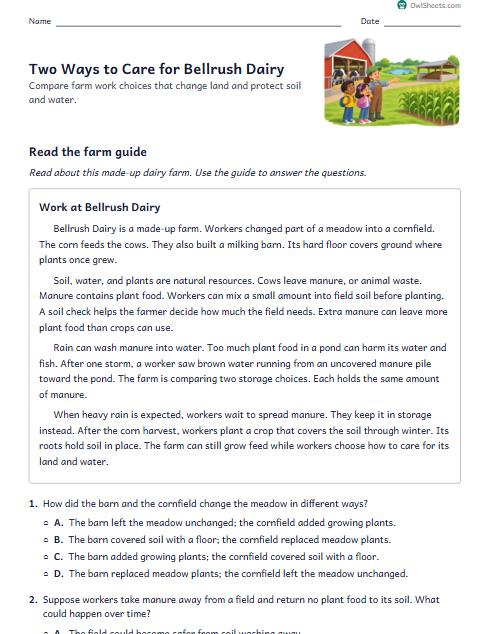
Preview
OwlSheets.com
Two Ways to Care for Bellrush Dairy
Compare farm work choices that change land and protect soil and water.
Read the farm guide
Read about this made-up dairy farm. Use the guide to answer the questions.
Work at Bellrush Dairy
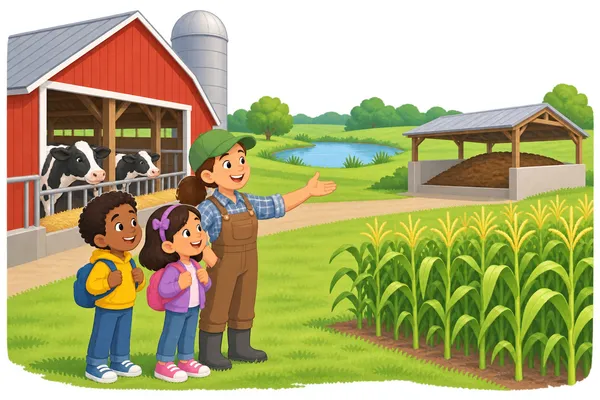
Bellrush Dairy is a made-up farm. Workers changed part of a meadow into a cornfield. The corn feeds the cows. They also built a milking barn. Its hard floor covers ground where plants once grew.
Soil, water, and plants are natural resources. Cows leave manure, or animal waste. Manure contains plant food. Workers can mix a small amount into field soil before planting. A soil check helps the farmer decide how much the field needs. Extra manure can leave more plant food than crops can use.
Rain can wash manure into water. Too much plant food in a pond can harm its water and fish. After one storm, a worker saw brown water running from an uncovered manure pile toward the pond. The farm is comparing two storage choices. Each holds the same amount of manure.
When heavy rain is expected, workers wait to spread manure. They keep it in storage instead. After the corn harvest, workers plant a crop that covers the soil through winter. Its roots hold soil in place. The farm can still grow feed while workers choose how to care for its land and water.
- A. The barn left the meadow unchanged; the cornfield added growing plants.
- B. The barn covered soil with a floor; the cornfield replaced meadow plants.
- C. The barn added growing plants; the cornfield covered soil with a floor.
- D. The barn replaced meadow plants; the cornfield left the meadow unchanged.
- A. The field could become safer from soil washing away.
- B. Growing crops could have less plant food available.
- C. Growing crops could need less water from the soil.
- D. The field could gain plant food from the barn floor.
Workers grow corn to feed the dairy cows.A worker saw brown water flow from an uncovered pile toward the pond.A soil check helps the farmer choose an amount of manure.Workers planted a crop after the corn harvest.
- A. Use the amount that covers the field most deeply.
- B. Use the amount that fills the storage place.
- C. Use the amount its own soil check calls for.
- D. Use the amount spread on the cornfield.
Compare two storage choices
Study the chart. Both places hold the same amount of manure.
| Feature | Open corner | Covered store |
|---|---|---|
| Roof | No roof | Roof over manure |
| Edge of storage | No wall | Low wall holds spills |
| Place | Beside the pond | Far from the pond |
- A. The roof would keep rain off the pile.
- B. The stored manure would slow the storm.
- C. The distant pond would pull rain away.
- D. The low wall would stop rain from falling.
- A. The new wall holds spills beside the pond.
- B. The pile now holds more manure than before.
- C. The roof leaves the manure out in falling rain.
- D. Spills still have no wall between them and the pond.
- A. Check how many rows of corn grow beside the storage place.
- B. Check whether the storage roof matches the milking barn roof.
- C. Check how many cows enter the milking barn each morning.
- D. Check whether dirty water escapes toward the pond after storms.
Choose careful farm work
Use the farm guide and chart to think about these new situations.
- A. Keep it in the covered store and wait.
- B. Pile it beside the pond until morning.
- C. Spread it now so the rain can move it.
- D. Spread extra so some stays after the rain.
- A. Grow plants whose roots hold the field's soil.
- B. Move loose field soil to the pond's edge.
- C. Pull out young plants before winter begins.
- D. Rake the field smooth and leave it bare.
- A. Leave the manure for the rain to wash away.
- B. Push the manure farther down the sloping lane.
- C. Collect the manure and return it to covered storage.
- D. Wash the manure toward the pond with a hose.
- A. Keeping manure covered will remove the farm's need for soil.
- B. The barn and cornfield will still be changes made by people.
- C. Protecting the pond will turn the cornfield back into meadow.
- D. Protecting the pond will make the barn floor grow plants.
Related worksheets
Rest Days at Bunchgrass Ranch
Grade 2 · GEO.2.4
14 questionsPremium
A Letter from Sunspool Guesthouse
Grade 2 · GEO.2.4
13 questionsPremium
Willows Along the Slate River
Grade 2 · GEO.2.4
14 questionsPremium
Oak Lantern School Resource Stewards
Grade 2 · GEO.2.4
14 questionsPremium
Two Places in Highvale
Grade 2 · GEO.2.4
14 questionsPremium
Cedar Block Resource Protectors
Grade 2 · GEO.2.4
14 questionsPremium