
WorksheetPremium
Steady Signs for the Seed Rows
Compare garden sign designs and use plant roots and a turtle shell as models for signs that stay up and keep their paper flat.
Grade 1ScienceInteractive · Printable
Aligned to1-LS1-1
Or unlock every Premium worksheet with Premium
What’s included
- Single worksheet
- Auto-graded online
- 1 NGSS standard
- Printable answer key
- 13 questions
- Classroom-ready
Details
- Format
- Interactive · Printable
- Grade
- Grade 1
- Subject
- Science
- Question types
- Fill in the blank, Multiple choice, Matching, Circle the answer, Sorting, Short answer, Drawing
About this worksheet
What students practice
- Students connect plant roots and a turtle shell to the ways these outside parts help living things survive.
- Students compare test results to choose parts for a garden sign.
- Students design a sign using ideas from plant and animal parts.
How to use
Read the text and prompts aloud. Help students read the two graphs, then let them compare designs and draw a sign that uses both nature ideas.
Curriculum
NGSS standard covered
Use how plants and animals use their outside parts to survive to design a solution to a human problem.
Preview
OwlSheets.com
Steady Signs for the Seed Rows
Use ideas from nature to choose a garden sign design.
A Garden Problem
Listen to the text. Think about parts that could help a sign.
Signs for the Seed Rows
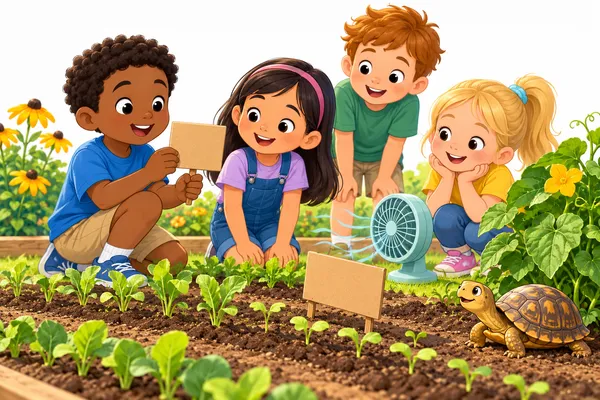
The school garden has paper signs that show where seeds were planted. Wind tips some signs over and bends the paper on others. The class wants signs that stay up and keep their paper flat.
The class looks at nature for ideas. A plant's roots branch out through the soil. In wind, its stem sways, but its roots stay in place. A box turtle pulls its head and legs under its hard shell when danger is near. The shell covers its soft body. The children will use cardboard to model helpful parts. They will not use real roots or shells.
- A. They help the leaves catch more wind.
- B. They help the stem reach more light.
- C. They help hold the plant in the soil.
- D. They help cover the plant's soft leaves.
- A plant's branching roots
- A box turtle's hard shell
- A. Shields a soft body from danger
- B. Holds a plant in the soil
The preview shows the first questions. Unlock the worksheet to see all of it.
Related worksheets
 Worksheet
Grade 1
The Pond Journal Design
Life Science · 1-LS1-1
Premium15 questions
 Worksheet
Grade 1
Rain-Smart Cards at Spillway Overlook
Life Science · 1-LS1-1
Premium14 questions
 Worksheet
Grade 1
A Seed Carrier for the Rooftop Garden
Life Science · 1-LS1-1
Premium15 questions
 Worksheet
Grade 1
Nature Ideas for Hoop-Crawl Knee Guards
Life Science · 1-LS1-1
Premium13 questions
 Worksheet
Grade 1
Dance Ribbons That Stay Put
Life Science · 1-LS1-1
Premium13 questions
 Worksheet
Grade 1
Nature Ideas for a Rainforest Sketch Bench
Life Science · 1-LS1-1
Premium13 questions