
Worksheet
Two Plans at Riverside Art Cart
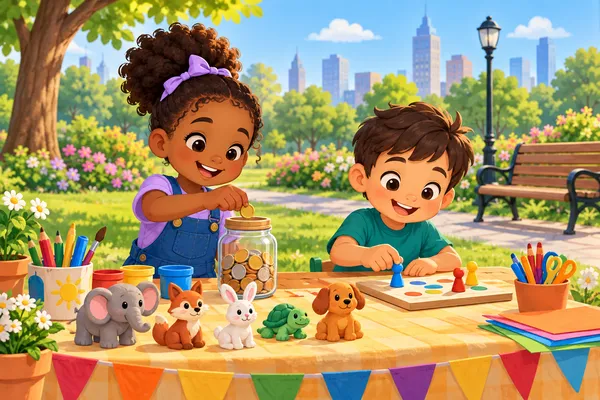
A city park art cart helps kindergarten students compare saving money and spending now when they want something later.
KindergartenSocial StudiesInteractive · Printable
Aligned toECO.K.4
What’s included
- Single worksheet
- Auto-graded online
- 1 C3 Framework standard
- Printable answer key
- 10 questions
- Classroom-ready
Details
- Format
- Interactive · Printable
- Grade
- Kindergarten
- Subject
- Social Studies
- Question types
- Fill in the blank, Multiple choice, Circle the answer, Sorting, Short answer
About this worksheet
What students practice
- Students explain why people save money for a want they plan to buy later.
- Students compare saving and waiting with spending money right away.
How to use
Read the notes aloud and use counters or play money to act out each plan. Talk about how saving and waiting can help someone buy a want later.
Curriculum
C3 Framework standard covered
Explain why people save money and wait to buy something they want later.
Preview
OwlSheets.com
Two Plans at Riverside Art Cart
Compare saving and spending at a city park.
Read the two notes
Listen as your teacher reads the notes. Then answer the questions.
Notes at the Art Cart
At Riverside Park, the art cart sells clay animal figures for 6 dollars. Imani writes: “I have 2 dollars and want a fox. I will put my money in a savings jar. I will add 2 dollars on each of the next two Saturdays.” Luis writes: “I have 6 dollars, but I will spend it on a game today. I will wait for a figure until I have money again.”
A clay animal figure at the art cart costs dollars.
- A. She already has enough for two figures.
- B. The art cart is closed on Saturdays.
- C. She has 2 dollars, and the figure costs 6 dollars.
- D. She wants to spend all her money on a game.
- A. Imani plans to save, and Luis plans to spend his money.
- B. Imani spends on a game, and Luis saves for a figure.
- C. Both children buy a figure right away.
- D. Both children have 2 dollars to use.
I will put my money in a savings jar.I want a fox.I will add 2 dollars on each of the next two Saturdays.I will spend my money on a game today.
Try a saving plan
Think about what each person can do with money for a want.
- A. Buy the crown with 3 dollars.
- B. Spend 3 dollars on a snack and stop saving.
- C. Choose another 3-dollar item, then wait for the crown.
- D. Put 3 dollars aside, add money later, and wait.
| Enough to buy now | Needs to save and wait |
|---|---|
- A. She has 4 dollars and needs 1 more.
- B. She has 5 dollars and can buy the paint set.
- C. She has 3 dollars because she saved on one day.
- D. She has 6 dollars because the price is added.
After Imani saves enough, she can the fox figure with her savings.
- A. Buy the lion because 7 dollars equals 8 dollars.
- B. Spend the 7 dollars on a treat.
- C. Save 1 more dollar, then buy the lion.
- D. Give the 7 dollars to a friend.
Related worksheets
 Worksheet
Kindergarten
Saving for a Kite
Economics · ECO.K.4
Premium10 questions
 Worksheet
Kindergarten
Dollars at the Maple Row Library Table
Economics · ECO.K.3
Premium10 questions
 Worksheet
Kindergarten
Choosing at Seabell Harbor
Economics · ECO.K.3
Free10 questions
 Worksheet
Kindergarten
The Supply Chest at Seabright Lighthouse
Economics · ECO.K.1
Free10 questions
 Worksheet
Kindergarten
Helpers at Mossybank Market
Economics · ECO.K.2
Premium12 questions
 Worksheet
Kindergarten
Work at Riverbend Landing
Economics · ECO.K.2
Free10 questions