
WorksheetPremium
The Museum Weather Window
Use a children's museum weather log to observe changes, record weather, and find simple patterns over four days.
KindergartenScienceInteractive · Printable
Aligned toK-ESS2-1
Or unlock every Premium worksheet with Premium
What’s included
- Single worksheet
- Auto-graded online
- 1 NGSS standard
- Printable answer key
- 14 questions
- Classroom-ready
Details
- Format
- Interactive · Printable
- Grade
- Kindergarten
- Subject
- Science
- Question types
- Fill in the blank, Multiple choice, Matching, Circle the answer, Sorting, Short answer
About this worksheet
What students practice
- Students observe and record sky, wind, and air conditions over several days.
- Students compare weather observations to find simple patterns over time.
- Students describe what happened next in a sequence of weather observations.
How to use
Read the museum observations aloud. Have children point to evidence, circle answers, and explain the weather changes in their own words.
Curriculum
NGSS standard covered
Observe and record local weather (sunny, cloudy, rainy, windy, warm, cool) to find patterns over time.
Preview
OwlSheets.com
The Museum Weather Window
Observe weather changes and look for patterns over time.
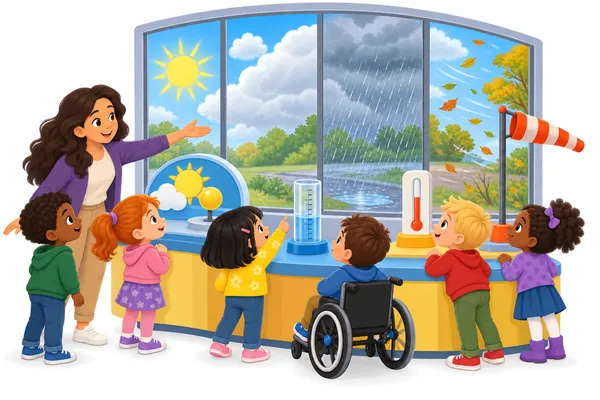
Watch the weather change
Listen to the observations from the museum weather window.
The Weather Window
At the Children's Museum, a class checked the outdoor Sky Window each day. On Monday, the sky was sunny, the air was warm, and the wind was windy. On Tuesday, clouds covered the sky, the air was cool, and the wind was windy. On Wednesday, rain fell, the air was cool, and the wind was not windy. On Thursday, the sun came out, the air was warm, there was no wind, and a puddle was smaller.
- A. The wind changed from windy to not windy.
- B. The rain changed from falling to stopping.
- C. The sky changed from sunny to cloudy.
- D. The puddle changed from small to large.
- A. The puddle became smaller.
- B. Rain fell the next day.
- C. The air became warm.
- D. The sun stayed bright.
The preview shows the first questions. Unlock the worksheet to see all of it.
Related worksheets
 Worksheet
Kindergarten
Two Orchard Weather Spots
Earth & Space Science · K-ESS2-1
Premium14 questions
 Worksheet
Kindergarten
Jalen's Bike Workshop Weather Journal
Earth & Space Science · K-ESS2-1
Premium11 questions
 Worksheet
Kindergarten
Weather Boards at Meerkat Court
Earth & Space Science · K-ESS2-1
Premium10 questions
 Worksheet
Kindergarten
Tractor Shed Weather: What Comes Next?
Earth & Space Science · K-ESS2-1
Premium10 questions
 Worksheet
Kindergarten
Weather at the Running Track
Earth & Space Science · K-ESS2-1
Premium10 questions
 Worksheet
Kindergarten
Five Mornings by the Backyard Ribbon
Earth & Space Science · K-ESS2-1
Premium10 questions